

Sheikh Dr Sultan bin Muhammad Al Qasimi, Ruler of Sharjah, on Wednesday heralded the third harvest of a vast wheat farm which is helping to bolster the emirate's food security, while sowing the seeds for a more sustainable future.
The farm in Mleiha was transformed from a stretch of barren desert land in 2022 into fertile ground for an ambitious mission to spur local food production and generate jobs in farming.
The initiative is reaping rewards, with an anticipated yield of 6,000 tonnes of organic wheat from a bumper harvest planted across 1,428 hectares.
Sheikh Dr Sultan took part in a harvest ceremony in which he launched organic products cultivated under the Saba Sanabel (Seven Spikes) wheat brand. These include pasta, croissants, cakes, biscuits, semolina and traditional Arabic bread.
The thriving farm is central to a broader drive – in Sharjah and across the Emirates – to invest in local agriculture to reduce reliance on imported goods and to champion local produce.
The Sharjah Ruler's grants this season have provided 25 tonnes of premium wheat seeds, benefiting 559 farmers.
Sharjah's wheat farm – in pictures
-

The wheat farm project in Mleiha, which was opened in November by Sheikh Dr Sultan bin Muhammad Al Qasimi, Ruler of Sharjah, is getting ready to produce its first harvest. Chris Whiteoak / The National -
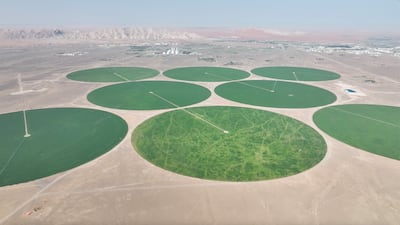
Drone images show the vast green patches. The farm covers 400 hectares, about the size of 500 football pitches. Photo: Supplied -

The irrigation system at the farm. Chris Whiteoak / The National -

Dr Khalifa Musabeh Ahmed Alteneiji, Chairman of the Department of Agriculture and Livestock, says the harvest should begin within weeks. Chris Whiteoak / The National -

The crop has been grown without the use of pesticides, chemicals or genetically modified seeds. Chris Whiteoak / The National -

The plan is to reach a total area of 1,900 hectares. Chris Whiteoak / The National -

An on-site weather station can predict temperature, wind speed and humidity up to 48 hours ahead. If rain is forecast, the farm cuts down on irrigation. Chris Whiteoak / The National -

The fields are irrigated using a reservoir with a capacity of 16,000 cubic metres. Chris Whiteoak / The National -

The irrigation system in action. Chris Whiteoak / The National -

In four months, the desert land has been transformed into a green oasis, ready to yield up to 1,700 tonnes of wheat. Chris Whiteoak / The National


Dr Khalifa Al Tunaiji, chairman of the Department of Agriculture and Livestock and chief executive of Sharjah Agriculture and Livestock Production (Iktifa), said the third season has seen the cultivation of 1,450 non-GMO (genetically modified organisms) soft and hard wheat strains, doubling the number from previous seasons.
The Mleiha wheat farm uses advanced irrigation technologies, resulting in 30 per cent lower water consumption. Satellite technology delivers daily updates on farm activities, irrigation methods and crop health.
Growing strong
In October, Sheikh Mohammed bin Rashid, Vice President and Ruler of Dubai, unveiled the Plant the Emirates initiative.
The project will include establishing a national agriculture centre and a number of targets for the next five years. They include a 20 per cent increase in production from farms, a 25 per cent increase in the number of organic farms and a 30 per cent increase in the percentage of farms that adopt climate-smart solutions.
Other goals include a 50 per cent reduction in waste from agricultural production, a 15 per cent increase in the number of workers in the farming sector, a 25 per cent increase in use of local products in the restaurant and hotel sector, and for 85 per cent of local farms to obtain the quality classification seal.
As part of the project local communities will also grow produce at home, Wam reported, and help to enhance green areas across the country.

