


Just 20 years ago, polio had been eliminated from most countries and remained endemic in just six thanks to widespread immunisation and gargantuan humanitarian efforts to keep the crippling infectious disease at bay. But as the final round of emergency polio vaccinations for 119,279 children trapped in the war-torn north of Gaza is suspended, hopes of eradicating polio worldwide have taken a backwards step.
In what looked like a vaccination success story of the modern age, with the Western Pacific declared polio-free in 2000, and the disease eliminated completely from the Americas six years earlier, worldwide cases plummeted by 99 per cent. By 2002, Europe was declared free of the wild poliovirus and it was no longer circulating across Africa by 2020.
consultan paediatrician, Burjeel Medical City
That success has hit a considerable roadblock, with a mutated strain originating from an oral vaccine appearing in the sewers of London and New York, and a much-vaunted vaccination campaign in Pakistan coming off the rails. A rise in cases has delivered a significant blow to the World Health Organisation efforts to wipe out the paralysing disease in its entirety.
Health authorities in Pakistan reported more than a dozen new cases in October, bringing the total number of infections in 2024 to 39 in the country, a concerning leap from just six last year. Paired with low vaccination uptake and more than a million children understood to have missed their polio immunisation, it is a warning sign that cannot be ignored.
Success story
World Polio Day is marked on October 24 each year and serves as a reminder of the challenges ahead. It is an opportunity to mark the global success in reducing the number of infections that in the mid-20th century killed or paralysed more than 500,000 people every year.
A world free from polio became tantalisingly close, thanks to humanitarian efforts driven by the Global Polio Eradication Initiative (GPEI) and its charitable partners. Global conflicts, mass migration and vaccine hesitancy driven by misinformation channelled through social media has seen a resurgence in polio, plunging the futures of millions of children into doubt.
Dr Arif Khan, a paediatric neurologist at Fakeeh University Hospital in Dubai, worked in India in the late 1990s and recalled treating young patients affected by the virus. “Because of good vaccination programmes, the chain of spread was blocked and in 1988 there were close to 350,000 cases worldwide, and that has come down to just a few numbers now,” he said.

“But once you have large conflicts and wars the chain of vaccinations is broken, and there's a chance of the virus spreading between populations and the numbers increasing. World Polio Day is essential to bring about the awareness and to make sure that the four doses required are followed to the core.
“In India we used to see sporadic polio in children or young adults with spasticity who were unable to walk, or only with crutches. They were not vaccinated and had a bout of polio infection in their childhood.
“We did see these cases in India and Pakistan in the 90s, but even that had come down significantly. We had almost won this battle with polio, the last few shreds are left – we just need to cover them.”
-
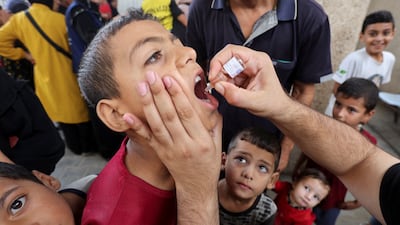
The UN-led polio vaccination campaign kicked off in central Gaza and is due to head south. Here, a child is inoculated in Deir Al Balah. Reuters -
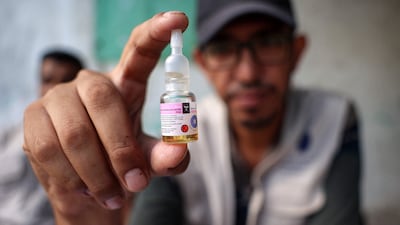
A vial of the vaccine being administered after the Palestinian territory recorded its first case of polio in a quarter of a century. AFP -
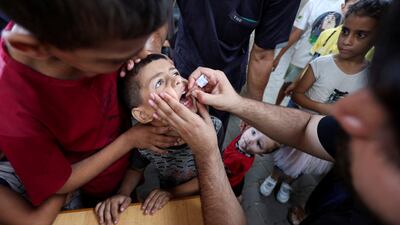
Three UN agencies and Gaza's Ministry of Health are working together to inoculate 640,000 children under 10. Reuters -
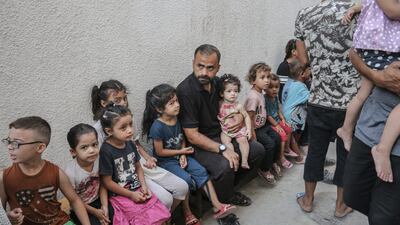
Palestinians wait for their children to receive a polio vaccination during a break in fighting in the Nuseirat refugee camp, central Gaza. Bloomberg -

At least 160,000 children were vaccinated in central Gaza during the first three days of the campaign, surpassing the goal of 156,000. Reuters -
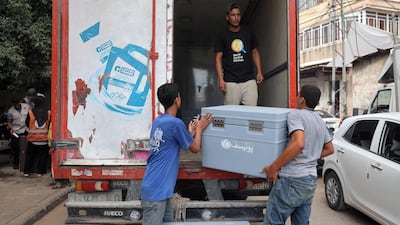
Crates of polio vaccines provided by Unicef are unloaded in Deir Al Balah. AFP -
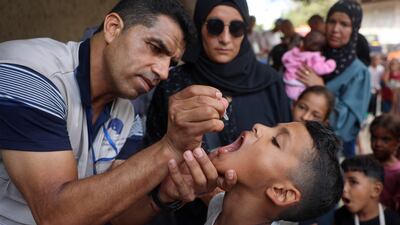
The World Health Organisation said Israel and Hamas had agreed to at least three days of 'humanitarian pauses' in parts of Gaza, starting on August 31, to facilitate the vaccination drive. AFP -
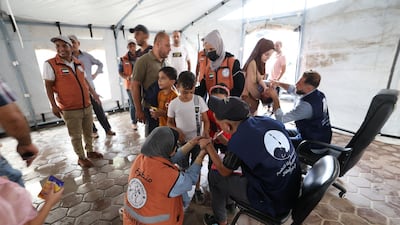
Medical staff during the vaccination drive for children in Gaza. Photo: Operation Gallant Knight 3 -
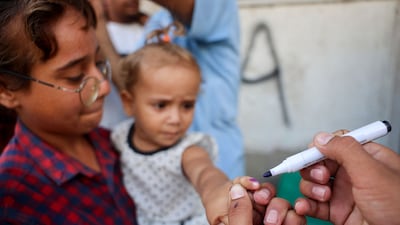
A health worker marks the finger of a Palestinian child, indicating that they have been vaccinated, in Zawaida, central Gaza. AFP -
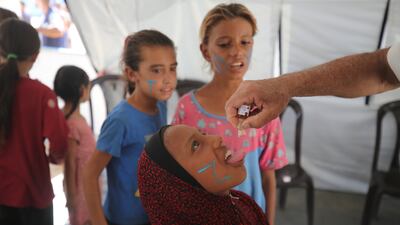
At this health centre in Zawaida, 1,500 children under 10 have been vaccinated. PA


Vaccine delivery
The challenges of delivering vaccines have been sharply focused in Gaza. Decimated infrastructure, blockades and constant shelling have made it almost impossible for the most vulnerable to access the vaccines they desperately need.
A $20 million donation from Gavi, the Vaccine Alliance, will step up immunisation programmes, including polio, across the Gaza Strip, West Bank and Palestinian refugee camps in Lebanon. In August, the UAE pledged $5 million to support polio vaccinations in Gaza.
Help cannot come soon enough, said Dr Sania Nishtar, Gavi’s chief executive. "Gavi is committed to helping address the urgent health and humanitarian crisis in Palestine and for the Palestinian refugees in Lebanon,” she said.
“We commend the tireless efforts of our partners, who continue to deliver essential health services in the most challenging conditions. Together, we must do everything we can to ensure that children, amid the horror of their daily lives, are given every opportunity to access their basic right to a healthy start in life.”
A fatal threat
Polio is fatal in between 5 and 10 per cent of those it paralyses, usually children. The virus attacks the central nervous system, particularly in the spinal cord and brain stem. In the most serious cases, poliomyelitis can lead to limb paralysis, breathing difficulties and death.
A perfect storm of poor sanitation, overcrowding in refugee camps and disruption to affective, regular immunisation programmes by local health authorities have placed thousands of children at risk of polio and other preventable disease, across Gaza, Lebanon and wider Middle East. What vaccines are able to get through the blockades to reach those "zero dose" unvaccinated children are being delivered by Unicef, the International Federation of Red Cross (IFRC), the Palestine Red Crescent Society (PRCS) and Lebanese Red Cross (LRC).
Adele Khodr, Unicef regional director for the Middle East and North Africa, said millions of vaccines had reached their destination, but more work was required. “In conflict-affected settings such as the State of Palestine and Lebanon, children are among the most vulnerable, and immunisation is often their last line of defence,” said Ms Khodr. “This funding is not just an investment in vaccines – it’s an investment in their lives.
“In Gaza, since the onset of the conflict, Unicef has managed to procure and deliver more than 1.55 million doses of different vaccines administered through routine vaccination; and over 1.65 million doses of polio vaccine recently used to respond to the polio outbreak in Gaza. We continue calling for a ceasefire to allow children and women to access essential life-saving health interventions including vaccination.”
In August, experts told The National it was likely polio had been circulating in Gaza since September 2023, and has since started to gain a dangerous foothold in the enclave. Dr Hamid Jafari, who is director of the WHO polio eradication programme, called the risk of polio spreading beyond regional borders a “clear and present danger”, with Syria, Egypt and Jordan most at risk from further infections. “The only way to stop this outbreak is a series of mass vaccination campaigns,” Dr Jafari said.
To halt the spread of polio, all children need a series of four vaccination doses. Disruption to vaccination schedules caused by conflict and displacement threatens to unravel the decades of work to protect children across the world.
Experienced paediatrician Dr Vijay Acharya, a former lecturer in childhood disease at the University of Leeds who now works at Burjeel Medical City in Abu Dhabi, said rural, tribal areas of Pakistan have been difficult for healthcare workers to access. “Most polio workers are ladies who have been attacked, or they've been mugged when they tried to access these tribal areas to deliver vaccines,” he said.
“Despite that length of effort, the WHO has not been able to eradicate polio, and is something we need to be very mindful about. The whole purpose of World Polio Day is to eventually eradicate polio from the world and also to drive vaccinations forward.
“But if health workers can't access the end person, like infants, it is going to be impossible to eradicate. People don't know the effects of polio, or that it is a very infectious disease.
“It is easy to prevent, but people are probably a bit complacent and there's a lot of hesitancy now towards some vaccines. Some migrants who probably don't get consistent education and refugees who find it difficult to access information on vaccines, this is where we are falling short.”

