

A surprise sighting of a large flock of white storks in the UAE last week has delighted experts, as the bird is rarely seen in large numbers across the Gulf.
The flock – or, in the case of white storks, the "mustering" – of birds were circling low in Mushrif, about 60 to 100 metres from the ground, flying south-westerly towards Hudayriyat Island.
Dr Andrew Gardner, associate director of biodiversity conservation at non-profit Emirates Nature-WWF, spotted more than 60 white storks circling the sky from his home in Abu Dhabi.
“I was working from home when I became aware of shadows flitting across the roof of the house opposite,” he told The National.
“Puzzled, I opened the door onto the balcony and could hardly believe what I saw.”
Dr Gardner managed to snap a photograph and counted about 64 birds.

“I then noticed there was a single bird standing in the waste ground about 60 metres from the house ... It looked like a young bird as its bill and legs were only partly red.”
The white stork, of which there are two subspecies, breeds from Europe to Africa or Asia, and migrates to southern Africa or India in the winter.
While it has been rated as Least Concern by the International Union for Conservation of Nature, globally numbers have been steadily declining due to industrialisation and habitat loss, according to Rewilding Britain.
The ciconia ciconia subspecies is native to the British Isles, but prior to 2020 the last breeding pair recorded in Britain was in 1416.
There are currently reintroduction programmes taking place across Europe, including two captive breeding schemes in southern England as part of the White Stork Project, which aims to re-establish 50 wild breeding pairs by 2030.
“They do not like to cross over water for long distances, so western European birds cross over to Africa via the Straits of Gibraltar and eastern populations cross the Bosphorus at Istanbul before heading down the Levant and onwards down the Nile,” Dr Gardner said.
“White storks do occasionally visit the UAE, perhaps migrating from Iran and heading for the Red Sea coast and East Africa, but these tend to be in very low numbers.”
Oscar Campbell, chairman of the Emirates Bird Records Committee (EBRC), which maintains a bird record database for the Emirates and validates rare bird records and observations, confirmed to Dr Gardner that the sighting is indeed a rare occurrence.
“In his 20 odd years in Abu Dhabi, he had only once seen white storks on the island,” said Dr Gardner.

Fellow EBRC member and webmaster Tommy Pederson believed it could be the first UAE record of direct white stork migration.
There have also been two other recent sightings in Asir, near Abha, in Saudi Arabia within the last two weeks, said Dr Gardner, with one former Emirates Nature-WWF employee spotting a flock of more than 100 birds, also a rare occurrence for the kingdom.
“Are the storks changing their migration route? While it is certainly possible that changing land use patterns and climate might affect the migration routes taken by white storks, time will tell if this becomes a regular occurrence,” said Dr Gardner.
Meanwhile, the 40-year record for a sighting of white storks stands at 300, spotted near Abu Dhabi Airport in September 1984, according to the EBRC.
“Perhaps this flock was just a rare, but magical occurrence.”
UAE conservation efforts - in pictures
-
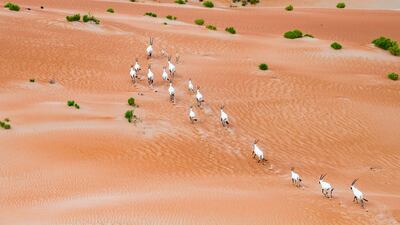
The largest population of Arabian oryx now lives in protected areas in the UAE after previously being listed as extinct in the wild. All photos: Environment Agency - Abu Dhabi -
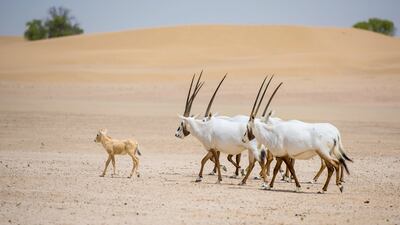
Arabian oryx were reclassified as vulnerable by the International Union for the Conservation of Nature in December 2023 -
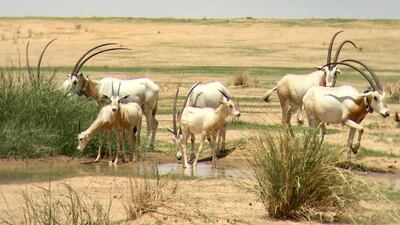
Environment Agency - Abu Dhabi has also spearheaded a repopulation programme for scimitar-horned oryx -
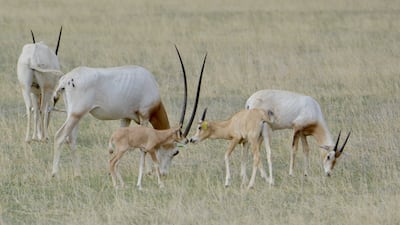
Scimitar-horned oryx calves with their mothers in Chad -
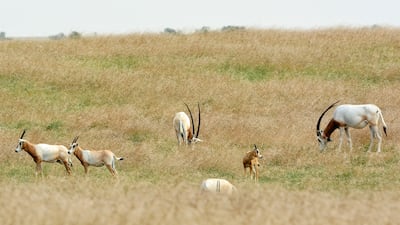
The Sahelian plains of Chad are now home to more than 600 scimitar-horned oryx -

The agency released six Dama gazelles into a wildlife reserve in Chad in May 2024 -
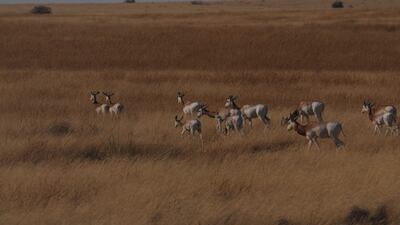
The Dama gazelle is classified as critically endangered -

Three of the gazelles are equipped with satellite tracking devices, so the team can monitor the animals’ progress in the reserve -

The agency has also helped repopulate the addax antelope in Chad -
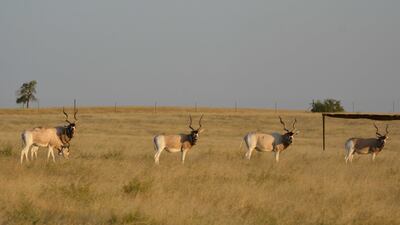
The addax, also known as the white antelope, is native to the Sahara -

The addax is classified as critically endangered



