On board Sharjah's sky pods aiming to take UAE public transport to new heights


Nick Webster
  • English
  • Arabic

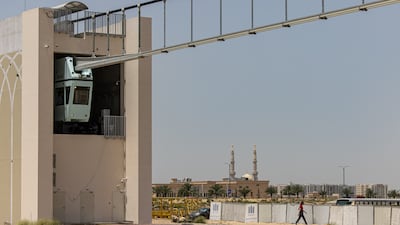
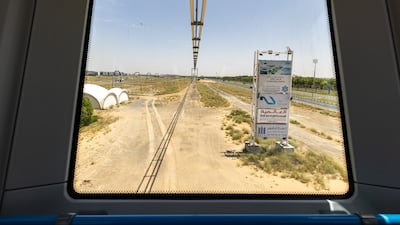
A 2.4km aerial track in Sharjah capable of transporting passengers in futuristic sky pods at speeds of up to 100kph has been unveiled for the first time.

Developed by uSky Transport, the pods that can carry 25 passengers at a time are on show at the $14 million Karat complex at Sharjah Research, Technology and Innovation Park (SRTIP).

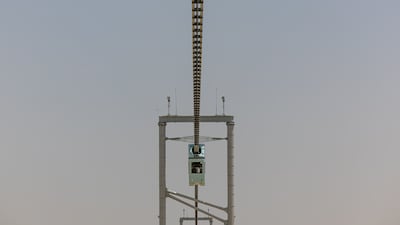
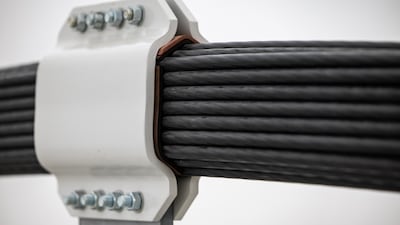
They move on cables made of extremely durable material.

The National was among the first to take a journey on the cutting-edge mode of transport, which is expected to contribute to ambitious plans to take thousands of cars off the roads and curb congestion.

It has been three years since the unveiling of the first prototype of the urban mobility system designed by Belarusian scientist Anatoli Unitsky, that costs a fraction of requirements to install a metro or tram system.

This is the unique track structure that is developed for carrying both passenger, container pods and their load
Oleg Zaretskiy,
chief executive of uScovery and uSky Transport systems

Since then a working public service has become operational in Belarus, and a contract signed to deliver a 400-metre tourist track in Karnataka, India.

In Sharjah, developers said the flagship Karat complex shows designs are more than just a proof of concept, and hope the pods could soon be connecting key points in Dubai.

“Each new innovation takes time and what we are developing is not just a new railway, new port, or new machine,” said Oleg Zaretskiy, chief executive of uScovery and uSky Transport systems.

“This is the unique track structure that is developed for carrying both passenger, container pods and their load, without heavy concrete structures, and without spending money for building huge concrete bridges.

“This is our advantage, and why we are more affordable than other technologies.”

Several technologies are vying for the preferable choice for long-term sustainable, cost-effective transport.

Although the much-vaunted Hyperloop project has been recently resurrected with a potential passenger route between Venice and Padua, estimated costs of about $862 million are financially prohibitive.

Meanwhile, the China Aerospace Science and Industry Corporation (Casic) recently announced its new magnetically levitated (maglev) train had broken speed records in tests on a 2km track, reaching 623 kph.

String rail

  • A sky pod runs along a 2.4km track at uSky Test & Certification Centre in Sharjah on May 7, 2024. All photos: Christopher Pike for The National
    A sky pod runs along a 2.4km track at uSky Test & Certification Centre in Sharjah on May 7, 2024. All photos: Christopher Pike for The National
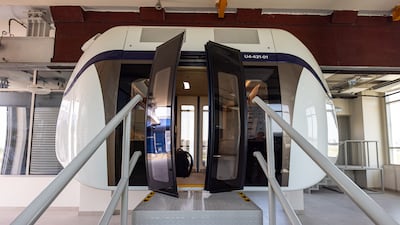
  • The pods that can carry 25 passengers at a time
    The pods that can carry 25 passengers at a time
  • They move on cables made of extremely durable material
    They move on cables made of extremely durable material
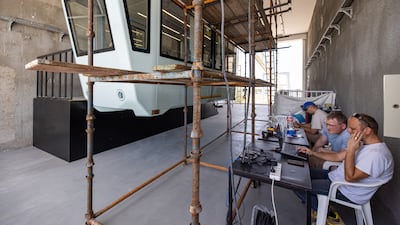
  • A four-person Skypod line at the uSky Test & Certification Centre in Sharjah
    A four-person Skypod line at the uSky Test & Certification Centre in Sharjah
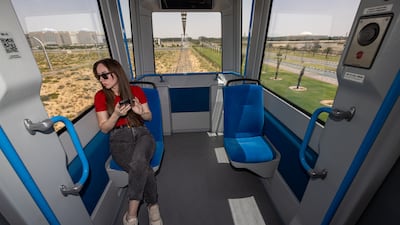
  • An employee of uSky rides on a pod at the test centre in Sharjah
    An employee of uSky rides on a pod at the test centre in Sharjah
  • A model of the steel cables on which the pods move on
    A model of the steel cables on which the pods move on
  • The futuristic sky pods can transport passengers at speeds of up to 100 kph
    The futuristic sky pods can transport passengers at speeds of up to 100 kph
  • The aerial track is expected to contribute to ambitious plans to take thousands of cars off the roads and curb congestion
    The aerial track is expected to contribute to ambitious plans to take thousands of cars off the roads and curb congestion
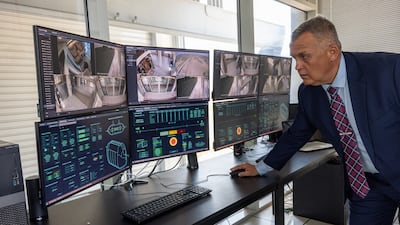
  • Oleg Zaretskiy, chief executive of uScovery and uSky Transport systems, at the test centre in Sharjah
    Oleg Zaretskiy, chief executive of uScovery and uSky Transport systems, at the test centre in Sharjah

While the string rail alternative offered by uSky Transport may not offer the same high speeds, it can be delivered at a fraction of the price.

A public tram system typically costs from $30 million to $40 million per kilometre of track, while the estimated costs to develop the planned 30km Blue Line metro in Dubai are about $4.9 billion.

A similar length of track using uSky string technology – where steel wheels run on steel rails – costs about $20m a km, the company said.

The uCar pod that began running in Sharjah along a 400m line in 2022 offered luxurious surroundings in a four-seater pod, but the latest uBus has a more functional, basic capacity to transport up to 25 passengers at a time.

The uFlash – a six seater long distance, aerodynamic pod with luggage space – also has luxurious leather seats and personal TV screens more akin to business air travel, as well as the capacity to travel at speeds approaching 500 kph.

The transport system is expected to help transform public transport in the UAE. Christopher Pike for The National

The company is exploring where to construct a 20km aerial track to begin testing of high speed travel, using the same string technology, with costs estimated to top $230 million.

Under an agreement, uSky pays ground rent to the SRTIP to continue testing, with private financing backing the project towards the next development step – another 2.4km track alongside the existing Sharjah route.

By raising uSky networks off the ground, land is spared from the destructive development of a traditional transport system, such as road or rail.

Technology weathers the storm

Oleg Zaretskiy, chief executive of uScovery and uSky Transport systems. Christopher Pike for The National

Mr Zaretskiy said the fully operational Sharjah uSky transport system uses mechanical blowers to remove dust from the lines, and was tested in the recent storms of April 16 in the UAE, performing well in high-winds and heavy rain.

“Our system operating in Belarus has proved very successful, and comfortable for people,” he said.

“When somebody wants to make connection between two points, such as a bus stop and a hotel or a hospital - this is where we can come in.

“We have practical experience, and we have huge desire to be there.

“There are plenty of places in Dubai where it can be implemented connecting the shopping malls with hotels, for example.

“Our system gives an opportunity to move transport to the next level.”

Should late investors consider cryptocurrencies?

Wealth managers recommend late investors to have a balanced portfolio that typically includes traditional assets such as cash, government and corporate bonds, equities, commodities and commercial property.

They do not usually recommend investing in Bitcoin or other cryptocurrencies due to the risk and volatility associated with them.

“It has produced eye-watering returns for some, whereas others have lost substantially as this has all depended purely on timing and when the buy-in was. If someone still has about 20 to 25 years until retirement, there isn’t any need to take such risks,” Rupert Connor of Abacus Financial Consultant says.

He adds that if a person is interested in owning a business or growing a property portfolio to increase their retirement income, this can be encouraged provided they keep in mind the overall risk profile of these assets.

Ten tax points to be aware of in 2026

1. Domestic VAT refund amendments: request your refund within five years

If a business does not apply for the refund on time, they lose their credit.

2. E-invoicing in the UAE

Businesses should continue preparing for the implementation of e-invoicing in the UAE, with 2026 a preparation and transition period ahead of phased mandatory adoption. 

3. More tax audits

Tax authorities are increasingly using data already available across multiple filings to identify audit risks. 

4. More beneficial VAT and excise tax penalty regime

Tax disputes are expected to become more frequent and more structured, with clearer administrative objection and appeal processes. The UAE has adopted a new penalty regime for VAT and excise disputes, which now mirrors the penalty regime for corporate tax.

5. Greater emphasis on statutory audit

There is a greater need for the accuracy of financial statements. The International Financial Reporting Standards standards need to be strictly adhered to and, as a result, the quality of the audits will need to increase.

6. Further transfer pricing enforcement

Transfer pricing enforcement, which refers to the practice of establishing prices for internal transactions between related entities, is expected to broaden in scope. The UAE will shortly open the possibility to negotiate advance pricing agreements, or essentially rulings for transfer pricing purposes. 

7. Limited time periods for audits

Recent amendments also introduce a default five-year limitation period for tax audits and assessments, subject to specific statutory exceptions. While the standard audit and assessment period is five years, this may be extended to up to 15 years in cases involving fraud or tax evasion. 

8. Pillar 2 implementation 

Many multinational groups will begin to feel the practical effect of the Domestic Minimum Top-Up Tax (DMTT), the UAE's implementation of the OECD’s global minimum tax under Pillar 2. While the rules apply for financial years starting on or after January 1, 2025, it is 2026 that marks the transition to an operational phase.

9. Reduced compliance obligations for imported goods and services

Businesses that apply the reverse-charge mechanism for VAT purposes in the UAE may benefit from reduced compliance obligations. 

10. Substance and CbC reporting focus

Tax authorities are expected to continue strengthening the enforcement of economic substance and Country-by-Country (CbC) reporting frameworks. In the UAE, these regimes are increasingly being used as risk-assessment tools, providing tax authorities with a comprehensive view of multinational groups’ global footprints and enabling them to assess whether profits are aligned with real economic activity. 

Contributed by Thomas Vanhee and Hend Rashwan, Aurifer

How to help

Call the hotline on 0502955999 or send "thenational" to the following numbers:

2289 - Dh10

2252 - Dh50

6025 - Dh20

6027 - Dh100

6026 - Dh200


Rock in a Hard Place: Music and Mayhem in the Middle East
Orlando Crowcroft
Zed Books

How to donate

Send “thenational” to the following numbers or call the hotline on: 0502955999
2289 – Dh10
2252 – Dh 50
6025 – Dh20
6027 – Dh 100
6026 – Dh 200

10 tips for entry-level job seekers
  • Have an up-to-date, professional LinkedIn profile. If you don’t have a LinkedIn account, set one up today. Avoid poor-quality profile pictures with distracting backgrounds. Include a professional summary and begin to grow your network.
  • Keep track of the job trends in your sector through the news. Apply for job alerts at your dream organisations and the types of jobs you want – LinkedIn uses AI to share similar relevant jobs based on your selections.
  • Double check that you’ve highlighted relevant skills on your resume and LinkedIn profile.
  • For most entry-level jobs, your resume will first be filtered by an applicant tracking system for keywords. Look closely at the description of the job you are applying for and mirror the language as much as possible (while being honest and accurate about your skills and experience).
  • Keep your CV professional and in a simple format – make sure you tailor your cover letter and application to the company and role.
  • Go online and look for details on job specifications for your target position. Make a list of skills required and set yourself some learning goals to tick off all the necessary skills one by one.
  • Don’t be afraid to reach outside your immediate friends and family to other acquaintances and let them know you are looking for new opportunities.
  • Make sure you’ve set your LinkedIn profile to signal that you are “open to opportunities”. Also be sure to use LinkedIn to search for people who are still actively hiring by searching for those that have the headline “I’m hiring” or “We’re hiring” in their profile.
  • Prepare for online interviews using mock interview tools. Even before landing interviews, it can be useful to start practising.
  • Be professional and patient. Always be professional with whoever you are interacting with throughout your search process, this will be remembered. You need to be patient, dedicated and not give up on your search. Candidates need to make sure they are following up appropriately for roles they have applied.

Arda Atalay, head of Mena private sector at LinkedIn Talent Solutions, Rudy Bier, managing partner of Kinetic Business Solutions and Ben Kinerman Daltrey, co-founder of KinFitz

FIGHT CARD

Sara El Bakkali v Anisha Kadka (Lightweight, female)
Mohammed Adil Al Debi v Moaz Abdelgawad (Bantamweight)
Amir Boureslan v Mahmoud Zanouny (Welterweight)
Abrorbek Madaminbekov v Mohammed Al Katheeri (Featherweight)
Ibrahem Bilal v Emad Arafa (Super featherweight)
Ahmed Abdolaziz v Imad Essassi (Middleweight)
Milena Martinou v Ilham Bourakkadi (Bantamweight, female)
Noureddine El Agouti v Mohamed Mardi (Welterweight)
Nabil Ouach v Ymad Atrous (Middleweight)
Nouredin Samir v Zainalabid Dadachev (Lightweight)
Marlon Ribeiro v Mehdi Oubahammou (Welterweight)
Brad Stanton v Mohamed El Boukhari (Super welterweight

Mercer, the investment consulting arm of US services company Marsh & McLennan, expects its wealth division to at least double its assets under management (AUM) in the Middle East as wealth in the region continues to grow despite economic headwinds, a company official said.

Mercer Wealth, which globally has $160 billion in AUM, plans to boost its AUM in the region to $2-$3bn in the next 2-3 years from the present $1bn, said Yasir AbuShaban, a Dubai-based principal with Mercer Wealth.

Within the next two to three years, we are looking at reaching $2 to $3 billion as a conservative estimate and we do see an opportunity to do so,” said Mr AbuShaban.

Mercer does not directly make investments, but allocates clients’ money they have discretion to, to professional asset managers. They also provide advice to clients.

“We have buying power. We can negotiate on their (client’s) behalf with asset managers to provide them lower fees than they otherwise would have to get on their own,” he added.

Mercer Wealth’s clients include sovereign wealth funds, family offices, and insurance companies among others.

From its office in Dubai, Mercer also looks after Africa, India and Turkey, where they also see opportunity for growth.

Wealth creation in Middle East and Africa (MEA) grew 8.5 per cent to $8.1 trillion last year from $7.5tn in 2015, higher than last year’s global average of 6 per cent and the second-highest growth in a region after Asia-Pacific which grew 9.9 per cent, according to consultancy Boston Consulting Group (BCG). In the region, where wealth grew just 1.9 per cent in 2015 compared with 2014, a pickup in oil prices has helped in wealth generation.

BCG is forecasting MEA wealth will rise to $12tn by 2021, growing at an annual average of 8 per cent.

Drivers of wealth generation in the region will be split evenly between new wealth creation and growth of performance of existing assets, according to BCG.

Another general trend in the region is clients’ looking for a comprehensive approach to investing, according to Mr AbuShaban.

“Institutional investors or some of the families are seeing a slowdown in the available capital they have to invest and in that sense they are looking at optimizing the way they manage their portfolios and making sure they are not investing haphazardly and different parts of their investment are working together,” said Mr AbuShaban.

Some clients also have a higher appetite for risk, given the low interest-rate environment that does not provide enough yield for some institutional investors. These clients are keen to invest in illiquid assets, such as private equity and infrastructure.

“What we have seen is a desire for higher returns in what has been a low-return environment specifically in various fixed income or bonds,” he said.

“In this environment, we have seen a de facto increase in the risk that clients are taking in things like illiquid investments, private equity investments, infrastructure and private debt, those kind of investments were higher illiquidity results in incrementally higher returns.”

The Abu Dhabi Investment Authority, one of the largest sovereign wealth funds, said in its 2016 report that has gradually increased its exposure in direct private equity and private credit transactions, mainly in Asian markets and especially in China and India. The authority’s private equity department focused on structured equities owing to “their defensive characteristics.”

$1,000 award for 1,000 days on madrasa portal

Daily cash awards of $1,000 dollars will sweeten the Madrasa e-learning project by tempting more pupils to an education portal to deepen their understanding of math and sciences.

School children are required to watch an educational video each day and answer a question related to it. They then enter into a raffle draw for the $1,000 prize.

“We are targeting everyone who wants to learn. This will be $1,000 for 1,000 days so there will be a winner every day for 1,000 days,” said Sara Al Nuaimi, project manager of the Madrasa e-learning platform that was launched on Tuesday by the Vice President and Ruler of Dubai, to reach Arab pupils from kindergarten to grade 12 with educational videos.  

“The objective of the Madrasa is to become the number one reference for all Arab students in the world. The 5,000 videos we have online is just the beginning, we have big ambitions. Today in the Arab world there are 50 million students. We want to reach everyone who is willing to learn.”

Mountain%20Boy
%3Cp%3E%3Cstrong%3EDirector%3A%3C%2Fstrong%3E%20Zainab%20Shaheen%3C%2Fp%3E%0A%3Cp%3E%3Cstrong%3EStarring%3A%3C%2Fstrong%3E%20Naser%20Al%20Messabi%3C%2Fp%3E%0A%3Cp%3E%3Cstrong%3ERating%3C%2Fstrong%3E%3A%203%2F5%3C%2Fp%3E%0A
Updated: May 08, 2025, 1:08 PM