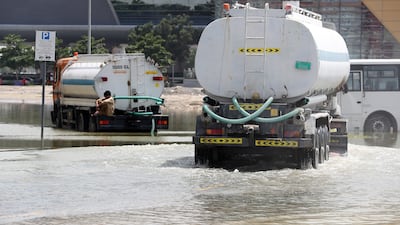
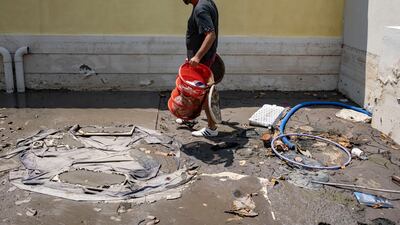
• The Abu Shagara neighbourhood in Sharjah. The low-lying city is struggling to clear water from flooded streets more than a week after the storm of April 16. Antonie Robertson / The National
    The Abu Shagara neighbourhood in Sharjah. The low-lying city is struggling to clear water from flooded streets more than a week after the storm of April 16. Antonie Robertson / The National
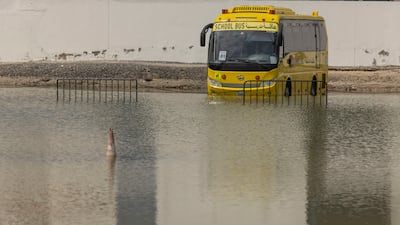
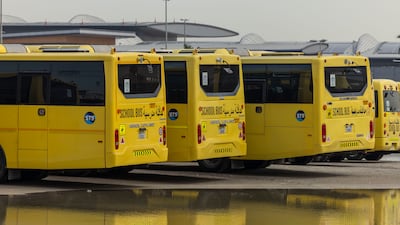
  • Businesses have closed and schools had to impose remote learning from home due to flooding and impassable roads.
    Businesses have closed and schools had to impose remote learning from home due to flooding and impassable roads.
  • The storms have highlighted how many of the Gulf's cities are poorly equipped to handle large volumes of water.
    The storms have highlighted how many of the Gulf's cities are poorly equipped to handle large volumes of water.
  • Car parts are left out to dry in the sun. Thousands of vehicles - possibly tens of thousands - are thought to have been damaged or written off in Dubai and Sharjah.
    Car parts are left out to dry in the sun. Thousands of vehicles - possibly tens of thousands - are thought to have been damaged or written off in Dubai and Sharjah.
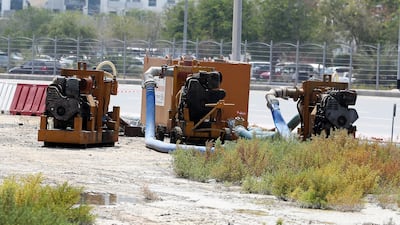
  • Hundreds of water pumps have been sent to the worst affected areas of Dubai and Sharjah in recent days.
    Hundreds of water pumps have been sent to the worst affected areas of Dubai and Sharjah in recent days.
  • Car garages have been inundated with customers whose vehicles were submerged in water. Many face significant delays in trying to get insurance payouts.
    Car garages have been inundated with customers whose vehicles were submerged in water. Many face significant delays in trying to get insurance payouts.
  • Scientists believe the massive downpours are just the latest example of climate change-linked extreme weather.
    Scientists believe the massive downpours are just the latest example of climate change-linked extreme weather.

UAE and Oman flooding 'up to 40% more intense due to climate change'


Daniel Bardsley
  • English
  • Arabic

The rainstorms that struck the UAE and Oman last week were between 10 per cent and 40 per cent more intense due to climate change, a major research body has said.

The World Weather Attribution (WWA) research initiative found greenhouse gas emissions caused the storms to be far more destructive than they would have been in the pre-industrial era.

The El Nino climate pattern and global warming together meant the storms were particularly destructive.

Twenty people died in Oman and four were killed in the Emirates when a series of storms battered the Gulf nations. Dubai and Sharjah were struck by four waves of rainstorms, leaving large parts of the cities badly flooded.

If it had not been an El Nino year, it would have not have rained in this way. But at the same time, if it had not been for climate change, it would not have rained as heavily as it did
Friederike Otto,
Imperial College London and World Weather Attribution

“If it had not been an El Nino year, it would have not have rained in this way. But at the same time, if it had not been for climate change, it would not have rained as heavily as it did,” said Friederike Otto, a senior lecturer in climate science at Imperial College London and a WWA researcher.

“Both were important factors for driving this event.”

A separate team of scientists in January found that by the middle of this century, annual rain in the UAE may rise by up to 30 per cent. More than 250 millimetres (10 inches) fell on Dubai over two days last week.

Despite modern infrastructure and an early-warning system, WWA said 80 per cent of people in Oman and 85 per cent of those in the UAE live on low-lying, flood-prone ground.

Speaking to The National, Dr Hylke Beck, assistant professor at King Abdullah University of Science and Technology in Saudi Arabia, said the Gulf nations will need to prepare for a wetter future.

"The general consensus in the scientific community is that as the atmosphere warms up, it can hold about seven per cent more moisture for every degree Celsius that it warms," said Dr Beck, who co-authored the Climate Futures Report, a major analysis published last year that looked at the effects of climate change on the Arabian peninsula.

"That means when there’s more water available … this can lead to much heavier rainfall."

Dubai pictured from a Nasa satellite on April 19. AFP

By the end of the century, the most severe rainfall event in the UAE in any given year is expected to be 10 to 15 per cent more intense than is the case now, according to climate models based on a "moderate" greenhouse gas emission scenario, Dr Beck said.

The Climate Futures Report also highlighted the risk that rising sea levels would contribute to increased coastal flooding and erosion, storm surges and saltwater contamination of groundwater.

Another notable rainfall event happened in 2016, when Dubai experienced more than 240mm of rainfall and suffered severe flooding.

Riyadh and Jeddah are among the other cities in the region that have been affected by deadly flash floods in recent decades.

Another scientist who researches climate change in the region, Prof Jos Lelieveld, of the Max Planck Institute for Chemistry in Germany and The Cyprus Institute, said it was not possible to say that a single event, such as the recent extreme rainfall in the UAE, had happened because of climate change.

However, Prof Lelieveld said that while it may have taken place without climate change, it would have been less likely.

"You can say in general these types of events are likely to become more common because of climate change," he added.

Urbanisation trapping flood water

"You cannot make a specific prediction for Dubai, but in the Middle East, not so much in the summer but in the winter, spring and to some extent in the autumn, such events are more likely in the future."

The region is particularly vulnerable to severe flooding for a number of reasons, among them that most rainfall tends to be "short duration and very intense", Dr Beck said.

The soil in the region is often very hard and dry, so it does not absorb water easily, Dr Beck said, while there is little vegetation to slow run-off.

Also, there has been a massive increase in the scale of urban areas, so there is less bare ground to absorb rainwater. Population increases mean the risk that flooding will lead to casualties is greater.

The recent storm and the one in 2016, Dr Beck said, are the result of what it called a mesoscale convective system, which involves moist air from the Arabian Gulf converging in regions of low pressure.

The air then rises, expands and cools, causing the water vapour to condense and form clouds that result in significant rainfall.

Research has shown, Dr Beck said, that mesoscale convective systems have increased in duration over the UAE during the past two decades.

"Natural hazard early warning systems are very important to prepare and respond and reduce the damage and loss of life and in the case of floods these early-warning systems have proven to be super useful," he said.

"The drainage systems were really put to the test and they didn’t quite hold up – the airport was flooded, roads. This shows how important it is to beef up the flood defences, improve the stormwater infrastructure and the drainage systems."

Creating floodwater infrastructure, including lakes and drainage systems, that can cope with the most severe events is not easy, he acknowledged, given the "huge amounts" of water that appear in a short space of time.

Aside from actually creating the drainage systems, Dr Beck said maintenance was essential, as they easily become clogged up with sand if not cleared out regularly.

"It’s very hard to maintain these reservoirs, these infrastructure drainage systems, very costly," he said.

"We don’t know what’s going to happen with climate change. Perhaps they’re sufficient for current conditions but not for future conditions."

UAE flooding clean-up - in pictures

  • Tankers clearing waterlogged roads near Discovery Gardens metro station in Dubai on April 22. Pawan Singh / The National
    Tankers clearing waterlogged roads near Discovery Gardens metro station in Dubai on April 22. Pawan Singh / The National
  • Many roads in Dubai have been flooded since last week's torrential rainfall. Pawan Singh / The National
    Many roads in Dubai have been flooded since last week's torrential rainfall. Pawan Singh / The National
  • The tankers are pumping the water from the roads. Pawan Singh / The National
    The tankers are pumping the water from the roads. Pawan Singh / The National
  • School buses on hand to drive pupils through the water after the flood. Antonie Robertson / The National
    School buses on hand to drive pupils through the water after the flood. Antonie Robertson / The National
  • Pupils are returning to school after many were closed due to the heavy rain and flooding. Antonie Robertson / The National
    Pupils are returning to school after many were closed due to the heavy rain and flooding. Antonie Robertson / The National
  • The clean-up is under way in District 5, Jumeirah Park. Antonie Robertson / The National
    The clean-up is under way in District 5, Jumeirah Park. Antonie Robertson / The National
  • District 5 residents deal with the aftermath of the flooding one week on. Antonie Robertson / The National
    District 5 residents deal with the aftermath of the flooding one week on. Antonie Robertson / The National
Key facilities
  • Olympic-size swimming pool with a split bulkhead for multi-use configurations, including water polo and 50m/25m training lanes
  • Premier League-standard football pitch
  • 400m Olympic running track
  • NBA-spec basketball court with auditorium
  • 600-seat auditorium
  • Spaces for historical and cultural exploration
  • An elevated football field that doubles as a helipad
  • Specialist robotics and science laboratories
  • AR and VR-enabled learning centres
  • Disruption Lab and Research Centre for developing entrepreneurial skills
About Karol Nawrocki

• Supports military aid for Ukraine, unlike other eurosceptic leaders, but he will oppose its membership in western alliances.

• A nationalist, his campaign slogan was Poland First. "Let's help others, but let's take care of our own citizens first," he said on social media in April.

• Cultivates tough-guy image, posting videos of himself at shooting ranges and in boxing rings.

• Met Donald Trump at the White House and received his backing.

COMPANY PROFILE
Name: HyperSpace
 
Started: 2020
 
Founders: Alexander Heller, Rama Allen and Desi Gonzalez
 
Based: Dubai, UAE
 
Sector: Entertainment 
 
Number of staff: 210 
 
Investment raised: $75 million from investors including Galaxy Interactive, Riyadh Season, Sega Ventures and Apis Venture Partners
What is Bitcoin?

Bitcoin is the most popular virtual currency in the world. It was created in 2009 as a new way of paying for things that would not be subject to central banks that are capable of devaluing currency. A Bitcoin itself is essentially a line of computer code. It's signed digitally when it goes from one owner to another. There are sustainability concerns around the cryptocurrency, which stem from the process of "mining" that is central to its existence.

The "miners" use computers to make complex calculations that verify transactions in Bitcoin. This uses a tremendous amount of energy via computers and server farms all over the world, which has given rise to concerns about the amount of fossil fuel-dependent electricity used to power the computers. 

Tips to avoid getting scammed

1) Beware of cheques presented late on Thursday

2) Visit an RTA centre to change registration only after receiving payment

3) Be aware of people asking to test drive the car alone

4) Try not to close the sale at night

5) Don't be rushed into a sale 

6) Call 901 if you see any suspicious behaviour

Company%20profile
%3Cp%3E%3Cstrong%3EName%3A%3C%2Fstrong%3E%20JustClean%3Cbr%3E%3Cbr%3E%3Cstrong%3EBased%3A%20%3C%2Fstrong%3EDubai%20with%20offices%20in%20other%20GCC%20countries%3Cbr%3E%3Cbr%3E%3Cstrong%3ELaunch%20year%3A%3C%2Fstrong%3E%202016%3Cbr%3E%3Cbr%3E%3Cstrong%3ENumber%20of%20employees%3A%3C%2Fstrong%3E%20160%2B%20with%2021%20nationalities%20in%20eight%20cities%3Cbr%3E%3Cstrong%3E%3Cbr%3ESector%3A%3C%2Fstrong%3E%20online%20laundry%20and%20cleaning%20services%3Cbr%3E%3Cbr%3E%3Cstrong%3EFunding%3A%20%3C%2Fstrong%3E%2430m%20from%20Kuwait-based%20Faith%20Capital%20Holding%20and%20Gulf%20Investment%20Corporation%3C%2Fp%3E%0A
Central%20Bank's%20push%20for%20a%20robust%20financial%20infrastructure
%3Cul%3E%0A%3Cli%3ECBDC%20real-value%20pilot%20held%20with%20three%20partner%20institutions%26nbsp%3B%3C%2Fli%3E%0A%3Cli%3EPreparing%20buy%20now%2C%20pay%20later%20regulations%26nbsp%3B%3C%2Fli%3E%0A%3Cli%3EPreparing%20for%20the%202023%20launch%20of%20the%20domestic%20card%20initiative%26nbsp%3B%3C%2Fli%3E%0A%3Cli%3EPhase%20one%20of%20the%20Financial%20Infrastructure%20Transformation%20(FiT)%20completed%3C%2Fli%3E%0A%3C%2Ful%3E%0A

Mercer, the investment consulting arm of US services company Marsh & McLennan, expects its wealth division to at least double its assets under management (AUM) in the Middle East as wealth in the region continues to grow despite economic headwinds, a company official said.

Mercer Wealth, which globally has $160 billion in AUM, plans to boost its AUM in the region to $2-$3bn in the next 2-3 years from the present $1bn, said Yasir AbuShaban, a Dubai-based principal with Mercer Wealth.

Within the next two to three years, we are looking at reaching $2 to $3 billion as a conservative estimate and we do see an opportunity to do so,” said Mr AbuShaban.

Mercer does not directly make investments, but allocates clients’ money they have discretion to, to professional asset managers. They also provide advice to clients.

“We have buying power. We can negotiate on their (client’s) behalf with asset managers to provide them lower fees than they otherwise would have to get on their own,” he added.

Mercer Wealth’s clients include sovereign wealth funds, family offices, and insurance companies among others.

From its office in Dubai, Mercer also looks after Africa, India and Turkey, where they also see opportunity for growth.

Wealth creation in Middle East and Africa (MEA) grew 8.5 per cent to $8.1 trillion last year from $7.5tn in 2015, higher than last year’s global average of 6 per cent and the second-highest growth in a region after Asia-Pacific which grew 9.9 per cent, according to consultancy Boston Consulting Group (BCG). In the region, where wealth grew just 1.9 per cent in 2015 compared with 2014, a pickup in oil prices has helped in wealth generation.

BCG is forecasting MEA wealth will rise to $12tn by 2021, growing at an annual average of 8 per cent.

Drivers of wealth generation in the region will be split evenly between new wealth creation and growth of performance of existing assets, according to BCG.

Another general trend in the region is clients’ looking for a comprehensive approach to investing, according to Mr AbuShaban.

“Institutional investors or some of the families are seeing a slowdown in the available capital they have to invest and in that sense they are looking at optimizing the way they manage their portfolios and making sure they are not investing haphazardly and different parts of their investment are working together,” said Mr AbuShaban.

Some clients also have a higher appetite for risk, given the low interest-rate environment that does not provide enough yield for some institutional investors. These clients are keen to invest in illiquid assets, such as private equity and infrastructure.

“What we have seen is a desire for higher returns in what has been a low-return environment specifically in various fixed income or bonds,” he said.

“In this environment, we have seen a de facto increase in the risk that clients are taking in things like illiquid investments, private equity investments, infrastructure and private debt, those kind of investments were higher illiquidity results in incrementally higher returns.”

The Abu Dhabi Investment Authority, one of the largest sovereign wealth funds, said in its 2016 report that has gradually increased its exposure in direct private equity and private credit transactions, mainly in Asian markets and especially in China and India. The authority’s private equity department focused on structured equities owing to “their defensive characteristics.”

COMPANY%20PROFILE%20
%3Cp%3E%3Cstrong%3ECompany%20name%3A%20%3C%2Fstrong%3ENomad%20Homes%3Cbr%3E%3Cstrong%3EStarted%3A%20%3C%2Fstrong%3E2020%3Cbr%3E%3Cstrong%3EFounders%3A%20%3C%2Fstrong%3EHelen%20Chen%2C%20Damien%20Drap%2C%20and%20Dan%20Piehler%3Cbr%3E%3Cstrong%3EBased%3A%3C%2Fstrong%3E%20UAE%20and%20Europe%3Cbr%3E%3Cstrong%3EIndustry%3C%2Fstrong%3E%3A%20PropTech%3Cbr%3E%3Cstrong%3EFunds%20raised%20so%20far%3A%3C%2Fstrong%3E%20%2444m%3Cbr%3E%3Cstrong%3EInvestors%3A%3C%2Fstrong%3E%20Acrew%20Capital%2C%2001%20Advisors%2C%20HighSage%20Ventures%2C%20Abstract%20Ventures%2C%20Partech%2C%20Precursor%20Ventures%2C%20Potluck%20Ventures%2C%20Knollwood%20and%20several%20undisclosed%20hedge%20funds%3C%2Fp%3E%0A
Updated: April 25, 2024, 5:54 PM