• Sheikh Shakhbout bin Nahyan, Minister of State, launches the UAE-sponsored hospital in Abeche, eastern Chad. All photos: Wam
    Sheikh Shakhbout bin Nahyan, Minister of State, launches the UAE-sponsored hospital in Abeche, eastern Chad. All photos: Wam
  • The hospital will cater to the needs of the Sudanese people affected by the conflict in their home country
    The hospital will cater to the needs of the Sudanese people affected by the conflict in their home country
  • Operated by Burjeel Hospital - Abu Dhabi, the centre has 22 doctors and 92 nurses
    Operated by Burjeel Hospital - Abu Dhabi, the centre has 22 doctors and 92 nurses
  • The hospital has an emergency department, laboratory, pharmacy and a fully equipped radiology department
    The hospital has an emergency department, laboratory, pharmacy and a fully equipped radiology department
  • The medical and non-medical staff of the new hospital
    The medical and non-medical staff of the new hospital
  • The centre has 50 beds for inpatients and another 10 for those needing critical care
    The centre has 50 beds for inpatients and another 10 for those needing critical care

New UAE field hospital set up in Chad to support Sudanese refugees


  • English
  • Arabic

The UAE has established a second field hospital in Chad to provide medical and healthcare services to Sudanese refugees.

The $20 million, 50-bed hospital in the eastern city of Abeche was inaugurated by Sheikh Shakhbout bin Nahyan, Minister of State, on Monday.

It has specialist departments for paediatrics, gynaecology and obstetrics, orthopaedics, general surgery and internal medicine.

It also has an operating room, emergency department, laboratory, pharmacy, a fully equipped radiology department and a 10-bed intensive care unit.

Sudan was plunged into chaos last April when clashes erupted in the capital, Khartoum, between rival forces – the country’s military, led by Gen Abdel Fattah Burhan, and the Rapid Support Forces paramilitary faction, commanded by Gen Mohamed Dagalo.

According to UNHCR, more than 553,000 refugees from Sudan had been counted in Chad by mid-February, meaning the nation was hosting the most displaced Sudanese people since the war started.

Operated by Burjeel Hospital - Abu Dhabi, the new field hospital has 22 doctors, 92 nurses, 12 medical support staff and 41 non-medical support staff.

Sheikh Shakhbout said the opening was part of the support provided to the Sudanese people affected by the conflict in their home country, since the war began in April 2023.

Over the past five years, the UAE has provided about $467 million worth of aid to Chad, of which $100 million went to support Sudanese refugees.

In July, another field hospital opened in Amdjarass offering medical services to those in need, especially children, the elderly and women.

Sudan tops the International Rescue Committee’s emergency watchlist, which looks at countries most likely to experience a deteriorating humanitarian crisis, because of the escalating conflict, mass displacement, economic crisis and a near collapse of healthcare services.

The conflict has left 25 million people – more than half of Sudan’s population – in need.

The Sudan conflict - in pictures

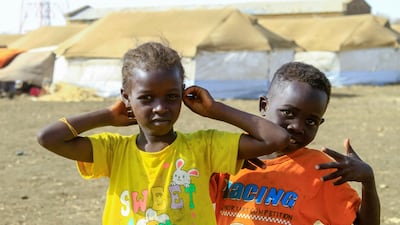
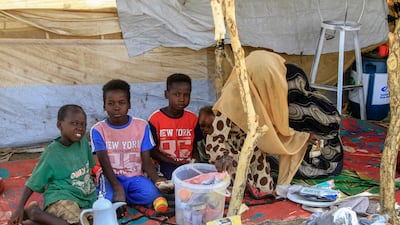
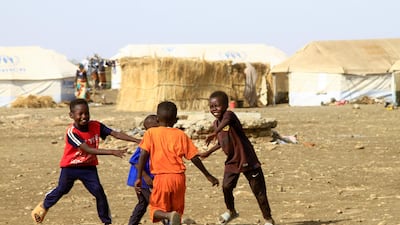
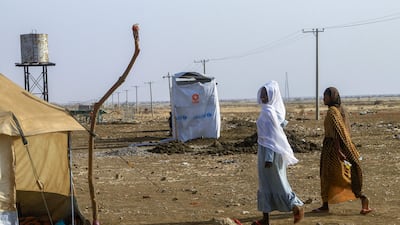
  • Children who fled Sudan's Khartoum and Jazira states to escape the civil war are living in a camp for the internally displaced in Gadaref state. All photos: AFP
    Children who fled Sudan's Khartoum and Jazira states to escape the civil war are living in a camp for the internally displaced in Gadaref state. All photos: AFP
  • After nearly a year of war, Sudan is suffering one of the worst humanitarian crises in recent history, the UN has warned
    After nearly a year of war, Sudan is suffering one of the worst humanitarian crises in recent history, the UN has warned
  • There has barely been any let up in the fighting between the Sudanese army and the paramilitary Rapid Support Forces (RSF)
    There has barely been any let up in the fighting between the Sudanese army and the paramilitary Rapid Support Forces (RSF)
  • The UN said about 730,000 children in Sudan, including more than 240,000 in Darfur, are believed to be suffering from severe acute malnutrition
    The UN said about 730,000 children in Sudan, including more than 240,000 in Darfur, are believed to be suffering from severe acute malnutrition
  • About eight million people have been displaced by the war, which has destroyed the nation’s infrastructure
    About eight million people have been displaced by the war, which has destroyed the nation’s infrastructure
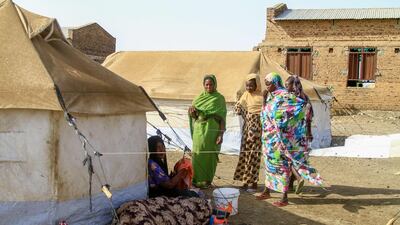
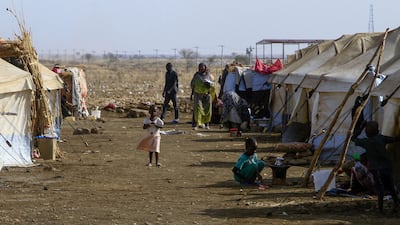
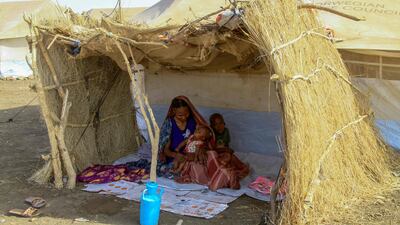
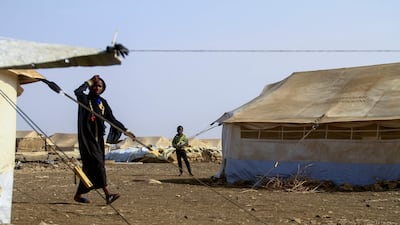
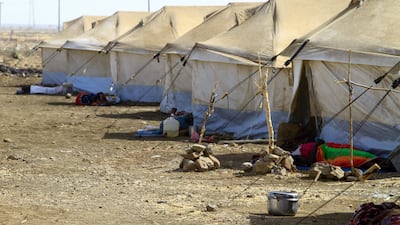
  • Many are stuck in tented camps like this one in Gadaref. The UN said 18 million of Sudan's 48 million people are acutely food insecure, five million of whom have reached the last level before famine
    Many are stuck in tented camps like this one in Gadaref. The UN said 18 million of Sudan's 48 million people are acutely food insecure, five million of whom have reached the last level before famine
  • The Security Council this month called for an immediate ceasefire during Ramadan and better access to humanitarian aid
    The Security Council this month called for an immediate ceasefire during Ramadan and better access to humanitarian aid
  • 'Since then, I regret to report that there has not been major progress on the ground,' said Edem Wosornu, a UN director of humanitarian operations
    'Since then, I regret to report that there has not been major progress on the ground,' said Edem Wosornu, a UN director of humanitarian operations
  • Meanwhile, heavy fighting continues in what has become a war of attrition
    Meanwhile, heavy fighting continues in what has become a war of attrition
  • But much suffering prevails among the internally displaced
    But much suffering prevails among the internally displaced
  • Relief operations are 'severely hampered' by a lack of access and resources, the UN said
    Relief operations are 'severely hampered' by a lack of access and resources, the UN said
  • The UN also called on regional powers to stop supplying arms to the warring parties in Sudan immediately, but there is no end in sight to the brutal civil war
    The UN also called on regional powers to stop supplying arms to the warring parties in Sudan immediately, but there is no end in sight to the brutal civil war
UK's plans to cut net migration

Under the UK government’s proposals, migrants will have to spend 10 years in the UK before being able to apply for citizenship.

Skilled worker visas will require a university degree, and there will be tighter restrictions on recruitment for jobs with skills shortages.

But what are described as "high-contributing" individuals such as doctors and nurses could be fast-tracked through the system.

Language requirements will be increased for all immigration routes to ensure a higher level of English.

Rules will also be laid out for adult dependants, meaning they will have to demonstrate a basic understanding of the language.

The plans also call for stricter tests for colleges and universities offering places to foreign students and a reduction in the time graduates can remain in the UK after their studies from two years to 18 months.

Mercer, the investment consulting arm of US services company Marsh & McLennan, expects its wealth division to at least double its assets under management (AUM) in the Middle East as wealth in the region continues to grow despite economic headwinds, a company official said.

Mercer Wealth, which globally has $160 billion in AUM, plans to boost its AUM in the region to $2-$3bn in the next 2-3 years from the present $1bn, said Yasir AbuShaban, a Dubai-based principal with Mercer Wealth.

Within the next two to three years, we are looking at reaching $2 to $3 billion as a conservative estimate and we do see an opportunity to do so,” said Mr AbuShaban.

Mercer does not directly make investments, but allocates clients’ money they have discretion to, to professional asset managers. They also provide advice to clients.

“We have buying power. We can negotiate on their (client’s) behalf with asset managers to provide them lower fees than they otherwise would have to get on their own,” he added.

Mercer Wealth’s clients include sovereign wealth funds, family offices, and insurance companies among others.

From its office in Dubai, Mercer also looks after Africa, India and Turkey, where they also see opportunity for growth.

Wealth creation in Middle East and Africa (MEA) grew 8.5 per cent to $8.1 trillion last year from $7.5tn in 2015, higher than last year’s global average of 6 per cent and the second-highest growth in a region after Asia-Pacific which grew 9.9 per cent, according to consultancy Boston Consulting Group (BCG). In the region, where wealth grew just 1.9 per cent in 2015 compared with 2014, a pickup in oil prices has helped in wealth generation.

BCG is forecasting MEA wealth will rise to $12tn by 2021, growing at an annual average of 8 per cent.

Drivers of wealth generation in the region will be split evenly between new wealth creation and growth of performance of existing assets, according to BCG.

Another general trend in the region is clients’ looking for a comprehensive approach to investing, according to Mr AbuShaban.

“Institutional investors or some of the families are seeing a slowdown in the available capital they have to invest and in that sense they are looking at optimizing the way they manage their portfolios and making sure they are not investing haphazardly and different parts of their investment are working together,” said Mr AbuShaban.

Some clients also have a higher appetite for risk, given the low interest-rate environment that does not provide enough yield for some institutional investors. These clients are keen to invest in illiquid assets, such as private equity and infrastructure.

“What we have seen is a desire for higher returns in what has been a low-return environment specifically in various fixed income or bonds,” he said.

“In this environment, we have seen a de facto increase in the risk that clients are taking in things like illiquid investments, private equity investments, infrastructure and private debt, those kind of investments were higher illiquidity results in incrementally higher returns.”

The Abu Dhabi Investment Authority, one of the largest sovereign wealth funds, said in its 2016 report that has gradually increased its exposure in direct private equity and private credit transactions, mainly in Asian markets and especially in China and India. The authority’s private equity department focused on structured equities owing to “their defensive characteristics.”

Race 3

Produced: Salman Khan Films and Tips Films
Director: Remo D’Souza
Cast: Salman Khan, Anil Kapoor, Jacqueline Fernandez, Bobby Deol, Daisy Shah, Saqib Salem
Rating: 2.5 stars

Updated: April 08, 2024, 10:17 AM