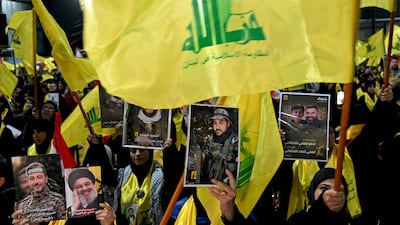
Tension continues to build in Lebanon over the arrest of five Hezbollah-linked men in the country's northern mountains, with local media reporting that senior regional officials from the Iran-backed group had been summoned for questioning by a military court.
Hezbollah, which has said the detentions were unjust, is unlikely to comply with the summons.
The five men were stopped last week in a remote area of the Batroun-Bcharre region and found to be carrying documents that included maps. They were questioned over charges related to endangering internal security.
Anti-Hezbollah politicians, already critical of the Lebanese state for not taking firmer action against the group, have called for its military and security leaders to also be questioned.
Samir Geagea, head of the Lebanese Forces party, said authorities must “complete the investigation by summoning those” who lead the group's military wing, which “operates outside the law and endangers the internal security of the state”.
On Friday, Hezbollah MP Hussein Hajj Hassan said the five men were being subjected to “arbitrary detention” and “false accusations”.
Hezbollah has refused to turn over for questioning those wanted in connection with another recent incident, the seizure of half a tonne of explosives from a vehicle travelling towards Beirut last month.
It has also demanded the release of the explosives, which it said were for use against Israeli forces in south Lebanon, as well as the operatives who were driving the vehicle.
Mr Hajj Hassan accused the government of operating at the whims of US and western pressure in investigating the cases.
The seizure of the explosives at a checkpoint in Dahr Al Baidar in the Bekaa Valley provoked outrage in Lebanon. Consternation has grown, particularly following the detentions in the Batroun-Bcharre region, an area considered part of Lebanon's Christian heartland and well away from the south of the country where Israeli forces are present.
The incidents have heightened tensions between the Lebanese state and Hezbollah, which has repeatedly rejected the government's push to disarm it and criticised the country's leaders for pursuing direct negotiations with Israel.
The government has come under pressure not just from Hezbollah over the disarmament push, but also from officials inside and outside the country – particularly the US and Israel – for failing to take a strong enough stance.

