
In an increasingly wintry Jerusalem, Israel’s opposition allowed itself to celebrate a few wins this week, as it started to take control of parts of the political system after last month’s inconclusive election. No one is close to declaring victory yet, but for the first time in four years Prime Minister Benjamin Netanyahu’s opponents are starting to exercise some form of power.
Gadi Eisenkot, the opposition leader who is currently trying to form a government, said it was “a breath of fresh air” when opposition politician Matan Kahana was elected Speaker of the Knesset, the Israeli parliament, ousting a Netanyahu ally. “My hope is that this Knesset will allow us to chart a different course,” Mr Eisenkot said.
Half an hour away in Jericho, in the occupied West Bank, there is no such hope. Israel’s opposition, driven by a mission to rehabilitate the country's image abroad, has made no dent in the wave of settler violence and settlement expansion that grew so extensively during the four-year term of Mr Netanyahu’s coalition.
Ahmed Aref Fheidat, 62, is one of its latest victims. On November 4, a week after Mr Netanyahu lost his majority and became a caretaker prime minister, Israeli settlers took over eight Palestinian homes in his neighbourhood of Ein a-Duyuk a-Tahta on the outskirts of Jericho.

Since then, his family have had to deal with arbitrary movement restrictions, violence and intimidation from the settlers. “Each time they pass us, they swear at me and my relatives. I once told them they were the age of my grandsons – why are they treating me like that?”
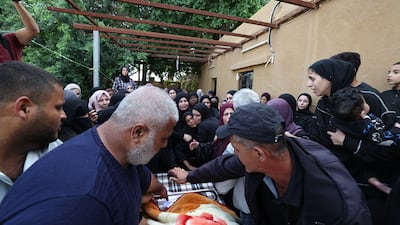
Less than two weeks after the settlement was established, it had claimed its first Palestinian victim, 72-year-old Fada Fheidat. She was shot in the head right next to Mr Fheidat, her brother-in-law, who was shot in the leg while trying to save her.
“I tried to take Fada. When I felt her head, it was completely broken. My hand was covered in blood. The blood was streaming down the street. They then started to shoot towards me. When I entered the gate, I got a bullet in my leg,” he recounted, surrounded by relatives sitting on plastic seats under the shade of a tree, some nursing their own wounds. Mr Fheidat’s leg was covered in a fresh bandage and he has to walk with the help of a stick.
Israel’s military described the incident on Monday night as a Palestinian “terror attack”, which Mr Fheidat called a “complete lie”.
“The real story is that the son of the victim was called and told that the settlers were attacking his family and that his mother was shot,” he said. “He drove very fast from outside the area. He skidded into a car belonging to the settlers because he was driving so fast. The settlers’ car was empty. After he got out of his car, they shot him. His cousin tried to run to help him and they shot the cousin, too.”
According to the Israeli military's account, “terrorists accelerated their vehicle towards an Israeli vehicle and rammed it”.
Few of the Palestinians The National spoke to in the area on Wednesday were surprised by what has happened. Settlers have long targeted the rural communities surrounding Jericho and much of its agricultural land is now under Israeli control.

There was nonetheless dread at the presence of extremist settlers in the city itself, where they harass residents on a daily basis, including in parts of Jericho that fall under the so-called Area A – parts of the West Bank where the beleaguered Palestinian Authority is supposed to have full military and civil control under the Oslo Accords.
Settlers aggressively confronted The National's correspondent and Israeli peace activists when they approached the new settlement on Wednesday.
There are fears that Jericho could now go the way of cities such as Hebron and Jerusalem, where settlers have moved into Palestinian neighbourhoods, bringing with them the Israeli military, mass surveillance of residents and crushing economic damage.
That certainly seems to be the intention of certain members of Mr Netanyahu’s government. Bezalel Smotrich, Israel's Finance Minister, visited the settlement on Tuesday morning, only hours after Mrs Fheidat was killed.
“Jericho is the lock of the Land of Israel,” he said, paying tribute to the settlers. “The farm here, the homes that have been purchased and the community we are establishing here in the area are renewing Jewish settlement in Jericho for the first time since the establishment of the State of Israel.”
The following day, Mr Smotrich criticised Gali Baharav-Miara, Israel’s attorney general, for her instruction on Tuesday to halt the tender process for the E1 settlement, issued hours after the UK announced sanctions on Israeli companies involved in construction of Israeli outposts. The vast E1 project on the outskirts of Jerusalem is widely viewed as a “doomsday” settlement that would render the two-state solution impossible.
Mr Smotrich accused her of “joining the governments of Britain and Australia”, referring to the new sanctions imposed. “We will not give up. We are determined to build in E1 and eliminate the idea of a Palestinian state,” he added.
The dispute came as settlers built a religious school in another area of the West Bank that is supposed to be under full Palestinian control. The yeshiva in the settlement of Homesh was built on the land of the Palestinian village of Yasid. Under Israeli law, Israelis are banned from entering Area A.
As ever in Israel, it is important to look at the facts on the ground, not merely what politicians in the Knesset are saying. While opposition members speak of the possibility of a new future for Israel, the picture for Palestinians is still dire.
When asked what he thought about the future, one elderly member of the Palestinian community in Jericho had nothing to say. He only pointed to the sky.

