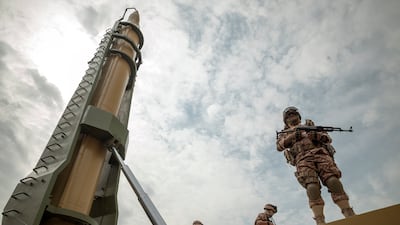

Yemen's Houthis have made a “major leap” in locally producing sophisticated ballistic missiles using components imported from China, an arms intelligence report has revealed.
Experts have also told The National that the militia's manufacturing was becoming increasingly sophisticated. Its engineers have developed the Palestine-2 missile that has the capability to manoeuvre during its terminal stage at 6,000kph, allowing it to evade defences. It was allegedly responsible for Saturday’s attack on Riyadh's King Khalid Airport attack that killed 13.
Attacks by the Houthis have significantly increased in the past month and are designed to put pressure on Saudi Arabia to end its blockade of the Yemen rebels.

Major leap
The Houthis have been significantly helped by specialist parts for missiles imported from China, according to the Conflict Armament Research report passed to The National.
Its teams examined weaponry from an intercepted shipment that had been heading to the Houthi-held port of Hodeida. The haul included highly specialist machined parts for rockets such as stabilising fins and equipment for hypersonic flight.
“The discovery points to a major leap in the group’s domestic production ambitions and has major regional security implications at a time when Houthi forces are intensifying their deep strike campaign against critical infrastructure in Saudi Arabia,” the report said.
The components, discovered in containers on a cargo ship from China, demonstrate that the Houthis are now advanced in their work to manufacture the Iranian-made Kheibar Shekan series of ballistic missiles. Their Palestine-2 variant has a range of 1,800km, bringing much of the Middle East into their sights.
The findings also demonstrate that the rebels, who are under a UN arms embargo, have expanded their supply chains beyond their traditional Iran-linked networks, the paper said.
“The documented components suggest that, in terms of longer-range ballistic missiles, the Houthis have moved beyond simply reassembling Iranian systems,” it stated.
“Only a few countries in the world have the capacity to manufacture missiles of comparable ranges domestically.”

Accelerated progress
While the Houthis have “not yet mastered” the technology for the Kheibar Shekan ballistic missile, Iranian expertise on the ground is “accelerating their progress”, said Dr Nawaf Obaid, of Kings College London.
“Their principal constraint is time, not technical impossibility,” he told The National.
While it is understood the airport attack involved several projectiles in a swarm attack, the Houthis currently cannot build significant numbers, he added.
“Scale remains their weakness,” he said. Analysis by Kings College's department of war studies showed that 85 to 90 per cent of missiles were intercepted by Saudi Arabia’s advanced defence system, he added.
It is understood that the Houthis exploited a gap between Saudi Arabia’s lower and middle air defence layers in the airport attack, rather than a “technological breakthrough”, said Dr Obaid. He added that the kingdom’s air defences were “performing exceptionally well under sustained wartime conditions”.

UK support for Riyadh
Documents show the contents from four shipping containers arrived in the Aden Free Zone in Yemen in June and October 2025 from China.
The shipments contained custom-made metal parts including components of the airframe and a solid-propellant rocket motor for a Kheibar Shekan missile.
They were made by a Chinese precision-metal producer “that advertises itself as a specialist manufacturer of custom aerospace parts”, the report said.
It demonstrated that the Houthis were buying “more specialised parts for the construction of missiles, apparently independent of Iran-linked supply networks”.
According to UN reports, Chinese companies form the biggest source of seized goods bound for the Houthis and they have been importing components for solid-fuel missiles from China for at least two years. China has stated that it adheres to the UN Houthi arms ban.
Asked by The National what action the UK government might take against Chinese companies allegedly supplying components, the prime minister’s official spokesman said Britain “strongly condemns Houthi attacks and remains committed to supporting the security of the Kingdom of Saudi Arabia”.

Saudi Arabia's ambassador to London told a meeting of parliamentarians on Tuesday that the UK's support in the face of the Houthi missile menace was welcomed by his government.
Prince Abdullah bin Khaled held discussions focused on “recent Houthi attacks against the kingdom, regional security, and the importance of international co-operation in safeguarding stability and supporting peace in Yemen”, an embassy post on social media said.

