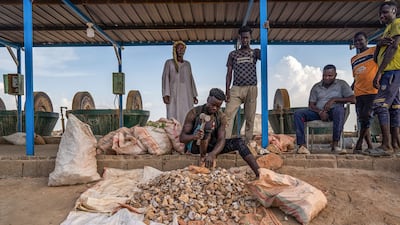

At least 72 gold miners have been killed in an air strike in northern Sudan that three Sudanese groups blamed on neighbouring Egypt.
Emergency Lawyers, a coalition of pro-democracy groups known by its acronym Somood and Sudan Doctors' Network each condemned the air strike and accused the military-aligned government in Sudan of not doing enough to protect its people and the country's territorial integrity.
All three said the air strike took place inside Sudan.
“We reject the targeting of civilians and putting their lives at risk, which cannot be justified on security grounds,” Somood said in a statement. “The leadership of the relevant authorities appointed by the armed forces bear the responsibility for what happens in areas under its control.”
Emergency Doctors put the death toll at 72, while Sudan Doctors' Network gave an initial tally of 13 dead and 28 wounded, warning the death toll was likely to rise.
Somood, Sudan's main opposition group, did not give a figure.

There has been no official word from the Sudanese or Egyptian governments on the incident. However, sources in Cairo confirmed the air strike took place, saying it was carried out at first light on Saturday targeting illegal gold prospectors operating on Egyptian territory near the Sudanese border.
“They had repeatedly been warned to leave the area but they never did,” said one source.
An image widely shared online appeared to show a leaflet dropped by Egyptian aircraft over the area before the strike.
Titled “final security warning”, the leaflets threatened the illegal miners with “immediate targeting” unless they left the area. They also called on them to surrender with their equipment. “Your lives are more valuable,” the leaflets told the miners.
The authenticity of the image could not immediately be verified by The National. The leaflet claimed the miners were operating inside Egyptian territory and said any action against them would be necessary to protect Egypt's resources.
Images and videos shared online, which The National was unable to verify, purport to show the aftermath of the air strike, with bodies strewn in rubble, others wrapped in green sheets and angry survivors, mostly men in their 20s or 30s.
One video showed a military helicopter flying over the site but it was unclear whether it was before or after the air strike.
There has been an influx of gold prospectors in northern Sudan in recent years as the civil war between the Sudanese Armed Forces and the paramilitary Rapid Support Forces has hit the economy hard, driving hundreds of thousands to seek alternative income.
Egypt's military said in June it was engaged in a large-scale operation in the south of the country to tackle gangs involved in drug and arms trafficking, as well as illegal gold prospecting. It said 87 Egyptians and 136 foreigners had been arrested.
Gold production in Sudan has for years been a murky business, attracting adventurers, smugglers and foreign interests seeking quick profit. In several ways, the current gold rush is a by-product of most of the country’s oilfields being lost when South Sudan seceded in 2011.
The civil war that erupted in April 2023 has intensified the scramble for gold, with many venturing independently and randomly into mining. Some estimates put the number of men involved at around two million.
Official figures place government revenue from gold exports at about $2 billion, but experts say smuggling and local use of gold outside official channels account for far more. In 2025, for example, Sudan’s gold production was around 70 tonnes, but only 20 tonnes were exported, with the remainder smuggled out of the country or treated locally in primitive refineries.
Al Shafie Ahmed contributed to this report from Kampala, Uganda