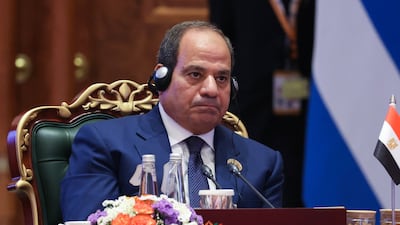

Egypt's share of the Nile's water is a “historical and legal” right that cannot be negotiated or touched, President Abdel Fattah El Sisi has said in the latest sabre-rattling in Cairo's water dispute with Ethiopia.
Addressing the nation in a televised speech, the Egyptian leader said: “Let me say very clearly and decisively that the Nile is Egypt's lifeline and has for thousands of years been the foundation of its very existence.
“Egypt's water share is an enshrined historical and legal right that cannot be reduced or touched,” he said.

While Egypt was ready to co-operate with fellow Nile basin countries, “it will not tolerate any action that touches its water security and continue to defend these rights by all means provided under international law”, he added.
Egypt, which depends on the Nile for nearly all its freshwater needs, has a share of 55.5 billion cubic metres of the river's water under a 1959 agreement with fellow downstream country Sudan. The agreement is dismissed by Ethiopia as invalid and outdated.

The question of Egypt's share of the Nile's water came to the fore when Ethiopia began building a dam on the Blue Nile, the river's largest tributary that accounts for more than 80 per cent of the water reaching Egypt.
While filling the water reservoir behind the dam had little impact on Egypt, thanks to plentiful rain in Ethiopia, Egypt is alarmed that its share will be reduced during a prolonged drought.
Egypt and Sudan have been pressing Ethiopia during a decade of negotiations to accept a legally binding deal that allows the two allies to have a say in the operation of the dam, a demand rejected by Addis Ababa as an infringement on its sovereignty.
Relations between Egypt and Ethiopia have deteriorated sharply in recent days, with Addis Ababa accusing Cairo along with Sudan and Eritrea of aiding an anti-government rebellion. The three countries have denied the charge.
The Egyptian leader's address came just hours after Ethiopia's foreign ministry issued a defiant statement reasserting the country's control of the Blue Nile and the “legitimate” right of the landlocked Horn of Africa nation to the Red Sea, which it lost when Eritrea seceded from Ethiopia in 1992.
Turning to the issue of access to the Red Sea, the ministry said Ethiopia was geographically and historically connected to the strategic waterway despite the change of political boundaries.
“Accordingly, any serious discussion of regional maritime affairs and security architecture must account for Ethiopia's legitimate interests and its enduring connection to the Red Sea,” it said.

The comments on the Red Sea appeared to be in response to a statement issued after Mr El Sisi and the leaders of Eritrea, Somalia and Sudan met in Egypt on Sunday.
The four, whose countries control an uninterrupted Red Sea coastline that stretches from Egypt to the Horn of Africa, vowed to keep the governance of the Red Sea exclusively in the hands of littoral states.

