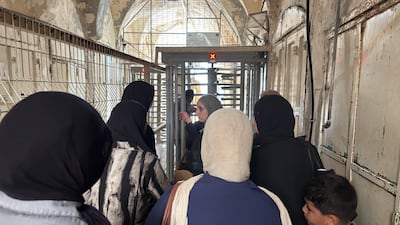

Palestinian women wait patiently for the red light on a metal panel ahead to turn green so they can pass through a turnstile, one at a time. Next is a metal detector, a baggage scanner and a diligent search by female Israeli soldiers.
The women are not visiting loved ones incarcerated in a maximum-security jail. They are there to visit an ancient mosque in the occupied West Bank city of Hebron, which is home to the tombs of several prophets revered by Muslims and Jews, including Abraham and his wife Sarah.
If there is one place in Palestine where the story of occupation can be seen in a single frame, it is the Ibrahimi Mosque's compound.
Palestinians and Israelis, Muslims and Jews, pray metres apart, but live in two different realities, with barriers cutting through the holy site to separate worshippers and direct them down different paths. For Palestinians, reaching the mosque means navigating checkpoints, turnstiles and security searches under the watch of Israeli soldiers. For Israelis, the route is shorter, and access is far easier.
“It's like gaining access to a military base, not a mosque,” Youssef Al Jaabari, a member of Hebron's city council, told The National during a recent tour of the compound. “Muslim visitors go through one search after another. These measures are unnecessary.”
Hebron's old city is recognised as a Palestinian World Heritage site. Hundreds of Jewish settlers live among tens of thousands of Palestinians in parts of the ancient city that are under Israeli security control. Their coexistence within the confines of the city's old quarter fuels tension and sometimes violent clashes.
Jews believe the Cave of the Patriarchs is where Abraham, Isaac, Jacob and their wives are buried. Muslims, who, like Christians, also revere Abraham, built the Ibrahimi mosque, also known as the Sanctuary of Abraham, in the 14th century.

The site is one of the most potent symbols of Israel's heavy-handed occupation at a time when settler violence and land grabs are fuelling tension in a region occupied by Israel for nearly 60 years. It is broadly comparable to the strict security measures enforced by Israeli authorities at Al Aqsa Mosque in Jerusalem.
But few places capture Hebron's contradictions so starkly.
Those who approached the tomb of Abraham on that Saturday afternoon could clearly hear Jewish worshippers chanting their prayers in the adjacent section of the mosque, which they have access to pray in. A closer look through a barred window in the room housing the tomb allows pilgrims on the Muslim side to glimpse the Jewish worshippers in their off-white shawls and skullcaps.
The sharing of the mosque's complex between Jews and Muslims follows a delicate schedule. Muslims can have the entire place to themselves for 10 days a year, covering major holidays and select days in the final third of the holy month of Ramadan.
The Jews also have 10 days every year when they can have exclusive access to the entire complex to mark special days in the Jewish calendar.
“We remove the carpets before the Jews take over our part of the mosque,” said Arafat Abu Turky, a veteran of seven years on the mosque's staff of caretakers.

Mr Al Jaabari said a US-mediated protocol on Hebron dating back to 1997 gave the city council full control over Hebron's old city and religious sites.
However, last June Israel tightened its control of the site, seizing planning and construction powers at the Ibrahimi mosque from Palestinian authorities, thus scrapping parts of the agreement, according to the Finance Minister, Bezalel Smotrich.
'It is not right'
Most of the mosque's patrons on a recent weekend afternoon were women, a telltale sign of the difficulties that face adult Palestinian males who, to get to Hebron, must negotiate the seemingly endless security checkpoints across the West Bank and the suspicion with which Israeli soldiers view them.
Yet the atmosphere inside the mosque was one of jubilation. A large group of women from the nearby city of Bethlehem were in the mosque to celebrate four of them for having learnt the entire Quran by heart, an undertaking that can take years. The four took turns reciting parts of the Quran as the rest of the women formed a circle around them.
“It is not right that I, as a Palestinian whose family is from Hebron, should go through these security checks to visit the mosque,” said one of the women, who did not want to be named for fear of reprisals.

“I was once denied entry here because my mobile phone's cover had a map of Palestine with the words 'Jerusalem is ours',” said the woman, who is a PhD candidate in education and came to the mosque with her mother, who runs a women's Quranic school in Bethlehem.
In another corner of the complex, a large group of Turkish Muslims sat on the floor, listening to their Palestinian tour guide explain, in fluent Turkish, the site's history and significance. Palestinian children found another way to pass the time in the mosque: excitedly chasing each other or playing hide-and-seek around the shrines, bookshelves, and the ornate pulpit.
Israeli soldiers occasionally stage security raids in the Muslim part of the complex. Israeli security cameras installed throughout the section provide round-the-clock monitoring.
Mr Al Jaabari, the Hebron city council member, disputes the legality of the mosque's Jewish-Muslim sharing arrangement, claiming it was unilaterally introduced by an Israeli commission that had no mandate to do so.

“The Israelis have absolutely no rights in or a legitimate claim to the mosque. It's internationally recognised as a Muslim heritage site,” he said. “They are trying to change its Islamic character by adding new structures. The parties they organise at the mosque during their annual 10 days of full access are an offence to the feelings of Muslims.”
In a recent speech marking the establishment of a new Israeli settlement near Hebron, Mr Smotrich said the “historic step” of taking over the construction and planning of the site from the Palestinians would deepen “Israeli sovereignty” in the West Bank, which Palestinians seek as part of a future independent state, together with the Gaza Strip.
According to Mr Al Jaabari, the Israeli authorities have been breaching the accord to pander to settlers in both the city and the rest of the West Bank. “The general election next month has increased and sped up the facilities provided by Israeli authorities for Hebron's settlers,” he warned.

