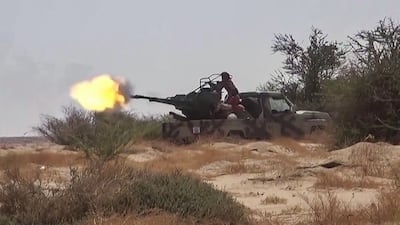

Western powers lack the military capacity or political appetite to intervene directly in the Middle East, as Saudi Arabia seeks support in countering the advances of the Houthi rebels in Yemen, analysts have said.
Whitehall officials have acknowledged that sending more UK forces to the region is “not politically expedient” and that Britain “doesn’t have much in the bank”, with military resources stretched.
A handful of UK and other western personnel are in Saudi Arabia discreetly discussing assistance with air defences, as Riyadh seeks to strengthen its ability to protect its territory and vital Red Sea shipping routes from the current Houthi offensive.


But neither Europe nor the US appeared ready for a major new military operation, said Sascha Bruchmann, an analyst at the International Institute for Strategic Studies.
“I don’t think that the Europeans have spare capacity either. And then there’s not yet any political commitment that translates into a tangible military operation,” he said.
The US is also heavily committed to its operation to reopen the Strait of Hormuz, limiting its ability to rapidly deploy forces to the Red Sea.
Western governments are already “quite occupied”, Mr Bruchmann said, with the US unable to afford to divert forces committed to the Strait of Hormuz operation.
“What’s happening is that as the Americans have found a way to allow more oil to leave the Strait of Hormuz, the Houthis have opened the second front to squeeze the Bab Al Mandeb strait,” he said. “As the Iranians are losing a bit of grip on the Strait of Hormuz, they’ve asked their allies in Yemen to squeeze harder on the Bab Al Mandeb [strait].”
Former Royal Navy commander Tom Sharpe said the US was also unlikely to want to open another major military front given its experience of the Iran war. “Given what they’ve just been through, I don’t think [America] has the stomach for it,” he said.
Britain currently has HMS Dragon, a Type 45 air-defence destroyer, in the Arabian Sea alongside the minesweeping support ship Lyme Bay, but Mr Sharpe said there was little else that could readily be sent and “little appetite” in Whitehall for a larger deployment.
Mr Sharpe also suggested that in Europe there was also “political mileage in saying ‘we're not involved in this, it's not our war’”. He said this was a mistake, as the energy crisis is having a significant impact on fuel prices.

Mr Bruchmann said there was little appetite for a land intervention. “No one has an interest in going on the ground in Yemen, at least thus far,” he said.
For now, Riyadh is expected to focus on strengthening forces already fighting the rebel Houthis and shoring up the internationally recognised Yemeni government and its defences.
“The Saudis actually have enough aircraft,” Mr Bruchmann said. He estimated that Saudi forces could generate about 60 sorties a day. “The problem is they need the satellites and electronic intelligence to generate a better target set.”
Dr Neil Quilliam, an expert on Gulf energy and security, suggested that Saudi Arabia was “heading towards an export crisis rather than a production crisis”.

The Chatham House think tank expert added that Britain and Europe had limited capacity to respond militarily, although there was a possible role for a more muscular European response, with potential air strikes on Houthi military sites.
Such a move could strengthen relations with Riyadh and other Gulf governments and be presented domestically as protecting European economies from the effects of prolonged energy disruption.
“But it is unlikely that there is currently the political appetite in Europe for a significantly expanded military role,” Dr Quilliam said.
Asked whether Britain would offer military assistance if requested, in a statement to The National, Downing Street said it would “continue to work with partners to support regional stability”.
It added that British forces were “deployed across a number of theatres to help protect regional stability” but declined to “get into specific operational matters”.
It is understood that energy was discussed on Wednesday when the UK's Defence Secretary Wes Streeting met Qatar’s Defence Minister Sheikh Saoud bin Abdulrahman.

