
Aisha Mohammad does not know what became of her five children after she fled the coastal area where they lived during clashes between Houthi rebels and government forces in south-west Yemen.
She is one of at least 125,000 people displaced by a sharp escalation in fighting this month, particularly along Yemen's west coast, with more than 2,400 crossing the sea to seek refuge in Djibouti, according to the UN.
Ms Mohammad says she was forced to leave without her two daughters and three sons, who were trapped in their home by the fighting.

“They are being blocked and shot at. Right now, they cannot reach us, and we cannot return to them. This is a trial from God,” she said as she boiled water in an old black kettle near a flimsy rope and fabric shelter in Taiz.
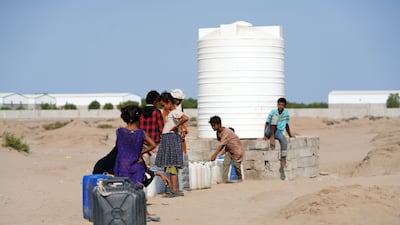
The renewed fighting in Yemen's civil war, which had largely subsided after a truce in 2022, has uprooted families in Hodeidah, Taiz, Lahj, Aden, Abyan, Marib, Al Dhalea and Shabwa provinces, the UN agency for refugees, UNHCR, said. According to aid groups, the sheer number of displaced people has forced some to sleep in the open, and led to scuffles over water and other provisions.

Mohammad Aiyash said he fled the port city of Mokha, which fell to the Houthis on September 10, with only his three children after his wife was killed by shrapnel.
“I fled with them to Aden … by God we do not possess even a single grain of flour. We have no mattresses and no clothes,” he told Reuters.
The story repeats itself. Khadija Kudaf and her family walked for three days. “The children are hungry. We have no food,” she said.
Aid workers say people seem to need everything: food, cash, shelter, clean water and health care.
“The numbers continue to grow,” an aid worker from Prosper Global, formerly known as Mercy Corps, told The National from Taiz.
They said families fled from the front lines in Taiz to Al Masrakh, Al Qaherah and Salah. “Around 350 displaced families sought refuge in Al Masrakh alone. And we are seeing new families arrive in these areas every day.”
Yemen is no stranger to mass displacement. War has plagued the country since at least 2014, when the Houthis took over the capital Sanaa, and a Saudi-led coalition intervened on behalf of the government. There were already four million internally displaced people before the latest fighting, some of whom have been forced to move several times over the past 12 years.
“Each time they are forced to move, they have fewer resources to rely on and fewer options available to them,” the aid worker said.
The clashes in Taiz emptied several displacement camps set up by the Norwegian Refugee Council, with residents forced to travel up to 15km away in search of safety, an NRC worker told The National.
They said it was impossible to keep track of everyone amid the chaos. “One blind displaced man was left behind in a camp because no one could safely walk with him to leave. He refused to let anyone be slowed down by taking him. No one knows where he is now.”
“People are sharing food and water, including their last chickens and livestock, with other displaced neighbours,” the NRC worker said.
The UNHCR said on Tuesday that humanitarian access remained “a major challenge”.
“Insecurity, damaged roads, telecommunications disruptions and movement restrictions are affecting operations,” the agency said in a statement.
Crisis extends beyond Yemen
The battles which broke out earlier this month have resulted in the Houthis expanding their control over the western coast, giving them control over the Bab Al Mandeb strait between the Gulf of Aden and the Red Sea. The Iran-aligned rebels last month declared an “embargo” against Saudi Arabia, which supports the internationally recognised government, and launched attacks on Saudi ships, oil facilities, cities and military bases.

The Houthis' control over Bab Al Mandeb strait and a long stretch of the Red Sea coastline threatens further disruption to global shipping and energy supplies. Iran has effectively blockaded the Strait of Hormuz on the opposite side of the Arabian Peninsula after being attacked by the US and Israel in late February.
Yemenis who crossed the sea to Djibouti have been arriving in Obock, Khor Angar, Moulhoule and Godoria. Most of them are women, children and the elderly, the UNHCR said. More people are expected to arrive.
They stand in long queues, hoping for a parcel containing material for the shelter they will live in until the fighting subsides at home. It is a familiar sight for NGO workers who deal with displaced populations. Women fill up jerry cans with water and young children help their family collect supplies.

“Behind every number is a family who's lost everything,” said Amy Pope, director general of the International Organisation for Migration.
“People are crossing the sea with nothing because they have no other choice left. Yemen is a country torn by poverty and conflict, and it cannot carry this crisis alone.”
Tom Fletcher, UN Emergency Relief Co-ordinator, said $9 million has been allocated to provide urgent assistance to the displaced, but relief efforts in Yemen are already underfunded, and aid workers are overstretched.
“We call Yemen the world's most neglected crisis,” one NGO worker told The National.

