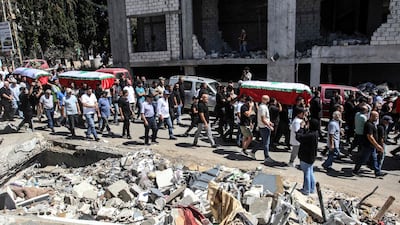
Direct US-brokered talks between Lebanon and Israel are expected to be split between Rome and Florida, sources told The National, with no breakthrough expected before Israeli elections are held next month.
The diplomatic impasse comes at a time of apparent fading optimism among Lebanon’s leadership that the US will pressure Israel to curb its escalating attacks.
Negotiations have largely stalled as Israeli troops continue heavily pounding southern Lebanon with air strikes that could jeopardise the fragile ceasefire and strain a US-brokered framework to end hostilities permanently.

Hundreds of people gathered on Tuesday to bury 13 people killed in Israeli strikes on the southern town of Kafr Remman the day before.
According to one source, the political and military tracks will be separated in the next phase of discussions. Lebanese and Israeli military delegations are expected to meet separately in Florida, while political talks will continue in Rome.
“They don’t want to discuss the pilot zones from now until the end of October, because of the elections. Everything is elections, elections,” a Lebanese official said. The source was pessimistic that the US would pressure Israel to stop its escalation, “leaving the Israelis alone” until the end of the elections period.
Under the US-brokered framework, pilot zones would be established in specific areas leading to Israeli withdrawal, Hezbollah disarming and the Lebanese army assuming control, until all of Lebanon comes under exclusive Lebanese control.
The official also described a growing sense that Lebanon is now “trapped” within the US-brokered negotiating framework, with little room to bring international partners into the process. Lebanese efforts to involve France, a historical ally with long-standing influence in the country, have faced Israeli opposition, the official said.
Lebanon sees little alternative to continuing with the negotiations, even as officials increasingly question whether talks can produce Israeli concessions without greater pressure from the Trump administration.
“We want to keep this process working because if you don’t have this process what will the alternative be?” the official said. “At least with the Americans [applying pressure], Israel hasn’t escalated its attacks to Beirut and Dahieh. We haven’t been able to do much beyond that.”
The assessment marks a deterioration in Lebanese expectations of the US-led process. Lebanon entered direct negotiations hoping Washington could use its leverage over Israel to secure an end to attacks in the south and begin a phased Israeli withdrawal from Lebanese territory.
Instead, Israeli military and demolition operations have continued alongside the negotiations, including in areas beyond the boundaries of the security zone established by Israel itself. Most recently, the Israeli army announced operational control of the strategic Ali Taher heights overlooking Nabatieh.
On Tuesday, Israeli forces planted an Israeli flag in Kfarshouba, a still-inhabited border village, marking an increasingly visible Israeli presence in the occupied south.
"We wake up to this flag now," said Walid Nasser, a Kfarshouba resident whose house sits below the hill upon which the flag has been raised. "They [Israeli forces] conduct patrols and shoot over our buildings on a daily basis."
Even the prospect of negotiations advancing after Israeli election remains uncertain.
Israeli officials are reportedly considering retaining control of a strip of southern Lebanon two to four kilometres deep, according to Israeli broadcaster Kan, which they could use as a launching point to operate against Hezbollah across the south.
Such a plan would fall far short of Lebanon’s clear demand for a complete Israeli withdrawal.