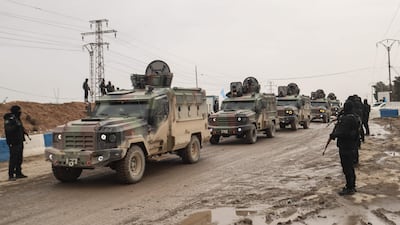

Syria has sent elite troops and heavy weapons to the border of Hezbollah strongholds in Lebanon, Middle East sources told The National on Tuesday, in a US-friendly move as the armed group enters the war.
A security source in the region who follows Syria said that the Damascus government has moved hundreds of soldiers, tanks, troop carriers and field artillery from the front lines with Kurdish areas in eastern Syria to the border with Lebanon in the past three weeks.
The Syrian government has “brought in some of its best troops”, the source said. Among them are Uzbek and Uighur fighters who fought beside President Ahmad Al Shara in rebel forces and are now part of the armed forces, the source said.

Mr Al Shara, a former operative in Al Qaeda, led forces that ousted the former Assad regime in December 2024. Syria's new leader became friendly to the US soon after he took power, and was received by President Donald Trump at the White House in November.
Unlike during wars in the past three decades, the pro-Iranian Hezbollah has no longer a base in Syria. Assad-ruled Syria played a big role in the creation of Hezbollah in the 1980s and later became a backup command and logistics centre for Hezbollah, as well as offering a supply route from Iran.
The source said that the Syrian deployment in recent days has concentrated on the Qusair region, across the border from Hermel in Lebanon, which is believed to house Hezbollah weapon stores. Parts of Lebanon's Bekaa valley, between Beirut and central Syria, are under de facto Hezbollah control.
Members of a newly created Syrian border guard have also arrived along a stretch of the border from Qusair to the coastal area of Tartus, the source said. They said the move appears intended as a show of force, without signs of offensive intent.
In the past 72 hours to Tuesday afternoon, Damascus has also sent Interior Ministry forces to the frontier with the Israeli-occupied Golan Heights, sources in the area said. Hezbollah's allies operated in the area until 2024 and occasionally attacked Israeli troops.
“The objective is to prevent remnants of Iran's proxies from any action that could draw Israeli retaliation against Syrian territory,” a local Syrian security official said.
The security personnel set up roadblocks near the villages of Jabata Al Khashab, Khan Arnabeh, and an area formerly called Baath City to make sure that only the residents of these areas can enter, the official said.
Israel had not allowed Syrian security forces into these areas in the year before the outbreak of the US-Israel war on Iran, suggesting that the deployment may have been co-ordinated with Israel, another regional source said.
During the Syrian civil war, Hezbollah played a crucial role in the survival of the former regime until the group itself could barely survive an Israel campaign in 2024, which wiped out many of its senior operatives in Lebanon and Syria.
The group oversaw other Iranian proxies in Syria, had access to Syrian army bases and storage, and used Iranian military hardware that was partly developed in Syria, according to regional security officials.
Parts of south Damascus, where Hezbollah was based near a Shiite shrine, formed its “backup southern suburb”, one of the source said, comparing the area to the group's nerve centre in the southern districts of Beirut.
However, Israeli aerial bombing in the two months that followed the downfall of the former regime destroyed many weapon storage and manufacturing compounds in Syria.