Pakistan and Afghanistan plunged into an “open war” on Friday after cross-border clashes killed dozens, drawing calls from the international community for de-escalation.
What happened?
Pakistan carried out air strikes in the early hours of Friday, aimed at cities in Afghanistan including the capital Kabul, citing what it called “unprovoked” firing from across the border.
Those strikes began after Afghanistan launched a large-scale military operation against Pakistani army installations along the shared border, marking the escalation of a long-running conflict.

Zabihullah Mujahid, spokesman of Afghanistan's ruling Taliban, called the attacks a response to “repeated border violations and provocations from Pakistani military circles”.
Pakistan declared “open war” on its neighbour, as it launched the air strikes on Kabul early on Friday. The Pakistani military said its operation is called Ghazab lil Haq, which translates to “righteous fury”.
It claimed 133 “Taliban operatives” were killed and more than 200 were wounded in the attacks, and that “Pakistan's effective counter-operations are ongoing”.
Kabul denied claims of casualties. “The cowardly Pakistani military has carried out air strikes in certain areas of Kabul, Kandahar and Paktia,” Mr Mujahid said in a post on X. “Fortunately, there have been no reported casualties.”
Hours later, Taliban authorities announced air operations against “key” Pakistani sites.
How did we get here?

Islamabad accuses the Taliban of hosting militant groups that carry out attacks in Pakistan, an allegation denied by Kabul.
Last year, border clashes killed dozens of soldiers from the two countries. The spate of fighting was reported as the worst violence in the frontier region since the Taliban reclaimed power in Afghanistan in 2021.
Calm was temporarily restored with a truce brokered by Qatar and Turkey, but the two sides have since failed to extend the agreement. Peace talks in Ankara collapsed without a long-term deal due to a dispute over militant groups hostile to Pakistan that operate inside Afghanistan.
Pakistan said its attack last week on Afghanistan was due to Pakistani security sources finding “irrefutable evidence” that militants in Afghanistan were behind a recent wave of attacks and suicide bombings aimed at Pakistani military and police.
The move escalated tension further, resulting in the latest violence.
Why are the two countries at odds?
In 2021 Imran Khan, at the time Pakistan's prime minister, welcomed the return of the Taliban to power in Afghanistan.
He said that Afghans had “broken the shackles of slavery”. But Islamabad soon found that the Taliban were not as co-operative as it had hoped.
Pakistan says that the leadership of militant group Tehreek-e-Taliban Pakistan (TTP) and many of its fighters are based in Afghanistan. The TTP, also known as the Pakistani Taliban are a separate group but allied with Afghanistan’s Taliban.
Islamabad also says that armed insurgents seeking independence for the south-western Pakistani province of Balochistan also use Afghanistan as a haven.
-
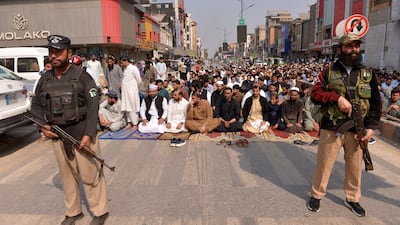
Pakistani security troops guard worshippers performing Friday prayers in Peshawar, near the border with Afghanistan. EPA -
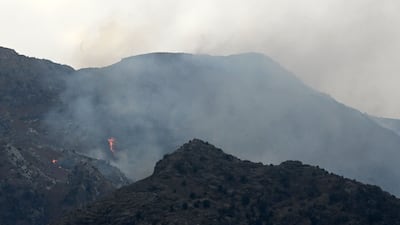
Smoke rises from the site of Pakistani air strikes near Shamshad Ghar, an Afghan military base at the border. AFP -
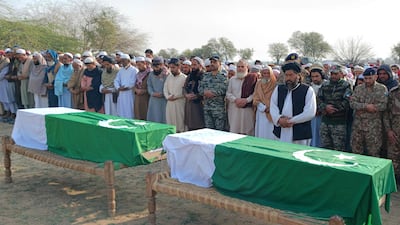
Funeral prayers are performed for security personnel killed in attacks in Pakistan's Khyber Pakhtunkhwa province. AFP -
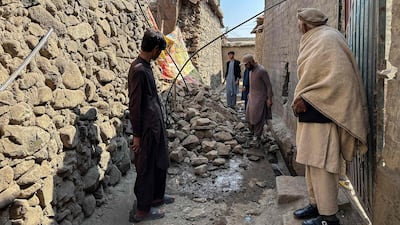
Pakistanis assess the damage to a house in Khyber Pakhtunkhwa province, after cross-border attacks. AFP -
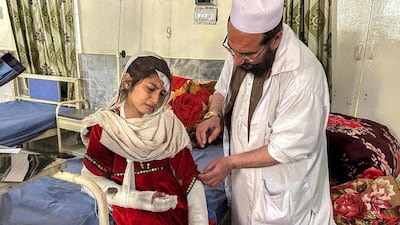
A girl is treated at a hospital in Bajaur, Khyber Pakhtunkhwa province. AFP -
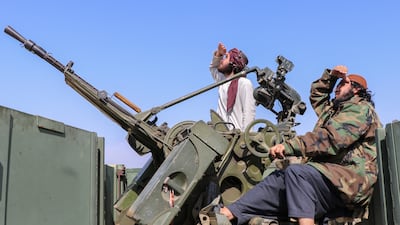
Taliban soldiers watch for Pakistani fighter jets in Khost province, Afghanistan. Reuters -
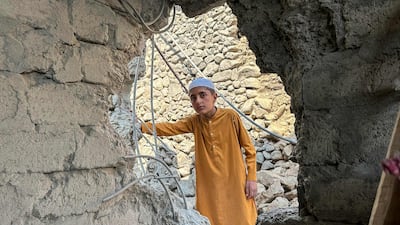
A boy inside a damaged house in Bajaur. AFP -
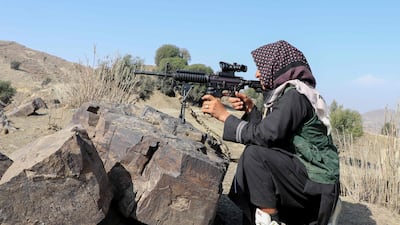
A Taliban security personnel keeps watch near the Durand Line in Afghanistan. AFP -
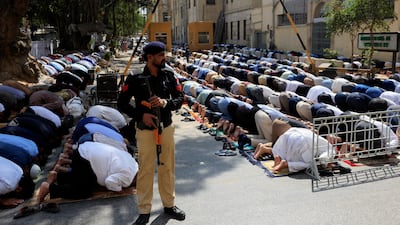
A police officer stands guard as people offer Friday prayers in Karachi, Pakistan. Reuters -
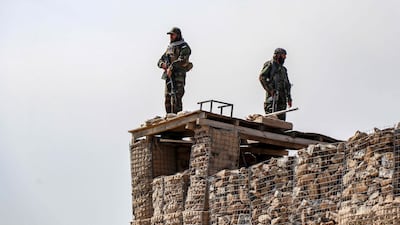
Taliban security personnel in the Gurbuz district. AFP -
Afghan women are treated at a hospital in Jalalabad, eastern Afghanistan. AFP -
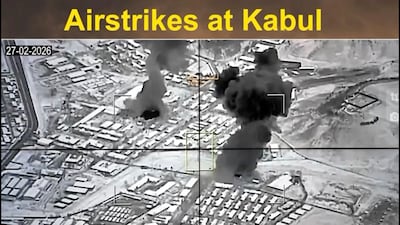
Smoke rises following what Pakistani and Taliban officials say are Pakistani strikes, in Kabul, Afghanistan. Reuters -
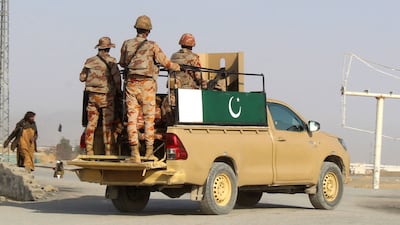
Pakistani soldiers patrol near the Pakistan–Afghanistan border in Chaman. AFP -
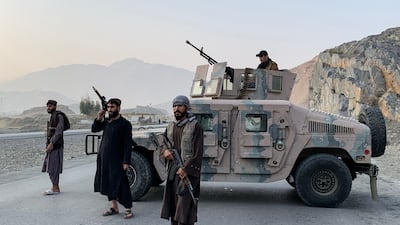
Taliban security personnel stand guard near the Torkham border crossing between Afghanistan and Pakistan in the Nangarhar province. AFP -
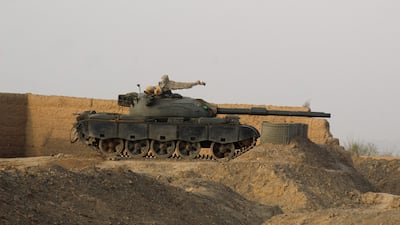
A Pakistani army tank stands at the Pakistan-Afghanistan border in Chaman. AFP


Militancy has increased every year since 2022, with attacks by the TTP and Baloch insurgents growing, according to Armed Conflict Location and Event Data, a global monitoring organisation.
Kabul has repeatedly denied allowing militants to use Afghan territory to launch attacks in Pakistan. The Afghan Taliban say Pakistan harbours fighters from its enemy, ISIS, a charge Islamabad denies.
Islamabad says the ceasefire did not hold long due to continued militant attacks in Pakistan from Afghanistan, and there have been repeated clashes and border closures since then that have disrupted trade and movement along the rugged frontier.
Who are the TTP?
The group is known as the Pakistani Taliban, which was formed in 2007 by several militant outfits active in north-west Pakistan.
The TTP have attacked markets, mosques, airports, military bases, police stations and also gained control of territory – mostly along the border with Afghanistan, but also deep inside Pakistan, including the Swat Valley.
The group was behind the 2012 attack on Malala Yousafzai, at the time a pupil, who received the Nobel Peace Prize two years later.
The TTP also fought alongside the Afghan Taliban against US-led forces in Afghanistan, while hosting Afghan fighters in Pakistan.
Pakistan has launched military operations against the TTP on its own soil with limited success, although an offensive that ended in 2016 drastically reduced attacks until a few years ago.