
Despite German Chancellor Friedrich Merz declaring that the rules-based world order “no longer exists” this weekend in Munich, many diplomats and international bureaucrats have challenged the notion.
UN Undersecretary General Jorge Moreira da Silva has warned that it is “very important that we don't confuse the narratives and analytical conversations with the reality and with needs”.
Speaking to The National during the Munich Security Conference, Mr Moreira da Silva said: “We may have narratives that are narrowing the commitment to multilateralism, but we are facing growing needs on the ground. So it's important that we focus on the needs, on the people we serve.”

He said his agency was intent on fostering “solidarity and co-operation … to deliver regardless of the difficult context”.
Mr Moreira da Silva is the executive director for the UN Office for Project Services (Unops), the fifth-largest UN agency, which implements infrastructure, building, hospitals, schools, roads, renewable energy and other major projects. He explained that Unops leads in “purchasing in a more sustainable manner and doing project management, which helps de-risking the project and makes the project more bankable”.
Unops is not directly impacted by the dramatic reduction in overseas development aid from traditional donors, as its work is funded through other partners, such as multilateral agencies like the World Bank. However, Mr Moreira da Silva said he is concerned about a more general financing gap for developing countries that is estimated to be $4.2 trillion.
“Finance is just one part of the question. You need finance, you need policy, and you need capacity for implementation,” he said. He believes Unops’ model could provide “an important lesson learnt to fix the system” as it implements projects based on partners directly funding them.
One of the challenges facing the UN system is the Israeli targeted attacks on UNRWA, the main UN agency dealing with Palestinians, in addition to restrictions affecting aid delivery by organisations such as OCHA or the World Food Programme. Mr Moreira da Silva said the importance of UNRWA was “irreplaceable”.
“Regardless of the good work from all the UN agencies, there is a role that nobody can play, which is education and health,” he said.
Rubble and tents
As for developments on the ground, Mr Moreira da Silva said: “When it comes to Palestine, the area that has been overlooked most recently in international conversations is the West Bank and East Jerusalem. It's fundamental that we don't overlook the situation there. When it comes to Gaza, Unops plays a fundamental role.”
Mr Moreira da Silva has been to Gaza three times in the past 27 months. He described the situation as “massive devastation”. He said some said aid was getting into Gaza. “Of course, we can see more food in the market. But the good news ends here. Gaza is basically rubble and tents.
In pictures: UAE’s 13th humanitarian aid ship for Gaza sets sail
-
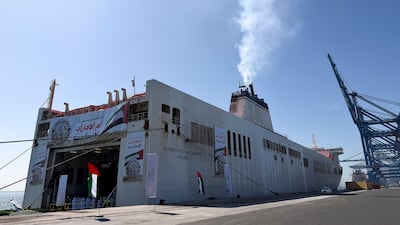
Umm Al Emarat (Mother of the Nation) sets sail for Gaza, ahead of Ramadan. All photos: Ahmed Ramzan / The National -
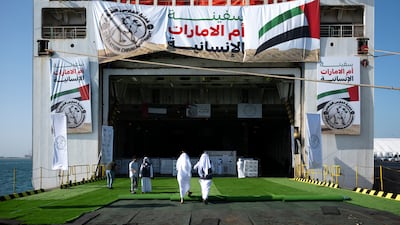
The aid ship is carrying more than 7,300 tonnes of food, medical and shelter supplies for beleaguered Palestinians -
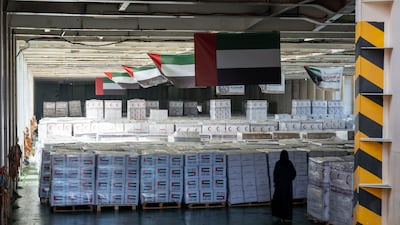
It is the 13th such humanitarian aid shipment from the UAE to Gaza since the war broke out on the territory in October 2023 -
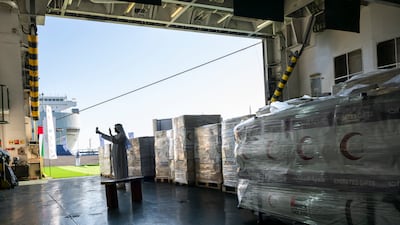
Gaza's Palestinian population is still undergoing extreme suffering, despite a ceasefire between Israel and Hamas -
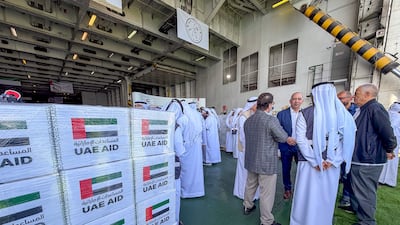
Officials and aid workers gather at Khalifa Port, Abu Dhabi, as the Umm Al Emarat prepares for launch -
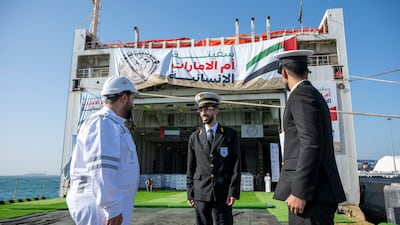
It's bon voyage for the Umm Al Emarat -
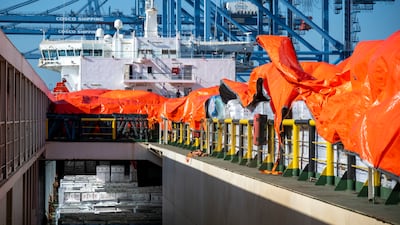
The ship is expected to reach Al Arish port in Egypt within 15 days, where the cargo will be transferred for delivery to Gaza -
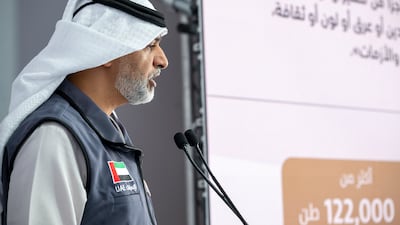
Mohammed Al Sharif, spokesman for Operation Gallant Knight 3, during the send-off ceremony ahead of Ramadan -
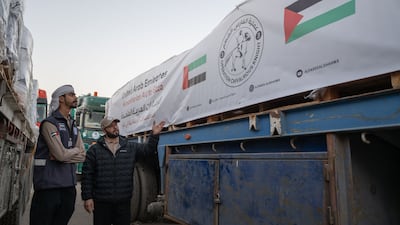
Convoy number 301 entered the Gaza Strip carrying more than 290 tonnes of food parcels and supplies -
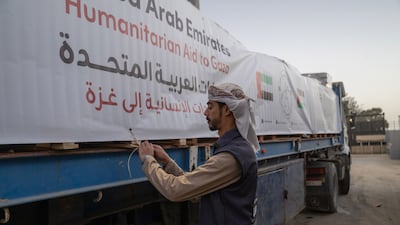
The convoy forms part of the continuous relief supply system aimed at meeting the basic needs of families in the strip


“I visit lots of refugee camps, and Gaza is not like a refugee camp. It's much worse.
“The people I saw in Gaza cannot wait for the big reconstruction … These big players talking about billions of dollars … people need something tomorrow … let's bring the early recovery with a few million immediately.”
Unops is responsible for all fuel delivery to Gaza, “fuel is the lifeline for bakeries, for kitchens, for hospitals, for sewage, for desalination … we are very honoured and proud of that role”, he said.
Unops is also responsible for the way consignments are procured and provided. He said the list of what was currently required in Gaza was “very easy: fuel, prefabs for the shelter, the repairing of the power plant, the repairing of water sanitation, telecommunication networks, the assessment of the damage and the safety of the buildings, the rubble removal”.
He also stressed the importance of “the management of the unexploded ordnance”. “We need quick wins. I know that word quick wins sometimes is not well received, but we need quick wins in Gaza. Not quick wins for diplomats, but quick wins for the people,” he said.
While the needs for Gaza to be reconstructed are estimated to be $52 billion, Mr Moreira da Silva explained: “It's the assessment of the World Bank, the UN and European Commission, for the early recovery, maybe we need in the next few weeks $300 million.”
However, an even bigger obstacle is access. “It doesn't matter the money, if we can't bring the heavy machinery to remove the rubble; if we can't bring the spare parts to repair the power plants; if we can't bring the solar panels that are fundamental to get mini and microgrids”.
Israel bans the entry of any of these items under the claim that they could have “dual use” – that is, nefarious use to harm Israel. Mr Moreira da Silva pushed back on this point: “The restrictions on dual use must be removed, must be lifted.”
He added that Unops can provide direct delivery of these items through the “Jordan corridor, which must be put to full use”.
“It's heartbreaking when you see that inside Gaza people are dying, literally freezing. And then I saw in Jordan in 10 warehouses -10 warehouses - full of boxes of shelters blocked from entry by Israel,” he said.
“US taxpayers’ money used for warehouses and lorries are stuck in Jordan … I have been making the call to Israel to allow this Jordan corridor to be fully functioning”.
The UN official said of major importance is restarting education and getting schools opened.
“The 700,000 kids that I saw in the streets, they have nothing to do,” he said. “So they basically are walking in the middle of the rubble. Many of them with no shoes, no proper clothes they have nothing to do.
“Their future is hijacked, in a situation where it's fundamental to bring education.”
'Very difficult to operate in Yemen'
Among the latest projects Unops has undertaken is in Yemen, despite the fact that dozens of UN workers have been detained there by the Houthis.
“It's very difficult to operate in Yemen, but we stayed in the country due to specific needs,” said Mr Moreira da Silva. One role for Unops there was monitoring and inspecting all vessels from Djibouti, allowing aid to be delivered. Other projects funded by the World Bank and Japan included the delivery of water, sanitation and electricity.
“I really hope that the conditions in Yemen would help us to do more. Currently, unfortunately, the situation is so stark that it's almost impossible to deliver, but we are still committed to stay and deliver,” Mr Moreira da Silva said.
Unops has operations in countries such as Afghanistan, Sudan, Myanmar, Somalia and Ukraine, which the UN official says should be funded and supported.
“The UN and the multilateral system need to prioritise precisely those places that are the most difficult to operate. I'm more worried in knowing whether the billions and the trillions are going to those most in need, or rather to the places where it is easiest to spend fast”, Mr Jorge Moreira da Silva said. He urged support to the most vulnerable communities, which often have the least capacity to deliver and thus projects can be delayed or derailed.

