
Iranians were waiting anxiously for news from their loved ones on Monday as the ruling regime declared it had restored calm after more than two weeks of nationwide unrest.
A prolonged internet shutdown left Iranians abroad cut off from their families and offered little clarity on whether authorities in Tehran had indeed quelled the violence.
"It’s a really bad feeling, I don’t know how to convey it," Ali, an Iranian from Mashhad, who now lives in Istanbul, told The National. "It’s really painful." He said Iranians living overseas were seeing footage of power cuts in their home cities, such as his own.

"Our city is one of the most significant in this issue and many people are pouring into the streets," Ali said. "They are killing and suppressing people in a really tragic way and then there is no internet or power. So I’m worried, I can’t communicate with people and I don’t have any news from them."
The threat of American military involvement is also hanging over the country. Iran said a "communication channel is open" with US President Donald Trump's foreign policy team.
Ali Larijani, a senior security official, said Mr Trump "talks too much" and should not be taken seriously.
White House press secretary Karoline Leavitt said on Monday that “air strikes would be one of the many, many options that are on the table for the commander in chief”.
“Diplomacy is always the first option for the President,” Ms Leavitt told reporters at the White House. “He's made it quite clear he certainly doesn't want to see people being killed in the streets of Tehran, and unfortunately, that's something we're seeing right now.”
Iran protests - in pictures
-

Anti-government demonstrators and supporters of exiled Iranian crown prince Reza Pahlavi outside the Houses of Parliament in London. EPA -

Iranians during a protest in Tehran on January 9. AFP -
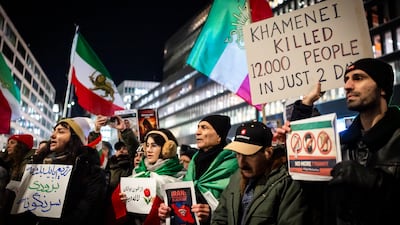
Protesters attend a rally in Zurich on January 13 in support of the nationwide mass demonstrations in Iran. EPA -

A screengrab shows body bags lying outside Kahrizak Forensic Medical Centre in Tehran, after deadly protests across Iran. Reuters -

Activists attend a rally in support of the protesters, in Los Angeles, California. AFP -

Protesters burn a picture of Iran's supreme leader Ayatollah Ali Khamenei outside Downing Street, in London. AFP -

Demonstrators gather in Paris to support the Iranian people amid the anti-government protests in Iran. AFP -
Smoke rises from a mosque as protesters gather amid evolving anti-government unrest in Tehran, Iran, on Friday. Reuters -
Protesters gather amid evolving anti-government unrest in Tehran, Tehran Province, Iran, on Friday. Reuters -
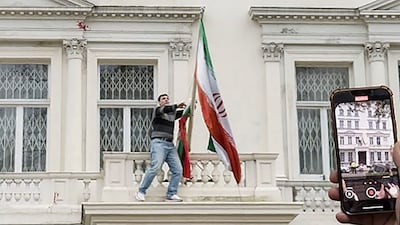
A protester pulls down the Iranian flag from the balcony of Iran's embassy in central London on Saturday. AFP -
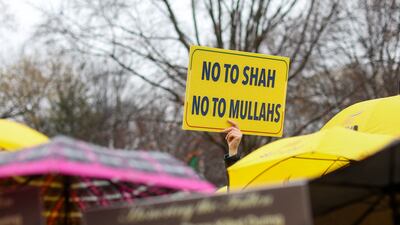
A person holds a placard, as demonstrators and activists rally in support of nationwide protests in Iran, outside the White House in Washington. Reuters -
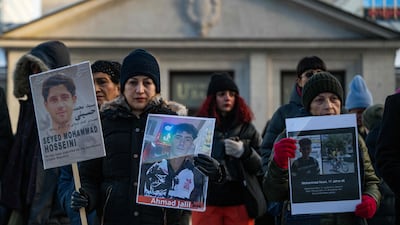
Protesters display placards featuring portraits of Iranians executed by the Iranian regime, during a rally in Berlin on Saturday. AFP -
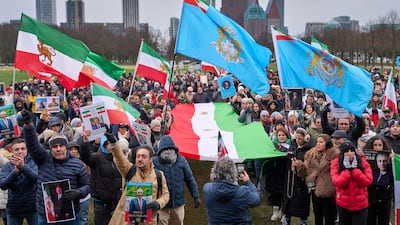
People protest in solidarity with demonstrations in Iran at Malieveld Square, Netherlands on Saturday. AFP


The protests caused by economic malaise have spiralled into a broad revolt against the clerical regime that has ruled Iran since 1979. Reza Pahlavi, the son of Iran's last shah who was ousted in the Islamic Revolution of 1979, has urged protesters to seize city centres. Activists say more than 500 people have been killed in the unrest. Official figures are almost impossible to come by.
Foreign Minister Abbas Araghchi said on Monday that the situation was "under total control" after violence had peaked at the weekend. State TV broadcast footage of pro-regime rallies from various cities, which it said were organised to promote “national unity” after recent “terrorist acts”.
Mr Araghchi said internet service would be resumed in co-ordination with security authorities. In the UAE, some Iranians have received messages from loved ones confirming they are safe but others have been unable to reach relatives throughout the shutdown.
“It’s as if they are in jail and are being killed inside and there is nothing we can do,” said one Iranian resident in Dubai. “We are crying, worrying and seeing videos of young people killed.
"Young people are our energy. I’m very sad, nervous, crazy with worry because when they [the regime] close the country, more people are killed.”

Iranians have been shaken after seeing videos online purporting to show bodies at the country's largest cemetery in Tehran, with weeping relatives trying to identify family members.
In London, police increased their presence outside the Iranian embassy after Iran's flag was taken down by a demonstrator who also waved a monarchist banner. A few protesters gathered again outside the building on Monday morning.
One Iranian in London, Fereshteh, told The National she was at the protest on Saturday when the “ugly flag, which is not our flag” was taken down. “I was happy, very happy, in fact very excited. We don’t recognise the current government, who are terrorists."
The ambassadors of Britain, Italy, Germany and France in Tehran were summoned to the foreign ministry to see footage of the violence, Iranian media reported, and asked to withdraw support for the protests.
Iran considers any political or media support for the protests "an unacceptable intervention in the internal security of the country", Tasnim news agency said. The European ambassadors "strongly expressed our concerns" during the meeting with Mr Araghchi, the French Foreign Ministry said.
Iranians also tried to stage a protest outside the country's consulate in Istanbul but Turkish authorities did not grant permission, said Ali, the Iranian living there. "It’s becoming really suffocating here. I don’t feel like I’m in my own country but at the same time it’s suffocating."

There are about 135,000 Iranians with legal residency permits in Turkey and many thousands more visit the country on tourist visas each year. Iranians are also among the foreign nationalities who buy most property in Turkey, alongside Russians, Ukrainians and Iraqis.
Iran has weathered past waves of protest by suppressing activists, at times causing international sanctions. But the country is still recovering from last year's war with Israel, and its regional influence has taken a blow from losses suffered by allies in Lebanon and Syria.
Reports say Mr Trump has been briefed on options for military intervention if Iran intensifies its clampdown. He said Iranian leaders "want to negotiate" due to being "tired of being beat up by the United States".
Ms Leavitt said Iran is sending messages to Washington that it is open to negotiations.
"What you're hearing publicly from the Iranian regime is quite different from the messages the administration is receiving privately, and I think the President has an interest in exploring those messages," she said "However, with that said, the President has shown he is unafraid to use military options if and when he deems necessary."
On Sunday, Iranian parliamentary Speaker Mohammad Bagher Ghalibaf said Iran would attack US bases in the Middle East in response to any strikes.
Gissou Nia, an Iranian-American human rights lawyer, said Iran's future "should not be the decision of the Trump administration" but instead "the decision of Iranians".
"What we're seeing is that Iran's people are brave. They've taken to the streets, and they're demanding a different future," she said. "And so what the international community needs to do is make sure that their wishes are respected."

