


Iran's authorities indicated they could intensify their crackdown on the largest demonstrations in years, with the Islamic Revolutionary Guard Corps blaming unrest on terrorists as activist groups warn of a rising protester death toll.
There were new reports of violence across Iran as protests continued on Saturday evening, although an internet blackout in place over the past days has made it difficult to assess the full extent of the unrest.
The death toll rose to 466 on Sunday, Reuters reported, citing The US-based Human Rights Activists News Agency. The group, which relies on an activist network in Iran, had reported 116 people killed on Saturday, including four medical personnel, one prosecutor and 37 members of the security forces. Oslo-based Hengaw Organisation for Human Rights said it had verified the identities of 50 people killed “by direct gunfire from the Iranian government”. It added that its team was working on verifying the death of 20 other people.

NetBlocks, which tracks internet access and digital rights around the world, on Sunday morning said Iran's internet blackout had passed the 60-hour mark. “The censorship measure presents a direct threat to the safety and well-being of Iranians at a key moment for the country's future,” it said on X.
After nightfall on Saturday, new videos posted online purported to show fresh protests in a number of neighbourhoods in the capital Tehran and several cities, including Rasht in the north, Tabriz in the north-west and Shiraz and Kerman in the south. The National could not immediately verify the latest videos.
State media said a municipal building was set on fire in Karaj, west of Tehran, and blamed “rioters”. State TV broadcast footage of funerals of members of the security forces it said were killed in protests in the cities of Shiraz, Qom and Hamedan.
Protests have spread across Iran since December 28, beginning in response to soaring inflation, and quickly turning political with protesters demanding an end to clerical rule. Authorities accuse the US and Israel of fomenting unrest.
The Iranian government on Sunday warned the US and Israel against any intervention over the protests.
US President Donald Trump has repeatedly warned the Iranian regime not to fire on demonstrators, including saying on Saturday that the US “stands ready to help!!!” The President has been briefed in recent days on new options for military strikes, The New York Times reported, quoting multiple US officials.
“In the event of a US military attack, both the occupied territories and US military and shipping centres will be legitimate targets for us,” the Iranian Parliament's Speaker Mohammad Bagher Ghalibaf said in remarks broadcast on state television.
He reiterated a warning that Iran could act preemptively against potential threats. “Within the framework of legitimate self-defence, we do not limit ourselves to responding only after an attack,” he said.
Israel's Prime Minister Benjamin Netanyahu said on Sunday his country was closely monitoring the protests.
"Israel is closely monitoring developments in Iran. The demonstrations for freedom have spread across the country. The people of Israel, and indeed the entire world, marvel at the immense bravery of the citizens of Iran," Mr Netanyahu said at the start of his cabinet meeting. "We all hope that the Persian nation will soon be freed from the yoke of tyranny."
In a statement broadcast by state TV, the IRGC – the paramilitary force which has suppressed previous bouts of unrest – accused “terrorists” of attacking military and law enforcement bases over the past two nights. It said several citizens and security personnel had been killed and public and private property set on fire.
Safeguarding the achievements of the Islamic revolution and maintaining security was a “red line”, it added.
-

Anti-government demonstrators and supporters of exiled Iranian crown prince Reza Pahlavi outside the Houses of Parliament in London. EPA -

Iranians during a protest in Tehran on January 9. AFP -
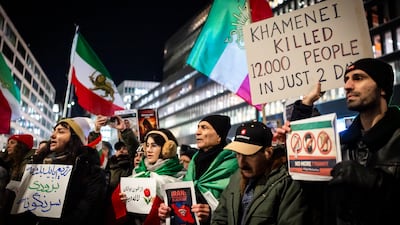
Protesters attend a rally in Zurich on January 13 in support of the nationwide mass demonstrations in Iran. EPA -

A screengrab shows body bags lying outside Kahrizak Forensic Medical Centre in Tehran, after deadly protests across Iran. Reuters -

Activists attend a rally in support of the protesters, in Los Angeles, California. AFP -

Protesters burn a picture of Iran's supreme leader Ayatollah Ali Khamenei outside Downing Street, in London. AFP -

Demonstrators gather in Paris to support the Iranian people amid the anti-government protests in Iran. AFP -
Smoke rises from a mosque as protesters gather amid evolving anti-government unrest in Tehran, Iran, on Friday. Reuters -
Protesters gather amid evolving anti-government unrest in Tehran, Tehran Province, Iran, on Friday. Reuters -
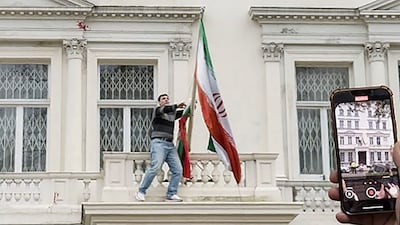
A protester pulls down the Iranian flag from the balcony of Iran's embassy in central London on Saturday. AFP -
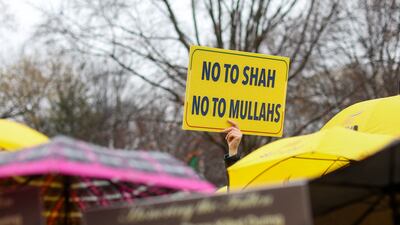
A person holds a placard, as demonstrators and activists rally in support of nationwide protests in Iran, outside the White House in Washington. Reuters -
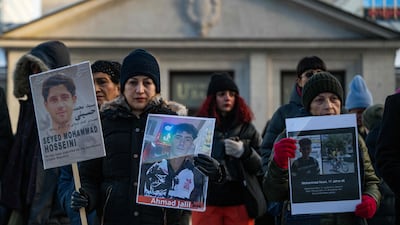
Protesters display placards featuring portraits of Iranians executed by the Iranian regime, during a rally in Berlin on Saturday. AFP -
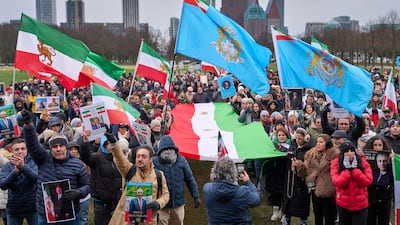
People protest in solidarity with demonstrations in Iran at Malieveld Square, Netherlands on Saturday. AFP
The regular military also issued a statement saying it would “protect and safeguard national interests, the country’s strategic infrastructure, and public property”.
The IRGC said it had arrested a foreign national who had entered Iran on behalf of the Mossad, Israeli intelligence, to “collect information and assess the situation”. Iran has cracked down on suspected spies since the 12-day war with Israel in June that also saw US strikes on key nuclear sites.
Tasnim also linked the protesters to Komala – an Iranian Kurdish opposition party that is based in Iraq's Kurdistan Region – claiming they had received weapons from them. Classified as a terrorist group by Iran, unrest is often linked by authorities to such parties. This often leads to a violent crackdown on protests in the Kurdish areas in the north-west of the country.
Iran's rulers have weathered repeated bouts of unrest, including student protests in 1999, over a disputed election in 2009, against economic hardships in 2019, and in 2022 over the death in custody of a woman accused of violating dress codes.
Since sending forces to seize the president of Venezuela – a Tehran ally – a week ago, Mr Trump has repeatedly warned the US would intervene if more protesters are killed in Iran.
On Sunday, the New York Times reported that Mr Trump had been briefed in recent days on new options for military strikes in Iran, citing multiple US officials.
In a phone call on Saturday, Israeli Prime Minister Benjamin Netanyahu and US Secretary of State Marco Rubio discussed the possibility of US intervention in Iran, Israeli media has been reporting.
Oman's Foreign Minister Badr Albusaidi was in Tehran on Saturday for meetings with the Iranian foreign minister. Muscat has played a key intermediary role between Washington and Tehran during negotiations and at times of defusing tension.

