


Iran hopes to rapidly rearm with advanced weaponry and is drawing up order lists of equipment that could only be transferred to Tehran's control in defiance of the UN's newly revived sanctions regime, a leading military expert has told The National.
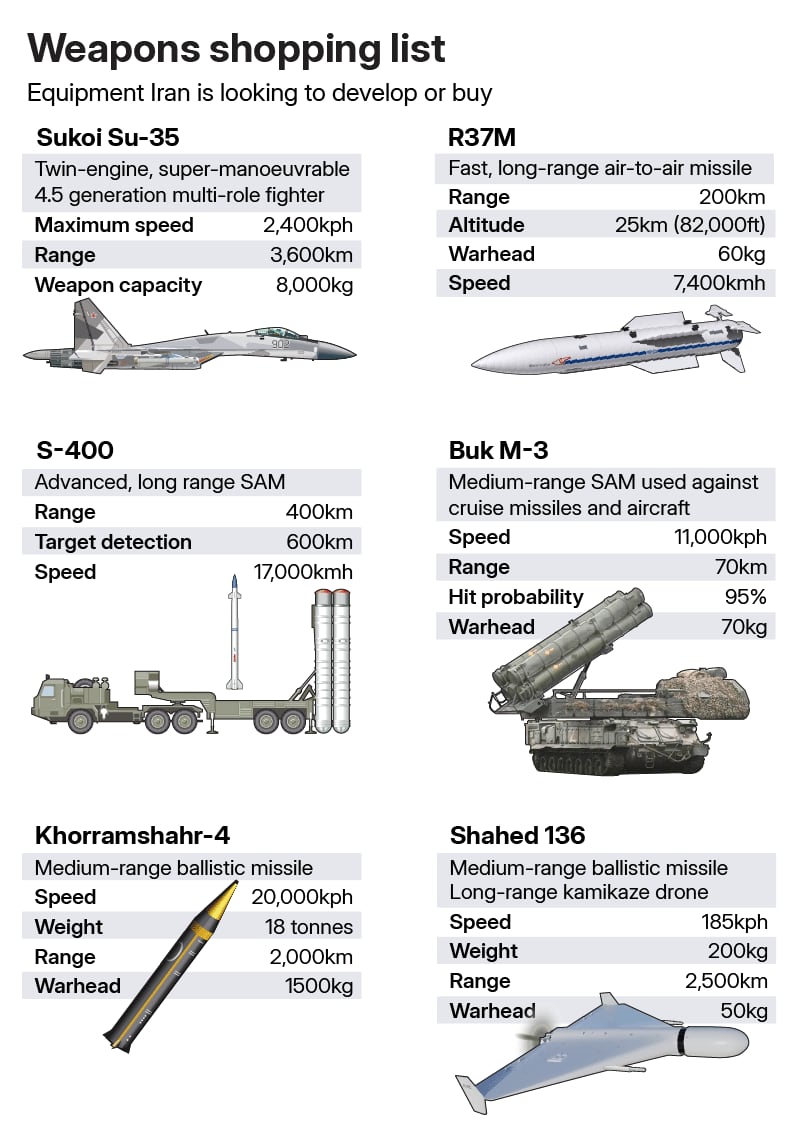
The Tehran regime would benefit from discussions with Moscow to purchase Su-35 advanced air superiority fighters and state-of-the-art air defence systems, as well as technology to significantly increase the accuracy of its ballistic missiles, said Dr Jack Watling, senior research fellow at the Royal United Services Institute think tank.
The unprecedented attacks launched by Israel during its 12-day war on Iran in June proved the regime’s air defences and conventional military were ineffective under fire. The devastation of its defence equipment begs the question how the country's leadership will respond to pressure from hardliners to robustly rearm.

More worryingly for the Gulf countries and Israel is the battle-tested nature of some of the systems it has in its sights after almost four years of the Ukraine war. Iran has supplied thousands of drones used to attack Kyiv.

Any deal on selling weapons to Iran would breach the UN arms embargo that was reinstated after Britain, Germany and France triggered the “snapback” sanctions at the end of September over Iran continuing its nuclear programme. The 2015 UN Security Council Resolution 2231 specifically bans the sale or transfer of fighter jets and air defence missiles under the sanctions regime.
Things changed the same year when the sanctions were put in abeyance. Sanctions lifted in the 2015 JCPOA nuclear agreement were reimposed this year when talks on the nuclear programme collapsed with the outbreak of war. European parties to the nuclear deal snapped back the sanctions, including the arms embargo and restrictions to Iran’s ballistic missile programme.
Russian and Chinese diplomats have disputed the legality of the snapback, creating questions over whether the sanctions will hold global force.
‘4.5 gen’ fighter
If they do not hold, then foremost among Iran’s plans will be to buy the “4.5 generation” Sukhoi Su-35 warplanes that have similar capabilities to the Eurofighter Typhoon and French-made Rafale.
Watching to see if Iran embarks on discussions with Russia has become a priority for the intelligence community. It is thought “those talks are now being pushed with more vigour” within Iran, said Dr Watling, a British military historian.
The Su-35 has “a mature and effective” radar system which means that it can detect and track objects and manage multiple engagements.
Equipped with the R37M air-to-air missile, it will significantly threaten Israeli aircraft at distance. Russia’s air force used the missile to shoot down a Ukraine warplane from 177km.

Israeli drones, which caused significant damage in Operation Rising Lion in June as they roamed the skies unchallenged, “would be very, very easy to knock out for Su-35s”.
But a greater threat to the Israeli air force will be the fighters getting airborne in eastern Iran with the ability to track aircraft and engage them at a safe distance. They will also pose a threat to Israel’s air-to-air tankers which in June flew close to Iranian airspace to enable their jets to refuel, allowing longer sorties.
The Su-35 would “add a layer to the Iranian air defence picture which is actually very significant”, Dr Watling said.
But having not had a modern air force for decades, it will take Iran at least two years to train the pilots – who will probably do a lot of their schooling in Russia – and around six years to become a serious threat in the region.

Generational shift
Iran could become a significant beneficiary of the Ukraine war in several ways, especially if a peace deal is achieved.
Russia’s defence industry has been ramping up production of surface-to-air missiles (SAMs) and will be left with an excess if the conflict ends, as US President Donald Trump hopes with the 19-point peace plan that envoys are aiming to finalise. .
“They're going to have a glut of production versus their domestic requirements,” said Dr Watling. “The Russians will want to export because their businesses will want to recover their investments.”
But more beneficial for Iran’s forces are the improvements Russia has made because of the war.
“Russian air defence has now been tested against a lot of western systems and so the software and the radar performance has improved significantly, such that the Russians are achieving a high intercept rate against ATACMS [army tactical missile systems], GMLRS [guided multiple launch rocket systems] and HARM anti-radiation missiles,” said Dr Watling, who travels to Ukraine every other month.

“So these are much more capable because they have actually now been field-tested against western capabilities.”
But a “generational shift in capability” would be achieved for Tehran if the Kremlin allowed its highly advanced S400 SAM systems to be transferred. The S400, which travels at 17,000kph at distances of up to 600km, would threaten Israeli tankers as well as its warplanes, with the possible exception of the stealthy F-35s.
But they are also not cheap, with export costs for a battery plus reserve missiles put at $1 billion. The Iranians might still look to buy the similar Chinese-made HQ9 system.
Its defences could also benefit from other less expensive battle-tested systems such as the shorter-range Buk-M3 whose missiles travel at 5,600kph and are able to detect targets 140km away.
However, Dr Watling argued that given the possibility of a conflict with Nato, Russia would see the S400s as “absolutely critical” but may be persuaded that exporting them could continue the “good relationship with the Iranians”.

Missile tech danger
Israel’s biggest concern remains Iran’s indigenous capabilities, especially its arsenal of ballistic missiles. With sufficient stocks the Iranian projectiles could potentially overwhelm its Iron Dome and other air defences.
While the Israeli air force destroyed numerous missile systems in the summer, Iran fired more than 550 ballistic missiles and 1,000 Shahed kamikaze drones in June, hitting cities, a hospital and 12 military bases, killing 28 civilians and injuring 3,600.
Many of the weapons were shot down or failed to reach their targets. However Russia has also learnt from Ukraine how to evade the US-supplied Patriot aid defence missiles with different attack profiles and penetration aids. It is understood that Patriot’s success rate has dropped from about 70 per cent to below 20 per cent in some instances.
“There are technologies that the Russians could transfer that would make a very significant difference, both in terms of the Iranian missiles ability to evade capabilities like Patriot and accuracy,” Dr Watling said.
Western countries are waiting to see if there is an increased level of collaboration between the Russians and the Iranians on production and design for such missiles as the Khorramshahr, which has a nuclear potential, or the hypersonic Fattah-1.
“There could be an improvement in Iranian capability that the Russians provide. We just haven't seen it yet,” he added.

Drones in thousands
When Russia was struggling to make headway during the Ukraine war in late 2022 it went to Iran for assistance and was provided with 6,000 Shahed-136 one-way attack drones costing $193,000 each.
But more importantly, Tehran also conducted a large-scale transfer of the technology, allowing the Kremlin to build a factory that is producing 5,000 a month. This gives it the ability to devastate Ukraine’s power infrastructure.
Again, the Russians have learnt through experience how to plan missions and routes to the greatest effect while producing drones in huge numbers.
“If we start seeing Russian industrial practices proliferate into Iran, and co-operation on things like guidance units, then it would be an indicator that there is going to be an improvement in Iranian UAV (unmanned aerial vehicle) performance,” Dr Watling said.
Before Israel’s operations in southern Lebanon, it had always been assumed that Hezbollah’s huge stockpile of missiles – estimated at 150,000 – would deter such an assault.
That was not the case, but Iran could now also adopt new tactics for the extremist group or provide it with better technology that it might get from Russia.
Ultimately, Iran, which has not agreed to stop its nuclear programme, could well use the coming years to rearm and become a significant regional threat, the military expert said.

