
Pope Leo XIV began his visit to Turkey on Thursday, calling for an embrace of social and religious diversity in a speech warning of the dangers of polarisation and wars fuelled by global economic and military competition.
In his first speech overseas since becoming pontiff, Pope Leo warned that societies were being “polarised and torn apart” by extreme positions.
“A society is alive if it has a plurality, for what makes it a civil society are the bridges that link its people together,” he said in an address at Turkey’s national library in Ankara. The Turkish capital was his first stop on a six-day trip during which he will also visit Lebanon.

“Justice and mercy challenge the mentality of ‘might is right’, and dare to ask that compassion and solidarity be considered as the authentic criteria for development,” he added.
In the audience was Turkish President Recep Tayyip Erdogan, who earlier on Thursday held private talks with the pontiff at the presidential palace. Mr Erdogan praised his guest for his stance on the Palestine-Israel conflict. Pope Leo has repeatedly called for peace.
-

Pope Leo XIV arrives at Ankara Esenboga Airport in Turkey on November 27, marking his first official overseas trip. Reuters -
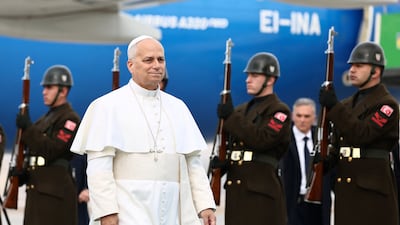
A welcome ceremony is held for the pontiff. Reuters -
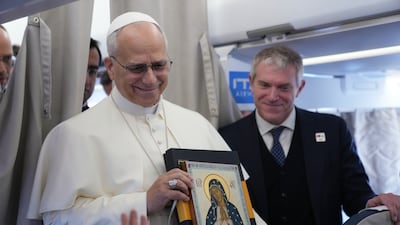
The Pope, seen here greeting reporters aboard the flight, is scheduled for a six-day trip to Turkey and Lebanon. AP -

The Pope lays a wreath during a visit to the mausoleum of modern Turkey's founder Mustafa Kemal Ataturk in Ankara. Getty Images -
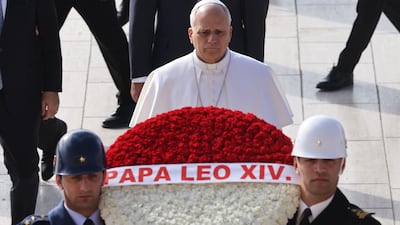
He is scheduled to meet people from local Catholic communities, as well as political and religious leaders. Getty Images -

The Pope is in Turkey until November 30. Reuters -
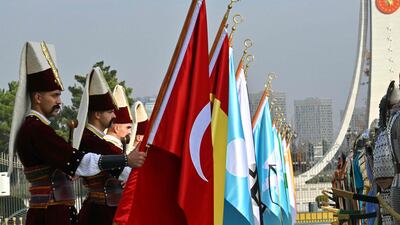
Guards of honour at the presidential palace before the Pope's meeting with Turkey's President Recep Tayyip Erdogan. AFP -
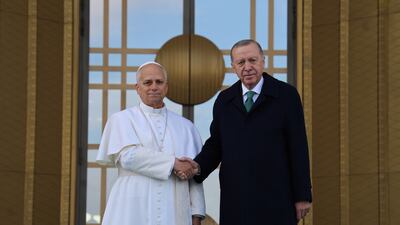
The Pope with Mr Erdogan. EPA -
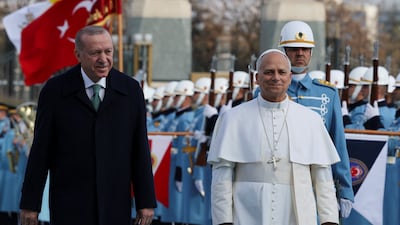
The two men review the guard of honour within the palace complex at Ataturk Forest Farm. Reuters -
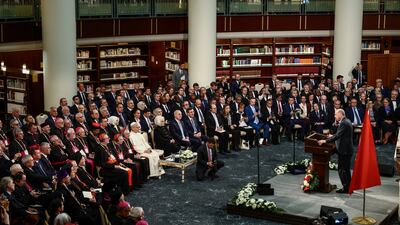
Mr Erdogan addresses the pontiff, diplomats and members of civil society at Nation's Library of the Presidency, in Ankara. Reuters -

The pontiff visited the library on the first day of his trip to Turkey. Reuters -

The Pope meets Turkey's President of Religious Affairs, Safi Arpagus, in Ankara. EPA -
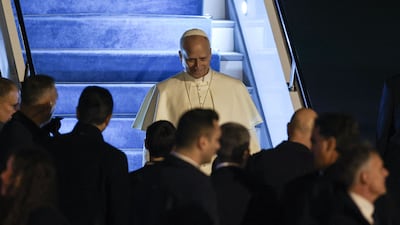
The Pope in Istanbul, his next stop in Turkey. AFP -
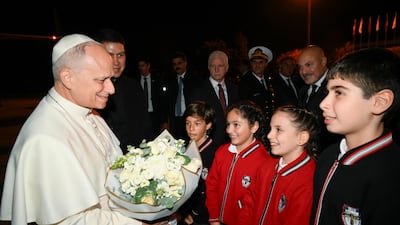
The Pope is greeted at Istanbul Ataturk Airport. EPA


The Pope did not reference any specific modern conflicts, but referred to his predecessor Pope Francis's warning of a “third world war fought piecemeal” as a result of “prevailing strategies of economic and military power”. “We must in no way give in to this,” he said.
Mr Erdogan, who spoke before the Pope, made more specific criticisms of Israel’s conduct in Gaza as he called for a strengthening of the fragile ceasefire in the strip. He offered the Pope condolences for Israel’s bombing in July this year of Gaza’s only Catholic Church, which killed at least three people. Israel later said it regretted the strike.
Mr Erdogan used his speech to reiterate his calls for a two-state solution in Israel and Palestine and unhindered humanitarian aid deliveries to Gaza. “As a family of humanity, our biggest responsibility towards Palestine is to ensure justice,” Mr Erdogan said.
The status of Jerusalem, which is holy to Muslims, Jews and Christians, also needs to be protected by way of joint efforts, the Turkish leader added. Christian and Muslim communities have been driven out of some areas of the holy city by the policies of Israeli Prime Minister Benjamin Netanyahu’s government, which sees the undivided city as the Israeli capital. Palestinians hope that its eastern sections will one day be the capital of a Palestinian state.

“I believe that we are going to continue to work together in order to stop any aggression towards Al Quds,” Mr Erdogan said, using the Turkish and Arabic name for Jerusalem.
On Syria, Mr Erdogan said he appreciated the Vatican’s support for the country, where Ankara’s influence has soared following the fall of Bashar Al Assad’s regime last December. Following a fatal suicide bombing at a church in Damascus in June, Pope Leo condemned what he called a “cowardly terrorist attack” and said the international community must continue to show it solidarity.
Mr Erdogan, who in recent years has attempted to boost Turkey’s reputation as a mediator and peace-broker, showed a willingness to work together with other faith groups towards common goals. "Our common and similar ideas are more important than our differences, whichever faith we believe in, we are all part of the family of humanity," he said.

Turkey is secular in its constitution, and conversion between religions is legal. But some Christian communities report prejudices against them by some of the Muslim majority, and the Catholic Church has no formal legal status in the country. Less than 0.5% of Turkey’s 86 million population is Christian.
Mr Erdogan described the country as a place where people of all religions are free to practise their faith. “This is a country where different civilisations and people live side by side and in peace,” Mr Erdogan said.
As well as calling for it to embrace global diversity, Pope Leo called on Turkey to strengthen its internal support for differences, especially between Muslims and Christians. “I willingly assure you that Christians desire to contribute positively to the unity of your country,” the pontiff said.
Pope Leo is currently on a four-day visit to Turkey, where he will visit churches and the Ottoman-era Sultan Ahmed Mosque, and hold meetings with Christian and Muslim leaders. He will also lead prayers at an ancient site in the town of Iznik, where in the year 325 bishops gathered and set out a creed that is still used in weekly masses by most Christians. The Pope will then travel on to Lebanon.

