

Thousands of displaced Gazans living in tents and makeshift shelters are facing flooding as heavy winter rain falls on the enclave.
The majority of homes in the Gaza Strip that the Israeli bombings have destroyed have not been rebuilt, leaving Gazans to suffer the harsh winter in tents.
Hundreds are requesting help, but the "resources are non-existent", Mahmoud Basal, the spokesman for Gaza Civil Defence, told journalists,
"The levels of water have risen to more than 10 centimetres in shelter centres, mattresses are soaked, blankets are drenched, and there are no options left – because every option has been destroyed by Israel.”

The Gaza government media office estimates that 93 per cent of all displacement tents are no longer suitable for shelter- that is 125,000 out of a total of 135,000.
On Saturday the Palestinian Authority appealed to the international community to put pressure on Israel to allow the urgent entry of and tents and supplies into Gaza.
Hisham Washah, a displaced Gazan, told The National that 30 minutes of rain managed to destroy his place of shelter.
"You can only imagine how much worse it would be if it rained for four hours. We were submerged in water after half an hour," he said.
"Look at how wet and dirty everything is."
A displaced Gazan woman began to cry as she described her situation. "Everything is flooded, we have nothing," she said in a video distributed by Palestinian news agency Wafa. "Everything is soaked, where shall we go?"
Displaced Gazans struggle in flooded camps - in pictures
-

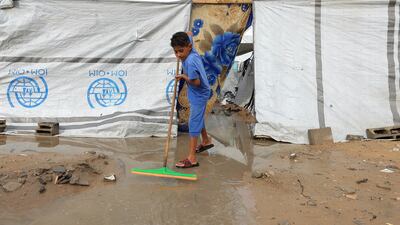
Displaced Palestinian children play in a puddle near their tents on a rainy day at a makeshift camp west of Gaza city. EPA -
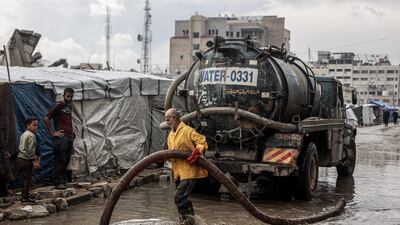
Stagnant water is cleared from the road near a displacement camp after this year's first winter rainfall in Gaza city. AFP -
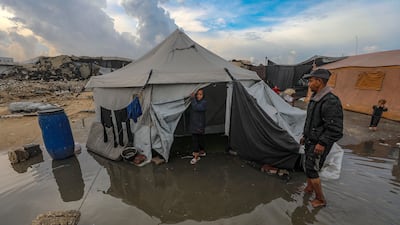
About 1. 9 million people in Gaza, nearly 90 per cent of the population, have been displaced at least once – but some many times – since the outbreak of the Israel-Hamas war October 2023, the UN says. EPA -
Water has swamped this camp in Gaza city, which is overcrowded with people who have fled the fighting or been forcibly evicted from their homes. Reuters -
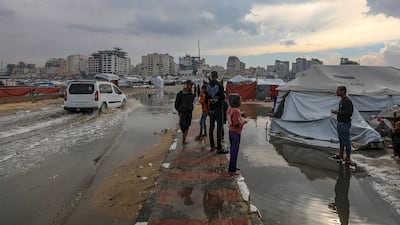
Tents housing Gazans who have already been forced to move several times have been washed away, with the worst-affected areas being Deir Al Balah, Khan Younis and Al Mawasi camp. EPA -
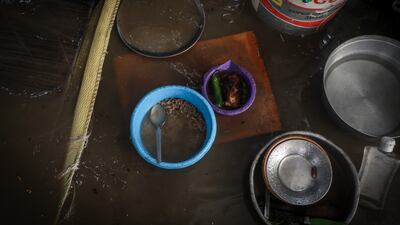
The bad weather has made life even more difficult for Palestinians who have endured a torrid two years. Getty Images -
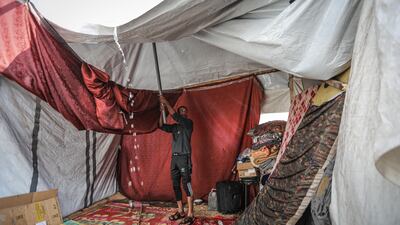
Makeshift tents offer little protection from heavy rain. Getty Images -
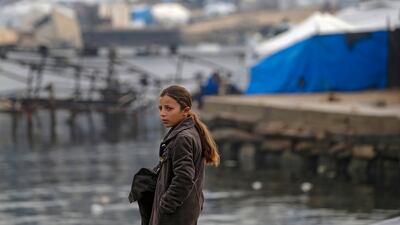
Meanwhile, strong winds have blown away some tents. But some families don't even have shelter, as there are not enough tarps and tents available to respond to the rising needs of displaced families. EPA


Fully exposed
The UN Secretary-General’s spokesman, Stephane Dujarric, said that hundreds of tents and makeshift shelters were flooded.
“We fear that thousands of displaced families are now left fully exposed to the harsh weather elements,” he told reporters.
The UN partners that are working on the shelter sector have reported that Gaza does not have the equipment needed to prevent flooding, Mr Dujarric said.
He added that tools to drain away water from tents and remove waste and rubble are not available in Gaza.
The UN has reported that nearly 1,000 tents were distributed to families in Deir Al Balah and Khan Younis on Thursday. Between Sunday and Wednesday, UN partners provided about 7,000 blankets to more than 1,800 households, along with some 15,000 tarpaulins to more than 3,700 households and winter clothing.
Mr Dujarric also said that millions of shelter relief items are stuck in Jordan, Egypt and Israel, awaiting approval to enter Gaza.
“Dire living conditions are also increasing people’s exposure to explosive ordnance, with children among those most at risk. Some people have been injured while collecting firewood; others are having to pitch tents near areas suspected of containing unexploded remnants simply because they have no safer options.”
Mr Dujarric called for the opening of existing and additional crossings, clearance of essential aid and equipment for entry, and access for all aid items from the UN and other aid groups.

