

Iran's President Masoud Pezeshkian held four hours of talks with Russian President Vladimir Putin in Beijing, state media quoted him as saying after his return from the Chinese capital on Wednesday.
The Iranian leader was one of 26 heads of state attending a once-a-decade event showcasing China’s increasing firepower and diplomatic clout alongside its closest international allies.
“We made very important, strategic and vital decisions in meetings with the presidents of Russia, China and Turkey. We will confront unilateralism with strength,” the Tasnim news agency quoted him as saying.

Mr Pezeshkian earlier criticised the UN's nuclear agency and accused western powers of “double standards” as he joined the leaders of China, Russia and North Korea for the military parade in Beijing.
He told Chinese state broadcaster CCTV he backed Beijing's drive to reform systems of global governance, which he said should take a multilateral and “justice-oriented” approach.
He said “double standards” currently allow Israel and its allies to disregard international legal frameworks while claiming to defend human rights, according to an account of the interview posted on the President's official website.
In a meeting with Iranian expats in China, Mr Pezeshkian added: “If Israel is rampaging today, it is because of the technologies provided to it by the United States and its other allies.”
He expressed “dissatisfaction” with the conduct of the International Atomic Energy Agency but said Iran was still ready to engage with international frameworks.
Without naming countries, he criticised the “double standards applied by proponents of unilateralism, particularly those who have violated the Joint Comprehensive Plan of Action”, a deal signed in 2015 to regulate Iran's nuclear energy programme.
“The same countries that violated the JCPOA are now claiming that Iran is not fulfilling its commitments,” the President said.
Iran has long been at odds with the West over its nuclear programme, with a number of countries suspecting it of trying to build a bomb. Tehran says its atomic programme is for civilian purposes only.
Tehran signed the nuclear deal with the US, Britain, France, Germany, China and Russia a decade ago, only for Washington to withdraw three years later under President Donald Trump. The agreement placed limits on the nuclear programme in return for the lifting of international sanctions on Iran.
The IAEA was charged with monitoring Tehran's nuclear sites, but in 2022 Iran removed most of its monitoring equipment, including cameras. A year later, Tehran barred some of the watchdog's most experienced inspectors.
-
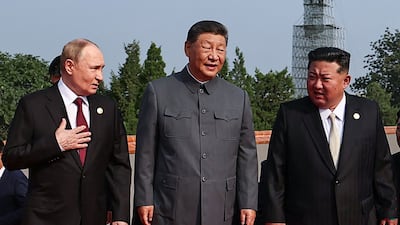
China's President Xi Jinping with Russia's President Vladimir Putin and North Korea's leader Kim Jong-un before a military parade in Beijing’s Tiananmen Square marking the 80th anniversary of victory over Japan and the end of the Second World War. AFP -

Balloons are released over in Beijing’s Tiananmen Square at the end of a military parade marking the 80th anniversary of victory over Japan and the end of the Second World War. AFP -
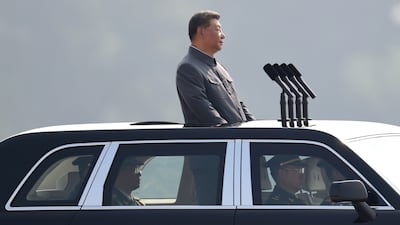
China’s President Xi Jinping attends a military parade in Tiananmen Square, Beijing, marking the 80th anniversary of victory over Japan and the end of the Second World War. Getty Images -
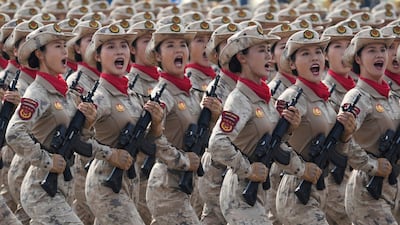
Chinese military personnel at Tiananmen Gate in Beijing take part in a parade to commemorate the 80th anniversary of Japan's Second World War surrender. AP -
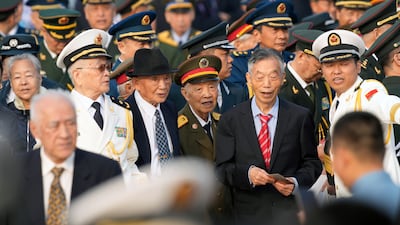
Chinese military veterans arrive at Tiananmen Square in Beijing for a parade to mark 80 years since Japan's defeat in the Second World War. Bloomberg -
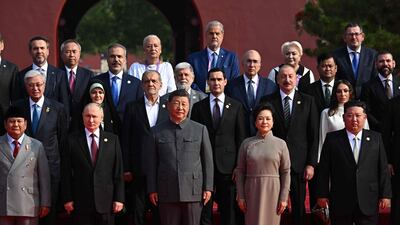
China's President Xi Jinping, his wife Peng Liyuan and dignitaries including Russia's President Vladimir Putin and North Korea's leader Kim Jong-un before a military parade in Beijing’s Tiananmen Square marking the 80th anniversary of victory over Japan and the end of the Second World War. AFP -
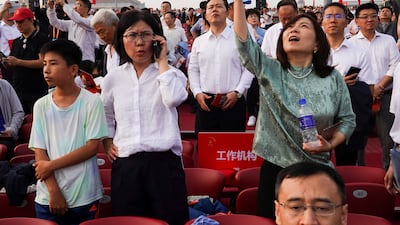
Visitors to Beijing wait for the beginning of a military parade to mark the 80th anniversary of the end of the Second World War. Reuters -

Soldiers rehearse for a military parade in Beijing to mark the 80th anniversary of the end of the Second World War. Reuters -
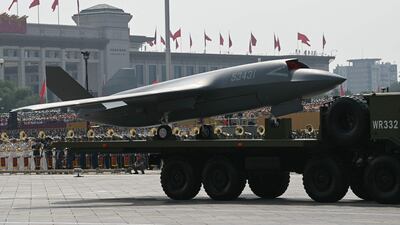
A drone is part of the convoy during a military parade marking the 80th anniversary of victory over Japan and the end of the Second World War in Beijing. AFP -

Chinese soldiers during a military parade in Beijing to mark the 80th anniversary of victory over Japan and the end of the Second World War. AFP -
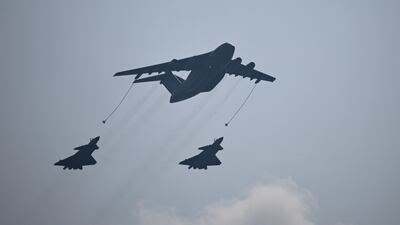
Two Mighty Dragon J-20 stealth fighters and a tanker plane of the People's Liberation Army Air Force fly over the military parade in Beijing marking the 80th anniversary of the end of the Sino-Japanese War. EPA


Last week Britain, France and Germany launched a 30-day process known as the “snapback mechanism” to reimpose UN sanctions, saying Tehran had not stuck to the terms of the deal.
Iran argues it has the right to abandon the deal’s limits because Washington withdrew. It also contends there is no legal basis for the Europeans to reimpose UN sanctions, claiming the countries failed to uphold the accord after the US exit.
Talks between the US and Iran took place this year but were halted abruptly when Israel launched air strikes on Iranian nuclear sites and military targets in a 12-day war. Washington later launched aerial bombardments of its own on the nuclear facilities.
Iran has refused to grant IAEA inspectors access to its nuclear sites since the attacks, which were launched a day after the watchdog passed a resolution accusing Tehran of being in non-compliance with its obligations under the Nuclear Non-Proliferation Treaty. Iranian and IAEA officials have been holding talks about resuming inspections, but without results.
IAEA director general Rafael Grossi confirmed on Wednesday that the agency had no idea what had happened to Iran's stockpile of highly enriched uranium after the attacks.
“I believe there is a general understanding that by and large, the material is still there. But, of course, it needs to be verified. Some could have been lost,” Mr Grossi told Reuters.
The IAEA reported in May that Iran had stockpiled more than 400kg of uranium enriched to 60 per cent purity – a short technical step from the 90 per cent needed for nuclear weapons.
Iran's security chief Ali Larijani on Tuesday said Iran was still open to nuclear talks with the US but ruled out suggestions by Washington that Tehran would have to accept restrictions on its development of missiles.

“The path for negotiations with the US is not closed, yet these are the Americans who only pay lip-service to talks and do not come to the table, and they wrongly blame Iran for it,” said Mr Larijani, secretary of Iran's Supreme National Security Council.
“By raising unrealisable issues such as missile restrictions, they set a path which negates any talks.”
Mr Pezeshkian was in Beijing alongside Russia’s President Vladimir Putin and North Korea’s Kim Jong-un, as well as a host of other leaders from countries that are being encouraged to co-ordinate in challenging the US-led global order.
Others attending the lavish military parade included leaders from Vietnam, Malaysia, Pakistan, Belarus, Indonesia, Serbia and Slovakia.

Formations of goose-stepping soldiers marched in unison through Beijing's vast Tiananmen Square as tanks and missile launchers rumbled past. China also showcased its latest anti-ship missiles, combat drones and nuclear-capable ballistic missiles.
Helicopters trailing large banners and fighter jets flew in formation during the 70-minute event, which was rich in Chinese symbolism and culminated in the release of 80,000 peace doves and colourful balloons.
Mr Trump sent a pointed message on his Truth Social platform, accusing the leaders of China, Russia and North Korea of working against the US.
“Please give my warmest regards to Vladimir Putin and Kim Jong-un, as you conspire against the United States of America,” he said, without elaborating.

