
Mosul has reclaimed its spirit with the completion of a UAE-led project that restored historic landmarks and erased some of the last remnants of ISIS destruction.
The seven-year project in the 2,500-year-old Iraqi city involved the reconstruction of Al Nuri Mosque and its leaning minaret, along with the churches of Our Lady of the Hour Convent and Al Tahera.
The completion was announced in a ceremony in the centuries-old mosque on Monday, attended by Iraqi Prime Minister Mohammed Shia Al Sudani, the UAE's Minister of Culture Sheikh Salem bin Khalid Al Qassimi and Minister of State at the Ministry of Foreign Affairs Noura Al Kaabi, as well as Unesco representatives and UN special envoy Mohamed Al Hassan.

In the evening, the mosque finally reopened it doors for worshippers.
The UAE funded Unesco in a $50.4 million initiative driven by its Ministry of Culture, part of a total of $115 million mobilised for the project.
Sheikh Salem told The National: "I feel extremely proud. We wanted to make sure that the coexistence and brotherhood feeling ... continue to exist throughout the years. We are looking at those incredible sites and seeing what else we can contribute."
Standing in front of the minaret, Ms Al Kaabi said the project has risen in a way that brings "joy to us all", adding that Mosul's heart "is beating once again".
"Today I see it rising again, stronger than before, a witness to the rebirth of the spirit of cities," added the Emirati minister. "Our message is clear: reviving heritage is reviving confidence in the future."
Watch: UAE-led project brings Mosul’s landmarks back to life
ISIS fighters shell-shocked Iraq and the world when they seized Mosul in June 2014 after a brief battle with the army, turning the ancient labyrinth of alleyways into a launchpad for a brutal regional campaign.
It was from the same mosque that ISIS’s former leader, Abu Bakr Al Baghdadi, declared a “caliphate” in July that year. His video, climbing the stairs to deliver his first sermon, is etched into the collective memory of Iraqis and the world.
The leaning minaret, which had stood over Mosul’s Old City for nearly 850 years before ISIS destroyed it, has risen once again as a guardian of history. A few metres away, the bells of Our Lady of the Hour Convent and Al Tahera churches rang again.

Bridge of cultures
Their restoration represents more than the revival of stone: it is the revival of hope, sending a powerful message of coexistence.
In April 2018, less than a year after the Iraqi army reclaimed Mosul following a brutal battle that destroyed nearly 80 per cent of the city, Ms Al Kaabi launched the project from Baghdad. Seven years later, she walked into Mosul, announcing its completion.
"Completing this project is a testament to the resilience of Iraqis in the face of terror, said Mr Al Sudani. “I want to thank everyone who worked to revive this rich legacy, and especially the UAE and Unesco.”
For centuries, Mosul has lived up to its Arabic name, which translates as “Linking Point”, a bridge between regions and cultures. The city became a crucible of Iraq’s diverse identity, marked by the coexistence of its ethnic, linguistic and religious groups.
When ISIS controlled the country's second-largest city, Christians were driven from their homes. Most who could not escape were killed. Churches and Christian heritage sites were either demolished or vandalised.

From the ashes of war
From the outset, the project faced major challenges. Thousands of tonnes of rubble had to be carefully removed and sifted for salvageable pieces. Workers also had to remove dangerous ordnance, including an unexploded bomb found beneath the mosque’s dome.
Al Nuri Mosque is named after the Seljuk ruler Nureddin Al Zinki, who ordered its construction in 1172. Its mihrab, a niche indicating the direction of Makkah, has been largely repaired with original stones. The minbar, from which sermons are delivered, had to be mostly rebuilt with new materials.
Before its destruction, Al Hadba minaret had a 40-metre rounded shaft, with an internal double helicoidal staircase and decorative brick panels. Originally built straight, it began to tilt over the centuries.
A central part of the plan was to create job opportunities for local people and attract foreign talent, aiming to put Mosul back on the path to regaining its reputation as a hub of connection.
An Iraqi-led panel of experts selected the winning design from 123 anonymous entries. The final design was created by a team of eight Egyptian architects.
The battle for the city, in its alleys and centuries-old streets, was among the most brutal in Iraq’s recent history. It marked the beginning of the end for ISIS after the extremists had seized about 30 per cent of Iraq and threatened Baghdad itself.
Other remnants of destruction are still visible in Mosul, particularly in the old neighbourhood, where ruined homes and piles of rubble bear witness to the fierce battles.
Al Nuri Mosque in Mosul from destruction to reconstruction - in pictures
-
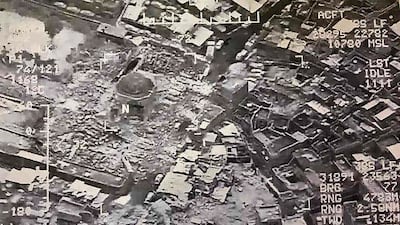
Al Nuri Mosque compound in Mosul. ISIS terrorists blew up the mosque and its iconic leaning minaret after their leader Abu Bakr Al Baghdadi declared a ‘caliphate’. All photos: AFP -
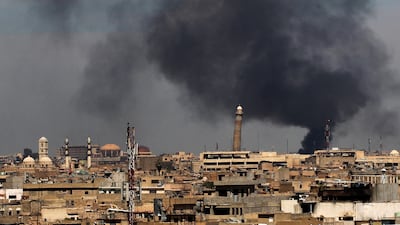
Smoke billows from behind the Great Mosque of Al Nuri in Mosul's Old City during an offensive by Iraqi security forces to recapture the city from ISIS in 2017 -
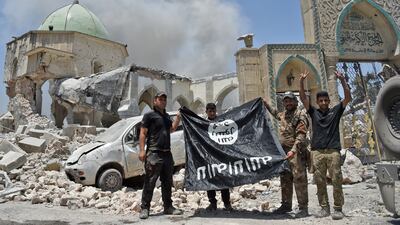
Members of the Iraqi Counter-Terrorism Service (CTS) with an ISIS flag held upside-down, after the terrorists were rooted out of Mosul -
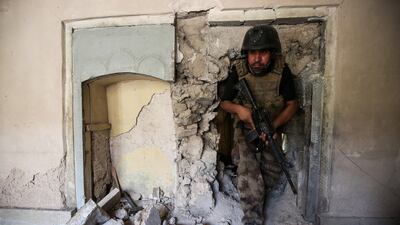
A counter-terrorism troop takes part in the advance towards the Grand Mosque, on the way to ISIS being overthrown in Mosul -
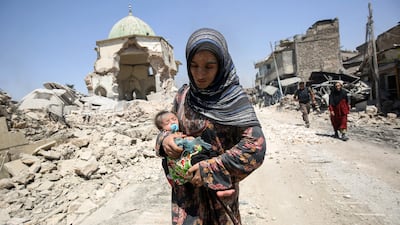
The destroyed Al Nuri Mosque became symbolic of the rise of ISIS in Iraq -
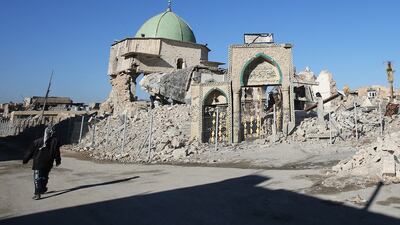
The mosque in January 2018, six months after Iraqi forces seized the country's second city from ISIS -
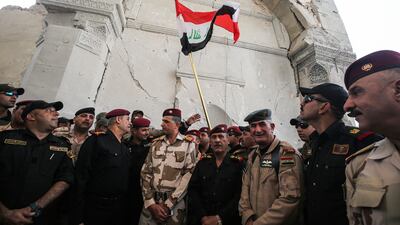
The Iraqi Army gather for a group photo with the national flag raised at the site of Al Nuri Mosque in July 2017, during the offensive to retake the city -
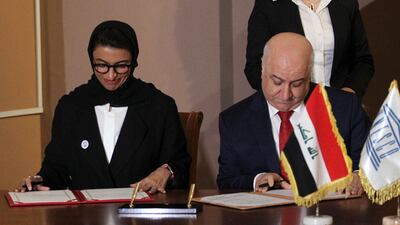
Noura Al Kaabi, UAE Minister of Culture and Knowledge Development at the time, and Iraqi Minister of Culture Firiyad Rawanduzi sign an agreement on the reconstruction of Al Nuri Mosque, at the Iraqi National Museum in Baghdad on April 23, 2018 -
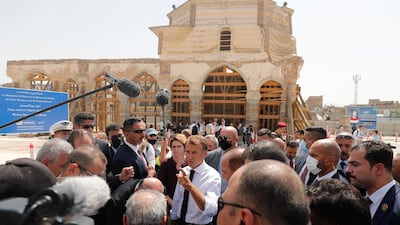
French President Emmanuel Macron tours Al Nuri Mosque in August 2021 -
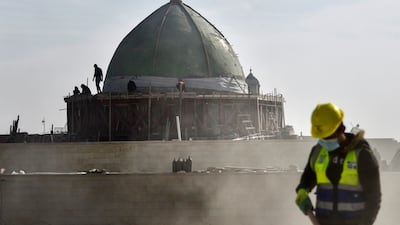
Builders work on the reconstruction of the historic mosque after its destruction at the hands of ISIS -
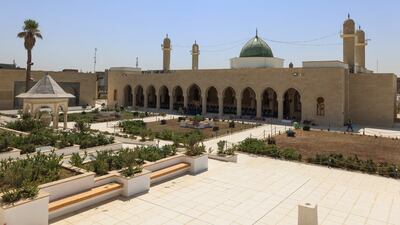
All's well that ends well, as the reconstructed Al Nuri Mosque dominates the Mosul skyline once again, ahead of a celebratory inauguration of restored heritage monuments in the city


From the ashes of that devastating war, Moslawis now have hope for a better future. The reconstruction project has shown that international co-operation is possible and can breathe life back into their ravaged city.
"By leading this project, what you did was not only reconstructing bricks, you revived our souls," Nineveh province governor Abdul Qadir Al Dakhil told Emirati officials during the ceremony.

