The role of journalists in Gaza in wartime has always been to document the suffering of civilians and share it with the world. But since the current war began in October 2023, journalists have become targets themselves, not only of Israeli air strikes and incitement, but also of fear from the very people they aim to serve.
“People became worried about journalists from the first months of the war,” Abdallah Miqdad, 41, a correspondent for Al Arabi TV, told The National.
“Especially after targeting journalists, and even more so after the family of [Al Jazeera correspondent] Wael Al Dahdouh was killed. People began to believe that a journalist could be targeted at any time,” he said.
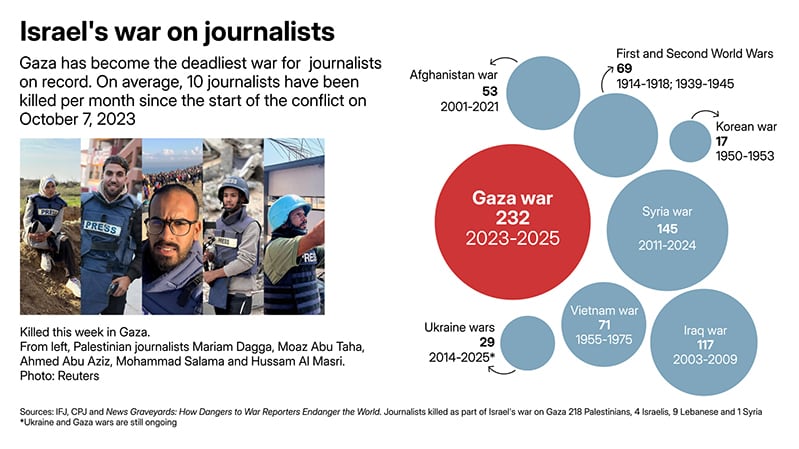
With foreign media barred from entering Gaza, local journalists are the main source of information on the deaths, destruction and displacement suffered by civilians in Israel's relentless targeting of homes, hospitals and schools to destroy the militant group Hamas. But with more than 230 killed so far – making this conflict one of the most lethal for journalists in modern history – ordinary Gazans now fear being in their presence.
In the most recent attack, five journalists were killed in an air strike on the Nasser Hospital in southern Gaza on August 25. The attack, which claimed 17 other lives, came two weeks after an Israeli air strike killed Al Jazeera reporter Anas Al Sharif and five other journalists in a tent near Al Shifa Hospital in Gaza city.
Miqdad said his flak jacket with the word "Press", once a symbol of credibility, has turned into a warning sign. “When people see me wearing it, they become afraid and uncomfortable dealing with me. Some are positive, but most are worried.”
That fear has had devastating personal consequences. After losing his home in the first days of the war, Miqdad tried to visit his displaced family members. But his family's hosts repeatedly refused him entry, fearing his presence might endanger them.
“Even when I tried to rent an office in Deir Al Balah, the owner stopped the deal when he found out we were journalists,” he recalled.
Abu Ahmad Mustafa, who lives in Gaza city and owns several apartments, said he refused to let them out to journalists because it worried the other tenants.
“I understand the role of journalists and how they put themselves at risk to show the world what is happening in Gaza. But the other residents in the building are afraid. They told me they would not stay if I rented to a journalist or others who have political affiliations,” Mr Mustafa told The National.
“Actually, because of our situation in Gaza, you have to be very careful about who you rent to in your neighbourhood. Before this war, people only worried about whether new tenants were connected to any political factions, since the Israeli army targeted apartments without regard for who was inside. Recently, however, people have also started to worry about journalists, because of the many incidents we’ve heard about where they were targeted.”
Anas Fateha, 31, a freelance photographer with Turkey’s Anadolu Agency, said that in his case, people's fear was compounded by defamatory allegations about his work.
“There is a clear fear among people towards journalists in Gaza,” he told The National. “This became worse after incitement campaigns. A major German newspaper, Bild, accused me of lying and distorting the truth. That changed how some people looked at me − they became hesitant to deal with me, even to speak to me.”
Fateha, however, refuses to abandon his duty. “Despite the looks, the pressure, the words of people, I have continued my work documenting events. My mission is to preserve the truth.”
He believes the only way forward is to rebuild trust through transparency, professionalism, and patience with communities who now fear the camera as much as air strikes.
Ahmad Al Areni, a freelance photojournalist, said the hostility can be brutal.
“People have started driving us away, telling us: ‘Go away so we don’t get killed because of you,’” he said. “During displacement, people told us: ‘Leave this place so they don’t bomb us and bomb you.’”
Al Areni said the absence of international protection for journalists is the central dilemma. “We consider ourselves martyrs. The fear around us is the result of journalism being neglected in this war. Any journalist could be targeted, any journalist could become a victim.”
What connects all these testimonies is a shared conclusion: that Israel has succeeded in reshaping the public perception of journalists.
“Journalists used to be appreciated for their work,” Miqdad said. “But after repeated targeting, people now see us as dangerous to be around. The journalist has become ostracised, not as someone who conveys suffering, but as someone who brings risk with him.”
This hostility has been echoed, and even legitimised, by Israeli media figures. Tsvi Yehezkeli, senior commentator on Israel’s i24 channel, openly justified the killing of five journalists at Nasser Hospital.
“If Israel has indeed decided to eliminate journalists, then better late than never,” Mr Yehezkeli said on air. “They are the spearhead of Hamas’s military wing, these so-called journalists. Israel did well to eliminate them. In my opinion, it was far too late, and there are still many of them causing damage.”
For Palestinian journalists, such statements are not just rhetoric. They become fuel for public suspicion, leaving them caught between the dangers of air strikes, political incitement, and the mistrust of their own communities.
“There is no safe place, and no respect for journalistic protections,” said Fateha. “But we continue. Because if we don’t tell the truth, it will be lost.”

Islamic%20Architecture%3A%20A%20World%20History
%3Cp%3E%3Cstrong%3EAuthor%3A%3C%2Fstrong%3E%20Eric%20Broug%3Cbr%3E%3Cstrong%3EPublisher%3A%3C%2Fstrong%3E%20Thames%20%26amp%3B%20Hudson%3Cbr%3E%3Cstrong%3EPages%3A%3C%2Fstrong%3E%20336%3Cbr%3E%3Cstrong%3EAvailable%3A%3C%2Fstrong%3E%20September%3C%2Fp%3E%0A
RESULTS
%3Cp%3E3.30pm%3A%20Al%20Maktoum%20Challenge%20Round%203%20%E2%80%93%20Group%201%20(PA)%20%2475%2C000%20(Dirt)%202%2C000m%3Cbr%3EWinner%3A%20Jugurtha%20De%20Monlau%2C%20Pat%20Dobbs%20(jockey)%2C%20Jean-Claude%20Pecout%20(trainer)%3C%2Fp%3E%0A%3Cp%3E4.05pm%3A%20Dubai%20City%20Of%20Gold%20%E2%80%93%20Group%202%20(TB)%20%24250%2C000%20(Turf)%202%2C410m%3Cbr%3EWinner%3A%20Global%20Storm%2C%20William%20Buick%2C%20Charlie%20Appleby%3C%2Fp%3E%0A%3Cp%3E4.40pm%3A%20Burj%20Nahaar%20%E2%80%93%20Group%203%20(TB)%20%24250%2C000%20(D)%201%2C600m%3Cbr%3EWinner%3A%20Discovery%20Island%2C%20James%20Doyle%2C%20Bhupat%20Seemar%3C%2Fp%3E%0A%3Cp%3E5.15pm%3A%20Nad%20Al%20Sheba%20Turf%20Sprint%20%E2%80%93%20Group%203%20(TB)%20%24250%2C000%20(T)%201%2C200m%3Cbr%3EWinner%3A%20Al%20Dasim%2C%20Mickael%20Barzalona%2C%20George%20Boughey%3C%2Fp%3E%0A%3Cp%3E5.50pm%3A%20Al%20Bastakiya%20%E2%80%93%20Listed%20(TB)%20%24170%2C000%20(D)%201%2C900m%3Cbr%3EWinner%3A%20Go%20Soldier%20Go%2C%20Adrie%20de%20Vries%2C%20Fawzi%20Nass%3C%2Fp%3E%0A%3Cp%3E6.25pm%3A%20Al%20Maktoum%20Challenge%20Round%203%20%E2%80%93%20Group%201%20(TB)%20%24450%2C000%20(D)%202%2C000m%3Cbr%3EWinner%3A%20Salute%20The%20Soldier%2C%20Adrie%20de%20Vries%2C%20Fawzi%20Nass%3C%2Fp%3E%0A%3Cp%3E7.10pm%3A%20Ras%20Al%20Khor%20%E2%80%93%20Conditions%20(TB)%20%24300%2C000%20(T)%201%2C400m%3Cbr%3EWinner%3A%20Al%20Suhail%2C%20William%20Buick%2C%20Charlie%20Appleby%3C%2Fp%3E%0A%3Cp%3E7.45pm%3A%20Jebel%20Hatta%20%E2%80%93%20Group%201%20(TB)%20%24350%2C000%20(T)%201%2C800m%3Cbr%3EWinner%3A%20Alfareeq%2C%20Dane%20O%E2%80%99Neill%2C%20Charlie%20Appleby%3C%2Fp%3E%0A%3Cp%3E8.20pm%3A%20Mahab%20Al%20Shimaal%20%E2%80%93%20Group%203%20(TB)%20%24250%2C000%20(D)%201%2C200m%3Cbr%3EWinner%3A%20Sound%20Money%2C%20Mickael%20Barzalona%2C%20Bhupat%20Seemar%3C%2Fp%3E%0A
The%20specs%20
%3Cp%3E%3Cstrong%3EEngine%3A%20%3C%2Fstrong%3EDual%20permanently%20excited%20synchronous%20motors%3Cbr%3E%3Cstrong%3EPower%3A%20%3C%2Fstrong%3E516hp%20or%20400Kw%3Cbr%3E%3Cstrong%3ETorque%3A%20%3C%2Fstrong%3E858Nm%3Cbr%3E%3Cstrong%3ETransmission%3A%20%3C%2Fstrong%3ESingle%20speed%20auto%3Cbr%3E%3Cstrong%3ERange%3A%20%3C%2Fstrong%3E485km%3Cbr%3E%3Cstrong%3EPrice%3A%20%3C%2Fstrong%3EFrom%20Dh699%2C000%3C%2Fp%3E%0A
In numbers
1,000 tonnes of waste collected daily:
- 800 tonnes converted into alternative fuel
- 150 tonnes to landfill
- 50 tonnes sold as scrap metal
800 tonnes of RDF replaces 500 tonnes of coal
Two conveyor lines treat more than 350,000 tonnes of waste per year
25 staff on site
COMPANY%20PROFILE
%3Cp%3E%3Cstrong%3EName%3A%20%3C%2Fstrong%3EEjari%3Cbr%3E%3Cstrong%3EBased%3A%20%3C%2Fstrong%3ERiyadh%2C%20Saudi%20Arabia%3Cbr%3E%3Cstrong%3EFounders%3A%20%3C%2Fstrong%3EYazeed%20Al%20Shamsi%2C%20Fahad%20Albedah%2C%20Mohammed%20Alkhelewy%20and%20Khalid%20Almunif%3Cbr%3E%3Cstrong%3ESector%3A%20%3C%2Fstrong%3EPropTech%3Cbr%3E%3Cstrong%3ETotal%20funding%3A%20%3C%2Fstrong%3E%241%20million%3Cbr%3E%3Cstrong%3EInvestors%3A%20%3C%2Fstrong%3ESanabil%20500%20Mena%2C%20Hambro%20Perks'%20Oryx%20Fund%20and%20angel%20investors%3Cbr%3E%3Cstrong%3ENumber%20of%20employees%3A%20%3C%2Fstrong%3E8%3C%2Fp%3E%0A
Key findings of Jenkins report
- Founder of the Muslim Brotherhood, Hassan al Banna, "accepted the political utility of violence"
- Views of key Muslim Brotherhood ideologue, Sayyid Qutb, have “consistently been understood” as permitting “the use of extreme violence in the pursuit of the perfect Islamic society” and “never been institutionally disowned” by the movement.
- Muslim Brotherhood at all levels has repeatedly defended Hamas attacks against Israel, including the use of suicide bombers and the killing of civilians.
- Laying out the report in the House of Commons, David Cameron told MPs: "The main findings of the review support the conclusion that membership of, association with, or influence by the Muslim Brotherhood should be considered as a possible indicator of extremism."
Timeline
2012-2015
The company offers payments/bribes to win key contracts in the Middle East
May 2017
The UK SFO officially opens investigation into Petrofac’s use of agents, corruption, and potential bribery to secure contracts
September 2021
Petrofac pleads guilty to seven counts of failing to prevent bribery under the UK Bribery Act
October 2021
Court fines Petrofac £77 million for bribery. Former executive receives a two-year suspended sentence
December 2024
Petrofac enters into comprehensive restructuring to strengthen the financial position of the group
May 2025
The High Court of England and Wales approves the company’s restructuring plan
July 2025
The Court of Appeal issues a judgment challenging parts of the restructuring plan
August 2025
Petrofac issues a business update to execute the restructuring and confirms it will appeal the Court of Appeal decision
October 2025
Petrofac loses a major TenneT offshore wind contract worth €13 billion. Holding company files for administration in the UK. Petrofac delisted from the London Stock Exchange
November 2025
180 Petrofac employees laid off in the UAE
UAE currency: the story behind the money in your pockets
The%20Caine%20Mutiny%20Court-Martial%20
%3Cp%3E%3Cstrong%3EDirector%3A%20%3C%2Fstrong%3EWilliam%20Friedkin%3Cbr%3E%3Cstrong%3EStars%3A%20%3C%2Fstrong%3EKiefer%20Sutherland%2C%20Jason%20Clarke%2C%20Jake%20Lacy%3Cbr%3E%3Cstrong%3ERating%3A%20%3C%2Fstrong%3E3%2F5%3C%2Fp%3E%0A
Sri Lanka-India Test series schedule
- 1st Test India won by 304 runs at Galle
- 2nd Test Thursday-Monday at Colombo
- 3rd Test August 12-16 at Pallekele
Brief scoreline:
Toss: South Africa, elected to bowl first
England (311-8): Stokes 89, Morgan 57, Roy 54, Root 51; Ngidi 3-66
South Africa (207): De Kock 68, Van der Dussen 50; Archer 3-27, Stokes 2-12
The%20specs
%3Cp%3E%3Cstrong%3EEngine%3A%20%3C%2Fstrong%3E2.0-litre%20four-cylinder%20turbo%20hybrid%0D%3Cbr%3E%3Cstrong%3EPower%3A%20%3C%2Fstrong%3E680hp%0D%3Cbr%3E%3Cstrong%3ETorque%3A%20%3C%2Fstrong%3E1%2C020Nm%0D%3Cbr%3E%3Cstrong%3ETransmission%3A%20%3C%2Fstrong%3E9-speed%20auto%0D%3Cbr%3E%3Cstrong%3EFuel%20consumption%3A%20%3C%2Fstrong%3E7.5L%2F100km%0D%3Cbr%3E%3Cstrong%3EOn%20sale%3A%20%3C%2Fstrong%3EEarly%202024%0D%3Cbr%3E%3Cstrong%3EPrice%3A%20%3C%2Fstrong%3EFrom%20Dh530%2C000%20(estimate)%3C%2Fp%3E%0A
More from Neighbourhood Watch:
COMPANY%20PROFILE
%3Cp%3E%3Cstrong%3ECompany%20name%3A%3C%2Fstrong%3E%20Revibe%20%0D%3Cbr%3E%3Cstrong%3EStarted%3A%3C%2Fstrong%3E%202022%0D%3Cbr%3E%3Cstrong%3EFounders%3A%3C%2Fstrong%3E%20Hamza%20Iraqui%20and%20Abdessamad%20Ben%20Zakour%20%0D%3Cbr%3E%3Cstrong%3EBased%3A%3C%2Fstrong%3E%20UAE%20%0D%3Cbr%3E%3Cstrong%3EIndustry%3A%3C%2Fstrong%3E%20Refurbished%20electronics%20%0D%3Cbr%3E%3Cstrong%3EFunds%20raised%20so%20far%3A%3C%2Fstrong%3E%20%2410m%20%0D%3Cbr%3E%3Cstrong%3EInvestors%3A%20%3C%2Fstrong%3EFlat6Labs%2C%20Resonance%20and%20various%20others%0D%3C%2Fp%3E%0A
Safety 'top priority' for rival hyperloop company
The chief operating officer of Hyperloop Transportation Technologies, Andres de Leon, said his company's hyperloop technology is “ready” and safe.
He said the company prioritised safety throughout its development and, last year, Munich Re, one of the world's largest reinsurance companies, announced it was ready to insure their technology.
“Our levitation, propulsion, and vacuum technology have all been developed [...] over several decades and have been deployed and tested at full scale,” he said in a statement to The National.
“Only once the system has been certified and approved will it move people,” he said.
HyperloopTT has begun designing and engineering processes for its Abu Dhabi projects and hopes to break ground soon.
With no delivery date yet announced, Mr de Leon said timelines had to be considered carefully, as government approval, permits, and regulations could create necessary delays.
