

“Every day, I remember my dad and my brother, their laughter, their gestures, their voices. I feel like they’re still here,” says Mahmoud Kareem, 14.
Mahmoud’s father and brother are among the more than 61,000 people, most of them civilians, killed in Gaza during Israel’s war to destroy the Palestinian militant group Hamas.
“I still can’t believe I’ll never again play football with my father, or go shopping with him. I can’t accept that I won’t walk with my little brother to the playground. He was my only brother,” says Mahmoud.
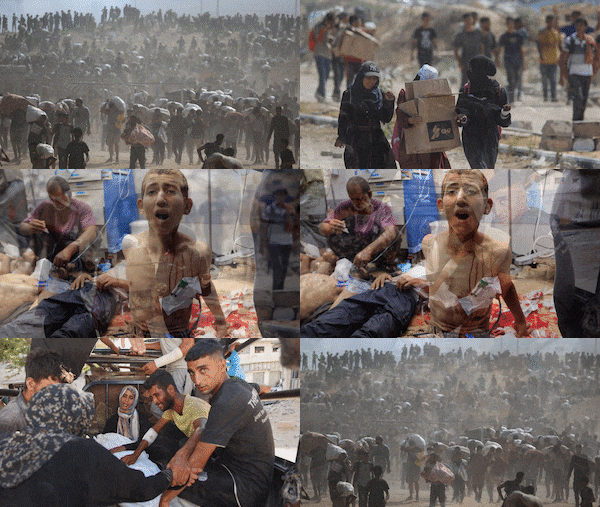
More than 22 months of Israeli attacks and blockades have done more than reduce Gaza to rubble and push its people to the brink of famine; they have robbed children like Mahmoud of family members, friends, dreams, and the simple joys of growing up.
For Mahmoud, life before the war was full of happy routines – football matches and trips to the market with his father, laughing with his nine-year-old brother, Odaid.
But after an Israeli air strike on their home killed them both early in the war, which began in October 2023, Mahmoud found himself in a role no child should have to fill: becoming the sole support for his grieving mother and three younger sisters, one of whom was injured in the bombing.
“All the time, I keep remembering the occasions, the events, everything that happened during the war, in a way no one can imagine,” he says. “This pain, these memories … they will never leave me. I was just a kid, and now I live with something that adults can barely survive.
“Sometimes I feel relieved that our room [in the family's former home] is gone. It carried every memory of my brother – my roommate, my best friend, my eating and sleeping companion. Maybe it’s easier not to see it.”

Just a few kilometres away, 12-year-old Ibrahim Islim walks alone through the Tel Al Hawa neighbourhood of Gaza city, afraid to make new friends after his constant companions of the prewar days died in Israeli attacks.
Ibrahim says Saber, who was killed the month after the war began, and Murad, who died in an Israeli air strike in July last year, were more than just classmates, they were his soul mates. They shared the same ambition and even liked the same food.
“We were always together – at school, after school. We studied together, played together, ate together. People thought we were brothers,” he told The National. “Losing friends who shared every moment of life with me, it’s something nothing can fix. I don’t know how life is supposed to go on without them.”
Ibrahim and his friends were top of their class and planned to study engineering together. But that future was stolen. “Now, I’m afraid to even cross the streets we used to walk together. If school comes back, I don’t know how I’ll sit in that class without them,” he says.
For Rahaf Al Shobaki, 15, the war took not only her older sister but her anchor in life. Nadine was her best friend, her second mother, her everything, she says.
“My whole life has been with Nadine. Even though she was four years older, we shared everything – clothes, laughter, even our secrets. She loved life. She loved dressing up, going to the market, eating out. We used to go out together almost every day before the war,” Rahaf told The National.
Palestinians wounded at aid sites taken to Nasser Hospital – in pictures
-
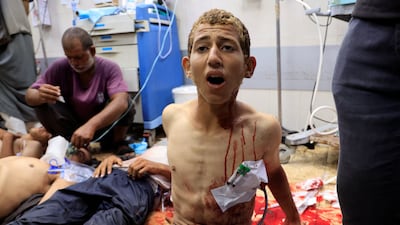
Palestinians wounded while seeking aid in Gaza are treated at Nasser Hospital, in Khan Younis. Reuters -
In addition to the wounded, Nasser Hospital said it received bodies from Morag and others killed near an aid site in southern Gaza run by the Gaza Humanitarian Foundation. EPA -
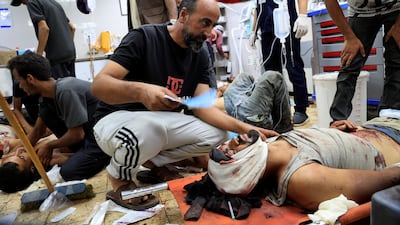
Dozens were killed or wounded as desperate crowds headed towards food distribution points, aid lorries and air-dropped parcels in the enclave. Reuters -
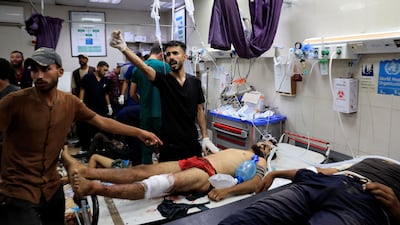
Witnesses and health officials said Israeli forces fired towards crowds near aid sites. Reuters -
Medics attend to wounded Palestinians at Nasser Hospital. Reuters -

People wounded while trying to reach aid lorries entering Gaza through the Morag corridor receive treatment at Nasser Hospital. AP -
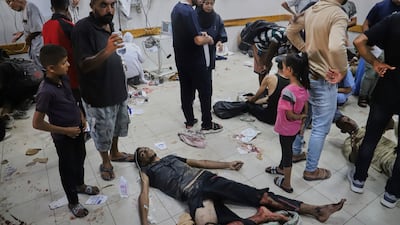
Palestinians wounded while trying to reach aid lorries entering Gaza through the Morag corridor receive treatment at Nasser Hospital. AP -
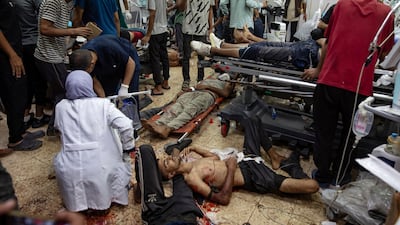
Wounded Palestinians are treated at Nasser Hospital. EPA


Nadine was killed in a drone strike in January 2024. She was on the roof of her grandfather’s house with her aunt, who was injured but survived. She dreamt of becoming a lawyer and was in her first year studying law at Al Azhar University. Rahaf dreamt of becoming just like her.
“I used to tell her: ‘When you get married, I want to live at your house, just like now, staying up late, talking, laughing.’ We promised we’d never grow apart.”
But that promise was shattered in a single moment. “That was the hardest moment of the war for me,” Rahaf says. “I saw her soaked in blood. I’ll never forget it. I don’t think I can ever heal from it.”
Rahaf's grief, as with Mahmoud and Ibrahim, is raw; their voices are young, and their pain far beyond their years. “Nothing can make it up to me,” Ibrahim says. “The colour and taste of life are fading, even if the war ends.”

