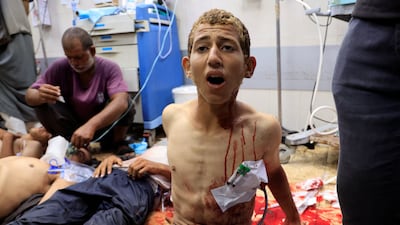
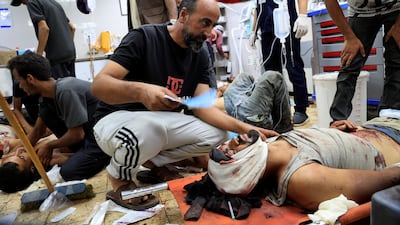
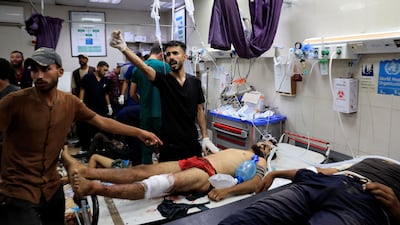
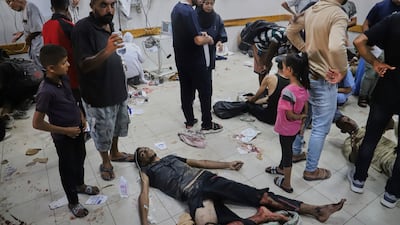
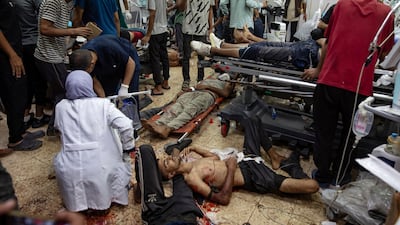
At least 20 people have been killed after an aid lorry overturned on a crowd of people in central Gaza – as condemnation of starvation caused by Israel's blockade grows.
Footage posted by the Palestinian Wafa news agency showed dead and injured bodies after the lorry overturned near the Nuseirat refugee camp on Wednesday. It is the latest in a string of tragedies to affect aid seekers.
Gaza's civil defence agency spokesperson, Mahmoud Bassal, told AFP that the lorry was driving on an unsafe road that Israel had previously bombed. Hamas has accused Israel of forcing lorry drivers to take dangerous routes to reach aid distribution centres and says it is aimed at “engineering” starvation and chaos.
Israel “forces drivers to navigate routes overcrowded with starving civilians who have been waiting for weeks for the most basic necessities,” Hamas's media office said in a statement.
Israel's government maintains it is not to blame for harrowing images of emaciated children in Gaza begging for food, or crying at some of the last remaining charity kitchens for a spoonful of beans. It says there are unused aid supplies in Gaza and accuses Hamas and the UN of preventing their delivery. But an Israeli blockade on the enclave has made the delivery of supplies almost impossible.
The UAE and Jordan are among several countries carrying out airdrops of aid in an attempt to provide some humanitarian relief in the Gaza Strip, where warnings of a famine are on the rise.
The Gaza Health Ministry said five more Palestinians have died of malnutrition and starvation in the past 24 hours. This brings the number of those who have died from hunger during the conflict to 193, including 96 children, the ministry added.
Members of the UN Security Council have blamed Israel for starving Palestinians in Gaza after imposing a two-month blockade on all food and medical assistance and condemned Israeli media reports that Prime Minister Benjamin Netanyahu plans to reoccupy the enclave, calling them “deeply alarming” if true.
The UN comments were made at an emergency meeting called for by Israel, after seeing footage of their emaciated hostages.
At the meeting, Algeria's Ambassador to the UN, Amar Bendjama, held up a picture of a malnourished child towards Israeli Foreign Minister Gideon Saar.
UN assistant secretary general Miroslav Jenca told the Security Council that reoccupying the whole of Gaza “would risk catastrophic consequences … and could further endanger the lives of the remaining hostages”.
Before the UN Security Council met on Tuesday, US President Donald Trump said his country was focused on bringing food into the enclave. He was responding to a question about whether he would support Israel reoccupying all of Gaza.
“As far as the rest of it, I really can't say. That's going to be pretty much up to Israel,” he said, in comments that distance the US from Israel's military plans in the enclave.
At the UN meeting, Mr Saar accused Russia and other council members, as well as the international media, of perpetuating “so many lies” about the situation in Gaza – particularly over starvation.
British Ambassador to the UN Barbara Woodward said the UK supported the release of hostages but said that their suffering and that of Palestinian civilians in Gaza had sunk to new depths. She blamed Israel for the situation, saying its aid restrictions had led to a famine – as declared by the IPC hunger monitor last week.
Ms Woodward said she spoke to doctors last week who had served in Gaza and had seen children so malnourished that “their wounds festered for months without healing”. The doctors also saw baby formula confiscated by the Israeli military, she said.
Acting US Ambassador Dorothy Shea reiterated Mr Trump's recognition of the “real starvation” in Gaza.
On the same day, Mr Trump said: “Israel is going to help us with that in terms of distribution and also money. Arab states are also going to help us with that in terms of money and possibly distribution.”
He said his primary focus was feeding people in Gaza “who are obviously not doing too well with the food”.

RESULTS
Bantamweight:
Zia Mashwani (PAK) bt Chris Corton (PHI)
Super lightweight:
Flavio Serafin (BRA) bt Mohammad Al Khatib (JOR)
Super lightweight:
Dwight Brooks (USA) bt Alex Nacfur (BRA)
Bantamweight:
Tariq Ismail (CAN) bt Jalal Al Daaja (JOR)
Featherweight:
Abdullatip Magomedov (RUS) bt Sulaiman Al Modhyan (KUW)
Middleweight:
Mohammad Fakhreddine (LEB) bt Christofer Silva (BRA)
Middleweight:
Rustam Chsiev (RUS) bt Tarek Suleiman (SYR)
Welterweight:
Khamzat Chimaev (SWE) bt Mzwandile Hlongwa (RSA)
Lightweight:
Alex Martinez (CAN) bt Anas Siraj Mounir (MAR)
Welterweight:
Jarrah Al Selawi (JOR) bt Abdoul Abdouraguimov (FRA)
%3Cp%3E%3Cstrong%3EDirector%3A%3C%2Fstrong%3E%20Nag%20Ashwin%3C%2Fp%3E%0A%3Cp%3E%3Cstrong%3EStarring%3A%20%3C%2Fstrong%3EPrabhas%2C%20Saswata%20Chatterjee%2C%20Deepika%20Padukone%2C%20Amitabh%20Bachchan%2C%20Shobhana%3C%2Fp%3E%0A%3Cp%3E%3Cstrong%3ERating%3A%20%3C%2Fstrong%3E%E2%98%85%E2%98%85%E2%98%85%E2%98%85%3C%2Fp%3E%0A
Your rights as an employee
The government has taken an increasingly tough line against companies that fail to pay employees on time. Three years ago, the Cabinet passed a decree allowing the government to halt the granting of work permits to companies with wage backlogs.
The new measures passed by the Cabinet in 2016 were an update to the Wage Protection System, which is in place to track whether a company pays its employees on time or not.
If wages are 10 days late, the new measures kick in and the company is alerted it is in breach of labour rules. If wages remain unpaid for a total of 16 days, the authorities can cancel work permits, effectively shutting off operations. Fines of up to Dh5,000 per unpaid employee follow after 60 days.
Despite those measures, late payments remain an issue, particularly in the construction sector. Smaller contractors, such as electrical, plumbing and fit-out businesses, often blame the bigger companies that hire them for wages being late.
The authorities have urged employees to report their companies at the labour ministry or Tawafuq service centres — there are 15 in Abu Dhabi.
TOUCH RULES
Touch is derived from rugby league. Teams consist of up to 14 players with a maximum of six on the field at any time.
Teams can make as many substitutions as they want during the 40 minute matches.
Similar to rugby league, the attacking team has six attempts - or touches - before possession changes over.
A touch is any contact between the player with the ball and a defender, and must be with minimum force.
After a touch the player performs a “roll-ball” - similar to the play-the-ball in league - stepping over or rolling the ball between the feet.
At the roll-ball, the defenders have to retreat a minimum of five metres.
A touchdown is scored when an attacking player places the ball on or over the score-line.
MATCH INFO
Uefa Champions League, last-16, second leg (first-leg scores in brackets):
PSG (2) v Manchester United (0)
Midnight (Thursday), BeIN Sports
Mercer, the investment consulting arm of US services company Marsh & McLennan, expects its wealth division to at least double its assets under management (AUM) in the Middle East as wealth in the region continues to grow despite economic headwinds, a company official said.
Mercer Wealth, which globally has $160 billion in AUM, plans to boost its AUM in the region to $2-$3bn in the next 2-3 years from the present $1bn, said Yasir AbuShaban, a Dubai-based principal with Mercer Wealth.
“Within the next two to three years, we are looking at reaching $2 to $3 billion as a conservative estimate and we do see an opportunity to do so,” said Mr AbuShaban.
Mercer does not directly make investments, but allocates clients’ money they have discretion to, to professional asset managers. They also provide advice to clients.
“We have buying power. We can negotiate on their (client’s) behalf with asset managers to provide them lower fees than they otherwise would have to get on their own,” he added.
Mercer Wealth’s clients include sovereign wealth funds, family offices, and insurance companies among others.
From its office in Dubai, Mercer also looks after Africa, India and Turkey, where they also see opportunity for growth.
Wealth creation in Middle East and Africa (MEA) grew 8.5 per cent to $8.1 trillion last year from $7.5tn in 2015, higher than last year’s global average of 6 per cent and the second-highest growth in a region after Asia-Pacific which grew 9.9 per cent, according to consultancy Boston Consulting Group (BCG). In the region, where wealth grew just 1.9 per cent in 2015 compared with 2014, a pickup in oil prices has helped in wealth generation.
BCG is forecasting MEA wealth will rise to $12tn by 2021, growing at an annual average of 8 per cent.
Drivers of wealth generation in the region will be split evenly between new wealth creation and growth of performance of existing assets, according to BCG.
Another general trend in the region is clients’ looking for a comprehensive approach to investing, according to Mr AbuShaban.
“Institutional investors or some of the families are seeing a slowdown in the available capital they have to invest and in that sense they are looking at optimizing the way they manage their portfolios and making sure they are not investing haphazardly and different parts of their investment are working together,” said Mr AbuShaban.
Some clients also have a higher appetite for risk, given the low interest-rate environment that does not provide enough yield for some institutional investors. These clients are keen to invest in illiquid assets, such as private equity and infrastructure.
“What we have seen is a desire for higher returns in what has been a low-return environment specifically in various fixed income or bonds,” he said.
“In this environment, we have seen a de facto increase in the risk that clients are taking in things like illiquid investments, private equity investments, infrastructure and private debt, those kind of investments were higher illiquidity results in incrementally higher returns.”
The Abu Dhabi Investment Authority, one of the largest sovereign wealth funds, said in its 2016 report that has gradually increased its exposure in direct private equity and private credit transactions, mainly in Asian markets and especially in China and India. The authority’s private equity department focused on structured equities owing to “their defensive characteristics.”
DUNE%3A%20PART%20TWO
%3Cp%3E%3Cstrong%3EDirector%3A%3C%2Fstrong%3E%20Denis%20Villeneuve%3C%2Fp%3E%0A%3Cp%3E%3Cstrong%3EStarring%3A%3C%2Fstrong%3E%20Timothee%20Chamalet%2C%20Zendaya%2C%20Austin%20Butler%3C%2Fp%3E%0A%3Cp%3E%3Cstrong%3ERating%3A%3C%2Fstrong%3E%205%2F5%3C%2Fp%3E%0A
Infiniti QX80 specs
Engine: twin-turbocharged 3.5-liter V6
Power: 450hp
Torque: 700Nm
Price: From Dh450,000, Autograph model from Dh510,000
Available: Now