Syrian Red Crescent trucks carrying humanitarian aid heading towards Sweida, the scene of deadly clashes this month. AFP

Red Cross enters Sweida for first time since deadly clashes


  • English
  • Arabic

The International Committee of the Red Cross said on Tuesday its team was able to gain access to Syria's southern city of Sweida, where fighting broke out this month.

The team, which joined a Syrian Arab Red Crescent humanitarian convoy sent to the city on Monday, was able to assess where the most pressing needs lie, the ICRC said.

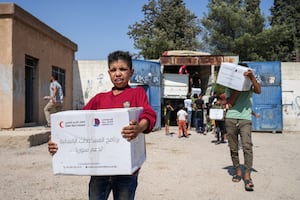
The convoy was carrying 1,000 food hampers as well as 200 tonnes of food, household items for people displaced by the fighting, and medicine, a Sarc official told The National. It was the third such convoy to enter the city since clashes subsided last week, and the first to be accompanied by ICRC officials.
The clashes erupted in early July between Bedouin and Druze factions, following the kidnapping of a Druze trader on a government-controlled road to the north of the city, and escalated into widespread violence, in which more than 1,000 people were killed.

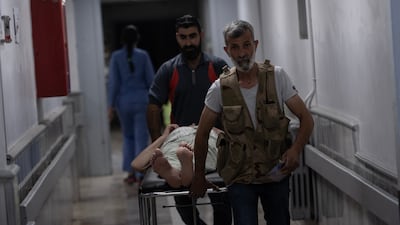
  • More than 1,000 people were killed and many others injured in the widespread violence between Bedouin tribes and Druze factions in the southern Syrian city of Sweida. All photos: Hasan Belal for The National
    More than 1,000 people were killed and many others injured in the widespread violence between Bedouin tribes and Druze factions in the southern Syrian city of Sweida. All photos: Hasan Belal for The National
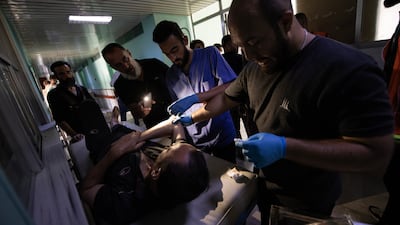
  • This injury victim had to be treated at Sweida's National Hospital under the flashlight of a mobile phone due to a power outage in the city.
    This injury victim had to be treated at Sweida's National Hospital under the flashlight of a mobile phone due to a power outage in the city.
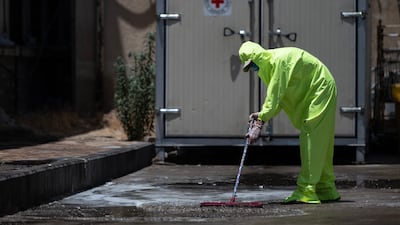
  • A hospital volunteer cleans up the remains of bodies that had been kept under the sun for three days due to the violence.
    A hospital volunteer cleans up the remains of bodies that had been kept under the sun for three days due to the violence.
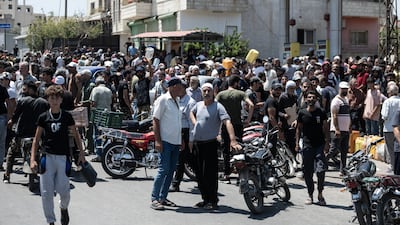
  • Large crowds of people from Sweida gather in front of a gas station to obtain their allocations of diesel and gasoline after the siege imposed on by the Syrian government.
    Large crowds of people from Sweida gather in front of a gas station to obtain their allocations of diesel and gasoline after the siege imposed on by the Syrian government.
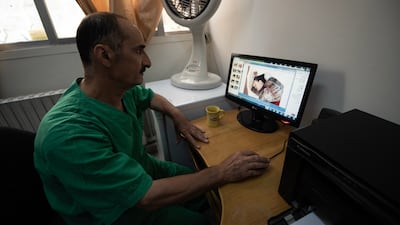
  • A doctor at the National Hospital is archiving photos of corpses to document the lives that were lost.
    A doctor at the National Hospital is archiving photos of corpses to document the lives that were lost.
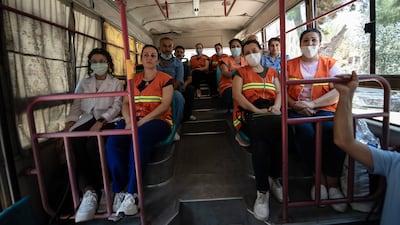
  • A group of doctors and nurses take the bus home after a long day at work.
    A group of doctors and nurses take the bus home after a long day at work.
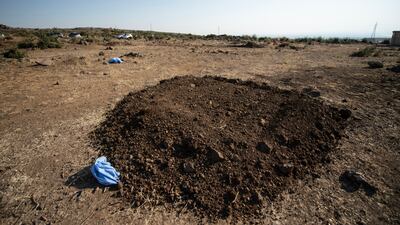
  • One of the mass graves in Al Raha area of Sweida, where the Druze hijab is placed as a symbol of the people.
    One of the mass graves in Al Raha area of Sweida, where the Druze hijab is placed as a symbol of the people.
  • Burnt buildings in Al Omran roundabout area.
    Burnt buildings in Al Omran roundabout area.
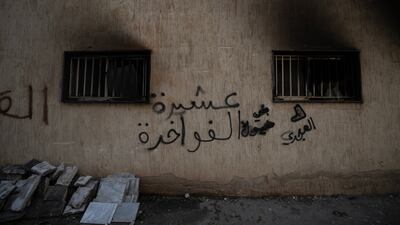
  • The name of one of the Bedouin tribes is written on a wall of a building in Al Omran roundabout area as evidence of their presence.
    The name of one of the Bedouin tribes is written on a wall of a building in Al Omran roundabout area as evidence of their presence.

Syrian government forces were sent to contain the unrest but Druze militias, who deeply distrust the newly established authorities in Damascus, who they accuse of siding with the Bedouin, mobilised to push them back.

Supplies to Sweida have been severely limited by the conflict between government forces seeking to deploy in the city and local powerbrokers resisting control of the newly established central authorities.

Stephan Sakalian, the head of ICRC's delegation in Syria, said its members “spoke with families, community leaders and health workers to identify what they need most”.

The ICRC members were able to visit the Sarc Sweida branch, as well as the Sweida National and Shahba hospitals. These two health complexes, assisted by the ICRC, received a large influx of people injured or killed following the recent escalation of violence, it said.

The ICRC said it would continue efforts to access Sweida and support the ongoing emergency response of the Sarc to those most in need in the area.


Mercer, the investment consulting arm of US services company Marsh & McLennan, expects its wealth division to at least double its assets under management (AUM) in the Middle East as wealth in the region continues to grow despite economic headwinds, a company official said.

Mercer Wealth, which globally has $160 billion in AUM, plans to boost its AUM in the region to $2-$3bn in the next 2-3 years from the present $1bn, said Yasir AbuShaban, a Dubai-based principal with Mercer Wealth.

Within the next two to three years, we are looking at reaching $2 to $3 billion as a conservative estimate and we do see an opportunity to do so,” said Mr AbuShaban.

Mercer does not directly make investments, but allocates clients’ money they have discretion to, to professional asset managers. They also provide advice to clients.

“We have buying power. We can negotiate on their (client’s) behalf with asset managers to provide them lower fees than they otherwise would have to get on their own,” he added.

Mercer Wealth’s clients include sovereign wealth funds, family offices, and insurance companies among others.

From its office in Dubai, Mercer also looks after Africa, India and Turkey, where they also see opportunity for growth.

Wealth creation in Middle East and Africa (MEA) grew 8.5 per cent to $8.1 trillion last year from $7.5tn in 2015, higher than last year’s global average of 6 per cent and the second-highest growth in a region after Asia-Pacific which grew 9.9 per cent, according to consultancy Boston Consulting Group (BCG). In the region, where wealth grew just 1.9 per cent in 2015 compared with 2014, a pickup in oil prices has helped in wealth generation.

BCG is forecasting MEA wealth will rise to $12tn by 2021, growing at an annual average of 8 per cent.

Drivers of wealth generation in the region will be split evenly between new wealth creation and growth of performance of existing assets, according to BCG.

Another general trend in the region is clients’ looking for a comprehensive approach to investing, according to Mr AbuShaban.

“Institutional investors or some of the families are seeing a slowdown in the available capital they have to invest and in that sense they are looking at optimizing the way they manage their portfolios and making sure they are not investing haphazardly and different parts of their investment are working together,” said Mr AbuShaban.

Some clients also have a higher appetite for risk, given the low interest-rate environment that does not provide enough yield for some institutional investors. These clients are keen to invest in illiquid assets, such as private equity and infrastructure.

“What we have seen is a desire for higher returns in what has been a low-return environment specifically in various fixed income or bonds,” he said.

“In this environment, we have seen a de facto increase in the risk that clients are taking in things like illiquid investments, private equity investments, infrastructure and private debt, those kind of investments were higher illiquidity results in incrementally higher returns.”

The Abu Dhabi Investment Authority, one of the largest sovereign wealth funds, said in its 2016 report that has gradually increased its exposure in direct private equity and private credit transactions, mainly in Asian markets and especially in China and India. The authority’s private equity department focused on structured equities owing to “their defensive characteristics.”

What are NFTs?

Are non-fungible tokens a currency, asset, or a licensing instrument? Arnab Das, global market strategist EMEA at Invesco, says they are mix of all of three.

You can buy, hold and use NFTs just like US dollars and Bitcoins. “They can appreciate in value and even produce cash flows.”

However, while money is fungible, NFTs are not. “One Bitcoin, dollar, euro or dirham is largely indistinguishable from the next. Nothing ties a dollar bill to a particular owner, for example. Nor does it tie you to to any goods, services or assets you bought with that currency. In contrast, NFTs confer specific ownership,” Mr Das says.

This makes NFTs closer to a piece of intellectual property such as a work of art or licence, as you can claim royalties or profit by exchanging it at a higher value later, Mr Das says. “They could provide a sustainable income stream.”

This income will depend on future demand and use, which makes NFTs difficult to value. “However, there is a credible use case for many forms of intellectual property, notably art, songs, videos,” Mr Das says.

The years Ramadan fell in May

1987

1954

1921

1888

ASHES SCHEDULE

First Test
November 23-27 (The Gabba, Brisbane)
Second Test
December 2-6 (Adelaide Oval, Adelaide)
Third Test
December 14-18 (Waca Ground, Perth)
Fourth Test
December 26-30 (Melbourne Cricket Ground, Melbourne)
Fifth Test
January 4-8, 2018 (Sydney Cricket Ground, Sydney)

'My Son'

Director: Christian Carion

Starring: James McAvoy, Claire Foy, Tom Cullen, Gary Lewis

Rating: 2/5

Updated: July 30, 2025, 7:52 AM