

Israel's most recent attacks against government troops in Syria are an example of its use of the Druze minority group as a “pawn” in a wider strategy, analysts have told The National.
Days ago, members of the Druze community in Sweida and Bedouins clashed in a local dispute that soon escalated – bringing state intervention by Syrian President Ahmad Al Shara's army.
Soon after, videos began emerging of Al Shara linked-troops harassing and cracking down on Druze leaders. Israel launched attacks, saying that it would protect the Druze in Syria. Its army attacked key symbols of power in Damascus including the presidential palace, the Defence Ministry and the army headquarters.
Prime Minister Benjamin Netanyahu also warned Israeli Druze living in the occupied Golan Heights against flocking to Sweida, but some did anyway.
The issues have brought back concerns of sectarian bloodshed in post-Bashar Al Assad Syria, particularly with the Druze not enjoying the same stability they once did under the long-time dictator.
The fighting was not just destabilising for Syria, but Israel too. Thousands of Druze rushed to border fences in the Israeli-occupied Golan Heights in a bid to help their comrades, many of them family. Dramatic footage emerged of people storming into Syria, trudging up dirt tracks as clouds of smoke and tear gas swirled around them.
Israel's motives
Amid the chaos, Israel’s leadership issued strong statements of support for the community and warnings for anyone who threatened them, alongside pleas for anyone who crossed the border to return for their safety.
“Netanyahu right now is trying to contain the dangers this has opened up. He's using the Druze as a pawn in a larger chessboard to keep Syria weak and divided,” said Joshua Landis, a Syria expert and head of the Centre for Middle East Studies at the University of Oklahoma.

Mr Netanyahu also had to appease people in his own country, as Israeli Druze make up a sizeable portion of the army. The conflict comes with Mr Netanyahu in deep political peril as rebellious ultra-Orthodox parties bring his coalition to the brink of collapse.
“His loyalty is to the Druze in Israel. It is an important minority that serves in the military. So Israel is using the Druze of Syria as a pretext to weaken the government there,” Mr Landis said.
There are some 150,000 Druze living in Israel and the Israeli-occupied Golan Heights, recognised by most of the international community as Syrian territory.
Druze in Israel − not including occupied Palestinian territory and the occupied Golan Heights − serve in the military, including in senior positions. Ghasan Alyan, the current head of Cogat, a military unit that administers Israeli control in the occupied West Bank and Gaza, is a member of the community.
The Druze are largely praised by Jewish-Israeli society for being loyal, integrated citizens. The community was nonetheless deeply angered by the 2018 Nation-State Law which gave only Jews in Israel the constitutional right to self-determination.
Israeli think tank IDI said the law “excludes minorities, omits equality, ignores democracy and the Declaration of Independence, and undermines the fragile balance of Israel as a Jewish and democratic state”. Druze politicians in Israel’s parliament filed petitions against the law.
The Druze in the occupied Golan Heights, however, do not serve in the military. Many still describe themselves as Syrian.
Syrian approach
Rahaf Al Doughli, an assistant professor at Lancaster University, said Israel's behaviour is not unexpected, but is also linked to the Syrian government's approach to the sectarian problem, which she described as one-sided.
Sectarian strife has repeatedly undermined Mr Al Shara's attempts to consolidate control of Syria since the rebel offensive that installed him in power last year.
“I don't think it's very strange for Israel to manipulate and instrumentalise sectarian identities in the region. It's a tactic,” Prof Al Doughli said.
Knowing that sectarian tension had been long present in the region, Prof Al Doughli said the Syrian state came in “without neutrality” appearing as if to use one community against the other.
“Instead of asking why Israel is bombing the Syrian army the question should be why the Druze community in Syria would ever need protection by Israel,” she said.
Who are the Druze?
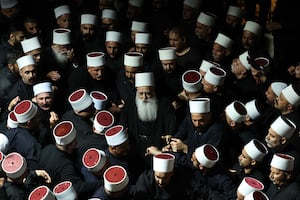
The Druze are an Arabic-speaking religious sect numbering about a million people, mostly in Israel, Jordan, Lebanon and Syria.
The faith emerged from a branch of Islam in the 11th century and its teachings blend elements of Islam with ancient traditions. Reincarnation plays a central role in their beliefs.
You can only be born Druze as people are not allowed to convert to or from the religion. Leaders have kept the details of their faith closed and secretive. Despite the comparatively small size of their community, the Druze have figured prominently in Middle Eastern history. They have served as kingmakers, military leaders and political mediators.

