
Facial reconstruction of the individual from Nuwayrat using 3D scan data of the skull and analysis of the bones. Photo: Caroline Wilkinson, Liverpool John Moores University

Skeleton of man from ancient Egypt gives up its secrets in scientific first


Paul Carey
  • English
  • Arabic

The first whole ancient Egyptian genome has been sequenced by researchers, taken from a man who lived 4,500 to 4,800 years ago in the age of the first pyramids.

By investigating chemical signals in his teeth relating to diet and environment, the researchers showed that the individual was likely to have grown up in Egypt.

They then used evidence from his skeleton to estimate sex, age, height, and information on ancestry and lifestyle. They found marks which indicate a lifetime of hard labour and signs suggesting he could have worked as a potter or in a trade requiring comparable movements, as his bones had muscle markings from sitting for long periods with outstretched limbs.
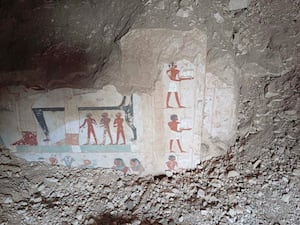
His higher-class burial is unexpected for a potter, who would not normally receive such treatment but researchers suggested he may have been exceptionally skilled or successful to advance his social status.

Some 80 per cent of his ancestry was related to ancient people in North Africa and 20 per cent to ancient people in West Asia.

The Sphinx is seen in front of the Pyramid of Chephren in Giza, Cairo. Getty Images

This finding is genetic evidence that people moved into Egypt and mixed with local populations at this time, which was previously only visible in archaeological artefacts.

During this period of ancient Egyptian history, archaeological evidence has suggested trade and cultural connections existed with the Fertile Crescent, particularly the area covering modern Iraq.

Researchers believed that objects and imagery, like writing systems or pottery, were exchanged, but genetic evidence has been limited due to warm temperatures preventing DNA preservation.

In this study, the research team extracted DNA from the tooth of an individual buried in a ceramic pot in a tomb cut into the hillside in Nuwayrat, a village 265km south of Cairo, using this to sequence his genome. His burial took place before artificial mummification was standard practice, which may have helped to preserve his DNA.

It is the oldest DNA sample from Egypt to date. Forty years ago, Nobel Prize winner Svante Paabo unsuccessfully attempted to extract DNA from people from ancient Egypt, investigating 23 mummies, one of which was a child that he believed could be cloned.

Pottery coffin and archaeological remains of the Nuwayrat individual, as discovered in 1902. Photo: The Garstang Museum of Archaeology, University of Liverpool

Improvements in techniques led to today’s breakthrough, published in Nature, by researchers from the Francis Crick Institute and Liverpool John Moores University (LJMU).

The burial had been donated by the Egyptian Antiquities Service, while under British rule, to the excavation committee and was initially housed at the Liverpool Institute of Archaeology (which later became part of the University of Liverpool) and then transferred to World Museum Liverpool.

Adeline Morez Jacobs, Visiting Research Fellow at Liverpool John Moores University, said: “Piecing together all the clues from this individual’s DNA, bones and teeth have allowed us to build a comprehensive picture. We hope that future DNA samples from ancient Egypt can expand on when precisely this movement from West Asia started.”

Linus Girdland Flink, Lecturer in Ancient Biomolecules at the University of Aberdeen, said: “This individual has been on an extraordinary journey. He lived and died during a critical period of change in ancient Egypt, and his skeleton was excavated in 1902 and donated to World Museum Liverpool, where it then survived bombings during the Blitz that destroyed most of the human remains in their collection.

"We’ve now been able to tell part of the individual’s story, finding that some of his ancestry came from the Fertile Crescent, highlighting mixture between groups at this time.”


The bio

Favourite book: Peter Rabbit. I used to read it to my three children and still read it myself. If I am feeling down it brings back good memories.

Best thing about your job: Getting to help people. My mum always told me never to pass up an opportunity to do a good deed.

Best part of life in the UAE: The weather. The constant sunshine is amazing and there is always something to do, you have so many options when it comes to how to spend your day.

Favourite holiday destination: Malaysia. I went there for my honeymoon and ended up volunteering to teach local children for a few hours each day. It is such a special place and I plan to retire there one day.

MATCH INFO

Who: UAE v USA
What: first T20 international
When: Friday, 2pm
Where: ICC Academy in Dubai

UAE currency: the story behind the money in your pockets
UAE%20v%20West%20Indies
%3Cp%3EFirst%20ODI%20-%20Sunday%2C%20June%204%20%0D%3Cbr%3ESecond%20ODI%20-%20Tuesday%2C%20June%206%20%0D%3Cbr%3EThird%20ODI%20-%20Friday%2C%20June%209%26nbsp%3B%3C%2Fp%3E%0A%3Cp%3EMatches%20at%20Sharjah%20Cricket%20Stadium.%20All%20games%20start%20at%204.30pm%0D%3Cbr%3E%0D%3Cbr%3E%3Cstrong%3EUAE%20squad%3C%2Fstrong%3E%0D%3Cbr%3EMuhammad%20Waseem%20(captain)%2C%20Aayan%20Khan%2C%20Adithya%20Shetty%2C%20Ali%20Naseer%2C%20Ansh%20Tandon%2C%20Aryansh%20Sharma%2C%20Asif%20Khan%2C%20Basil%20Hameed%2C%20Ethan%20D%E2%80%99Souza%2C%20Fahad%20Nawaz%2C%20Jonathan%20Figy%2C%20Junaid%20Siddique%2C%20Karthik%20Meiyappan%2C%20Lovepreet%20Singh%2C%20Matiullah%2C%20Mohammed%20Faraazuddin%2C%20Muhammad%20Jawadullah%2C%20Rameez%20Shahzad%2C%20Rohan%20Mustafa%2C%20Sanchit%20Sharma%2C%20Vriitya%20Aravind%2C%20Zahoor%20Khan%0D%3C%2Fp%3E%0A

Mercer, the investment consulting arm of US services company Marsh & McLennan, expects its wealth division to at least double its assets under management (AUM) in the Middle East as wealth in the region continues to grow despite economic headwinds, a company official said.

Mercer Wealth, which globally has $160 billion in AUM, plans to boost its AUM in the region to $2-$3bn in the next 2-3 years from the present $1bn, said Yasir AbuShaban, a Dubai-based principal with Mercer Wealth.

Within the next two to three years, we are looking at reaching $2 to $3 billion as a conservative estimate and we do see an opportunity to do so,” said Mr AbuShaban.

Mercer does not directly make investments, but allocates clients’ money they have discretion to, to professional asset managers. They also provide advice to clients.

“We have buying power. We can negotiate on their (client’s) behalf with asset managers to provide them lower fees than they otherwise would have to get on their own,” he added.

Mercer Wealth’s clients include sovereign wealth funds, family offices, and insurance companies among others.

From its office in Dubai, Mercer also looks after Africa, India and Turkey, where they also see opportunity for growth.

Wealth creation in Middle East and Africa (MEA) grew 8.5 per cent to $8.1 trillion last year from $7.5tn in 2015, higher than last year’s global average of 6 per cent and the second-highest growth in a region after Asia-Pacific which grew 9.9 per cent, according to consultancy Boston Consulting Group (BCG). In the region, where wealth grew just 1.9 per cent in 2015 compared with 2014, a pickup in oil prices has helped in wealth generation.

BCG is forecasting MEA wealth will rise to $12tn by 2021, growing at an annual average of 8 per cent.

Drivers of wealth generation in the region will be split evenly between new wealth creation and growth of performance of existing assets, according to BCG.

Another general trend in the region is clients’ looking for a comprehensive approach to investing, according to Mr AbuShaban.

“Institutional investors or some of the families are seeing a slowdown in the available capital they have to invest and in that sense they are looking at optimizing the way they manage their portfolios and making sure they are not investing haphazardly and different parts of their investment are working together,” said Mr AbuShaban.

Some clients also have a higher appetite for risk, given the low interest-rate environment that does not provide enough yield for some institutional investors. These clients are keen to invest in illiquid assets, such as private equity and infrastructure.

“What we have seen is a desire for higher returns in what has been a low-return environment specifically in various fixed income or bonds,” he said.

“In this environment, we have seen a de facto increase in the risk that clients are taking in things like illiquid investments, private equity investments, infrastructure and private debt, those kind of investments were higher illiquidity results in incrementally higher returns.”

The Abu Dhabi Investment Authority, one of the largest sovereign wealth funds, said in its 2016 report that has gradually increased its exposure in direct private equity and private credit transactions, mainly in Asian markets and especially in China and India. The authority’s private equity department focused on structured equities owing to “their defensive characteristics.”

UAE currency: the story behind the money in your pockets
Updated: July 03, 2025, 2:27 AM