
The pictures came in one after the other: a statue of Arash the Archer, a mythological character believed to have shot an arrow marking the border of ancient Iran. Next, a picture of Picasso’s Guernica, one of the world’s most famous paintings opposing war.
A resident of Tehran sent the pictures via WhatsApp with a message: Iranians are proud nationalists with a long history, and do not want conflict.
“Our nation knows how to resist and stand firm. In difficult times, everyone stands by Iran, regardless of their religion or belief,” the person, a foreign policy researcher, told The National, asking to remain anonymous.
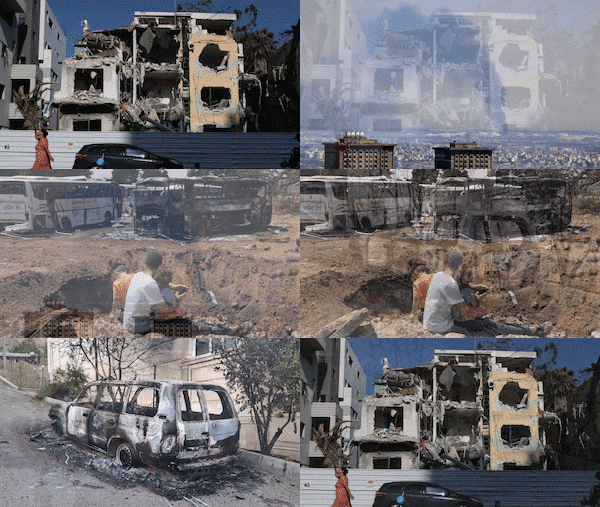
Even Iranians who oppose the country’s system of Islamic governance have criticised Israel's strikes in conversations with The National. The attacks have killed at least 224 people over five days, with more than 1,200 others taken to hospital, said Iran’s Health Ministry, including women and children. While deeply rooted in their communities, many Iranians fearing the unknown are deciding to pack up and leave in search of safety.
As Israeli strikes continue and the civilian death toll rises, Iranians are faced with a decision: should I stay or should I go?
“People are going where they think is out of the missiles’ reach,” another Tehran resident told The National.
For years, Iran had kept direct conflict with Israel, and other threats, at bay. It supported Hezbollah in Lebanon and Hamas in Gaza. It sent military advisers to Syria and Iraq to support Bashar Al Assad and, it said, fend off ISIS, whose presence once extended worryingly close to Iran's own borders.
But now, citing imminent threats from Iran, Israel has attacked, ushering in the worst direct conflict that Iran has seen since the 1980-1988 war with Iraq. Iran, which denies it is seeking nuclear arms, has launched missiles and drones back at Israel, claiming at least 24 lives, Israeli authorities have said.
“Every night, people are gathering in safe areas and waiting for either Israel or Iran to strike. It’s a really dire situation,” a resident of Isfahan told The National. “People are coming together, they have lived in war. It’s a really tough situation.”
People are going where they think is out of the missiles’ reach
Resident of Tehran
As well as striking remote military and nuclear sites, Israel has also struck densely populated areas of cities such as Tehran, including the busy Tajrish district. As it has done in Gaza and Lebanon, the Israeli military on Monday issued an evacuation warning for part of Area 3 in north-eastern Tehran.
It said it would carry out “actions to attack the Iranian regime's military infrastructure”. The area houses the city’s international exhibition centre and a sports complex.
In a later social media post, US President Donald Trump said “everyone should immediately evacuate Tehran”. The post was published in English around 3am Iran time. "I just want people to be safe," he later told journalists in explanation for the post.
Many Iranians have criticised the sudden evacuation orders for a city of around 10 million people, a population that swells on weekdays. On social media, users posted panicked messages about family members living in the area that Israel said it would attack.
Despite the threats, some people are not leaving their homes.
“Tehran is a populous and important city and is not being evacuated at all,” the foreign policy researcher said. “The situation is special, but we are not a nation state that was just created yesterday. We are defending ourselves and adapting to the new circumstances.”
But others, fearing the conflict may escalate further and uncertain of their safety, have either left, or are planning to. Mosques, schools and metro stations are available as shelters, an Iranian government spokeswoman has said, and authorities deny shortages of basic food. But unlike in Israel, Iranian cities do not have networks of official bomb shelters and air defence systems are limited.
Images showed long queues of traffic as people tried to leave Tehran, and social media users posted videos and pictures of the front doors of their homes before leaving.
"People don't know what they are supposed to do in this situation," the Isfahan resident said. "Out of fear, they think the best thing to do is to leave the cities."
The National spoke to one resident of Tehran who had left his home for another city in Iran, and another who was planning his route out.
“It is really scary,” he said. “I have to find a way to leave the city and probably the country.”
Closures of shops, government offices and other businesses make the Iranian capital feel “closed”, another resident said.
“Look, many people left Tehran,” he told The National. “Because the offices are closed, it's practically as if Tehran is closed. But people in service jobs and the people that have to stay, they all stayed.”
Some people are going to the holy city of Qom, normally a two-hour drive south of Tehran, while others are heading to northern regions bordering the Caspian Sea, the man added.
Queues are appearing to buy fuel, he said, and sent The National a picture of one petrol station surrounded by cars. “The petrol stations are operating, they are working, everyone wants petrol," he added. "It’s a long queue. People are waiting for one, one and a half hours.”
Iranians hope Mr Trump could end the conflict by placing pressure on Israel to end the attacks. The Iranian military has said its counter-attacks will continue as long as Israel keeps striking. But people have mixed feelings about how willing or able the US President is to de-escalate.
“I hope Trump can stop this," another Tehran resident told The National over the phone. “Because if he doesn’t, it will get much worse, it will be completely insane."
The overwhelming sense is that Iranians do not want any more conflict.
“If only the war would end, somehow,” the Isfahan resident said.
Additional reporting by Nada Atallah in Beirut

Tales of Yusuf Tadros
Adel Esmat (translated by Mandy McClure)
Hoopoe
PRISCILLA
%3Cp%3EDirector%3A%20Sofia%20Coppola%3C%2Fp%3E%0A%3Cp%3EStarring%3A%20Cailee%20Spaeny%2C%20Jacob%20Elordi%3C%2Fp%3E%0A%3Cp%3ERating%3A%203%2F5%3C%2Fp%3E%0A
Company%20Profile
%3Cp%3E%3Cstrong%3ECompany%20name%3A%3C%2Fstrong%3E%20myZoi%3Cbr%3E%3Cstrong%3EStarted%3A%3C%2Fstrong%3E%202021%3Cbr%3E%3Cstrong%3EFounders%3A%3C%2Fstrong%3E%20Syed%20Ali%2C%20Christian%20Buchholz%2C%20Shanawaz%20Rouf%2C%20Arsalan%20Siddiqui%2C%20Nabid%20Hassan%3Cbr%3E%3Cstrong%3EBased%3A%3C%2Fstrong%3E%20UAE%3Cbr%3E%3Cstrong%3ENumber%20of%20staff%3A%3C%2Fstrong%3E%2037%3Cbr%3E%3Cstrong%3EInvestment%3A%3C%2Fstrong%3E%20Initial%20undisclosed%20funding%20from%20SC%20Ventures%3B%20second%20round%20of%20funding%20totalling%20%2414%20million%20from%20a%20consortium%20of%20SBI%2C%20a%20Japanese%20VC%20firm%2C%20and%20SC%20Venture%3C%2Fp%3E%0A
Blackpink World Tour [Born Pink] In Cinemas
Starring: Rose, Jisoo, Jennie, Lisa
Directors: Min Geun, Oh Yoon-Dong
Rating: 3/5
In numbers: PKK’s money network in Europe
Germany: PKK collectors typically bring in $18 million in cash a year – amount has trebled since 2010
Revolutionary tax: Investigators say about $2 million a year raised from ‘tax collection’ around Marseille
Extortion: Gunman convicted in 2023 of demanding $10,000 from Kurdish businessman in Stockholm
Drug trade: PKK income claimed by Turkish anti-drugs force in 2024 to be as high as $500 million a year
Denmark: PKK one of two terrorist groups along with Iranian separatists ASMLA to raise “two-digit million amounts”
Contributions: Hundreds of euros expected from typical Kurdish families and thousands from business owners
TV channel: Kurdish Roj TV accounts frozen and went bankrupt after Denmark fined it more than $1 million over PKK links in 2013
Infiniti QX80 specs
Engine: twin-turbocharged 3.5-liter V6
Power: 450hp
Torque: 700Nm
Price: From Dh450,000, Autograph model from Dh510,000
Available: Now
Dubai works towards better air quality by 2021
Dubai is on a mission to record good air quality for 90 per cent of the year – up from 86 per cent annually today – by 2021.
The municipality plans to have seven mobile air-monitoring stations by 2020 to capture more accurate data in hourly and daily trends of pollution.
These will be on the Palm Jumeirah, Al Qusais, Muhaisnah, Rashidiyah, Al Wasl, Al Quoz and Dubai Investment Park.
“It will allow real-time responding for emergency cases,” said Khaldoon Al Daraji, first environment safety officer at the municipality.
“We’re in a good position except for the cases that are out of our hands, such as sandstorms.
“Sandstorms are our main concern because the UAE is just a receiver.
“The hotspots are Iran, Saudi Arabia and southern Iraq, but we’re working hard with the region to reduce the cycle of sandstorm generation.”
Mr Al Daraji said monitoring as it stood covered 47 per cent of Dubai.
There are 12 fixed stations in the emirate, but Dubai also receives information from monitors belonging to other entities.
“There are 25 stations in total,” Mr Al Daraji said.
“We added new technology and equipment used for the first time for the detection of heavy metals.
“A hundred parameters can be detected but we want to expand it to make sure that the data captured can allow a baseline study in some areas to ensure they are well positioned.”
The specs
Price, base / as tested Dh100,000 (estimate)
Engine 2.4L four-cylinder
Gearbox Nine-speed automatic
Power 184bhp at 6,400rpm
Torque 237Nm at 3,900rpm
Fuel economy, combined 9.4L/100km
Seven tips from Emirates NBD
1. Never respond to e-mails, calls or messages asking for account, card or internet banking details
2. Never store a card PIN (personal identification number) in your mobile or in your wallet
3. Ensure online shopping websites are secure and verified before providing card details
4. Change passwords periodically as a precautionary measure
5. Never share authentication data such as passwords, card PINs and OTPs (one-time passwords) with third parties
6. Track bank notifications regarding transaction discrepancies
7. Report lost or stolen debit and credit cards immediately
Killing of Qassem Suleimani
%20Ramez%20Gab%20Min%20El%20Akher
%3Cp%3E%3Cstrong%3ECreator%3A%3C%2Fstrong%3E%20Ramez%20Galal%3C%2Fp%3E%0A%3Cp%3E%3Cstrong%3EStarring%3A%3C%2Fstrong%3E%20Ramez%20Galal%3C%2Fp%3E%0A%3Cp%3E%3Cstrong%3EStreaming%20on%3A%20%3C%2Fstrong%3EMBC%20Shahid%3C%2Fp%3E%0A%3Cp%3E%3Cstrong%3ERating%3A%20%3C%2Fstrong%3E2.5%2F5%3C%2Fp%3E%0A
Teaching your child to save
Pre-school (three - five years)
You can’t yet talk about investing or borrowing, but introduce a “classic” money bank and start putting gifts and allowances away. When the child wants a specific toy, have them save for it and help them track their progress.
Early childhood (six - eight years)
Replace the money bank with three jars labelled ‘saving’, ‘spending’ and ‘sharing’. Have the child divide their allowance into the three jars each week and explain their choices in splitting their pocket money. A guide could be 25 per cent saving, 50 per cent spending, 25 per cent for charity and gift-giving.
Middle childhood (nine - 11 years)
Open a bank savings account and help your child establish a budget and set a savings goal. Introduce the notion of ‘paying yourself first’ by putting away savings as soon as your allowance is paid.
Young teens (12 - 14 years)
Change your child’s allowance from weekly to monthly and help them pinpoint long-range goals such as a trip, so they can start longer-term saving and find new ways to increase their saving.
Teenage (15 - 18 years)
Discuss mutual expectations about university costs and identify what they can help fund and set goals. Don’t pay for everything, so they can experience the pride of contributing.
Young adulthood (19 - 22 years)
Discuss post-graduation plans and future life goals, quantify expenses such as first apartment, work wardrobe, holidays and help them continue to save towards these goals.
* JP Morgan Private Bank
EXPATS
%3Cp%3E%3Cstrong%3EDirector%3A%3C%2Fstrong%3E%20Lulu%20Wang%26nbsp%3B%3C%2Fp%3E%0A%3Cp%3E%3Cstrong%3EStars%3A%3C%2Fstrong%3E%20Nicole%20Kidman%2C%20Sarayu%20Blue%2C%20Ji-young%20Yoo%2C%20Brian%20Tee%2C%20Jack%20Huston%3C%2Fp%3E%0A%3Cp%3E%3Cstrong%3ERating%3A%3C%2Fstrong%3E%204%2F5%3C%2Fp%3E%0A
UAE%20SQUAD
%3Cp%3E%0D%3Cstrong%3EMen%3A%3C%2Fstrong%3E%20Saif%20Al%20Zaabi%2C%20Salem%20Al%20Marzooqi%2C%20Zayed%20Al%20Ansaari%2C%20Saud%20Abdulaziz%20Rahmatalla%2C%20Adel%20Shanbih%2C%20Ahmed%20Khamis%20Al%20Blooshi%2C%20Abdalla%20Al%20Naqbi%2C%20Khaled%20Al%20Hammadi%2C%20Mohammed%20Khamis%20Khalaf%2C%20Mohammad%20Fahad%2C%20Abdulla%20Al%20Arimi.%0D%3Cbr%3E%3Cstrong%3EWomen%3A%3C%2Fstrong%3E%20Mozah%20Al%20Zeyoudi%2C%20Haifa%20Al%20Naqbi%2C%20Ayesha%20Al%20Mutaiwei.%3C%2Fp%3E%0A
