Missile trails in the sky late on Friday, seen from Nuseirat in central Gaza, as Iran attacked Israel. AFP

Israel mobilises reservists along borders with Lebanon and Syria


Nada Maucourant Atallah
  • English
  • Arabic

The Israeli army said on Saturday it had called up reservists to bolster its forces along the borders with Lebanon and Syria, amid fears of a regional escalation as tensions with Iran reach unprecedented levels.

The military said the move was to prepare for “various scenarios”. It comes after Israel carried out its largest military strike against Iran on Friday, prompting retaliatory air strikes.

Israeli officials say the deadly attack on Iranian nuclear and military facilities was necessary to prevent its long-standing enemy from building a nuclear bomb, which it sees as an existential threat.
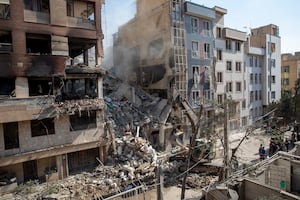
The exchange of air strikes has raised fears of a regional spillover, even as Iran’s regional allies, including Hezbollah, the powerful Lebanese political party and Tehran’s most significant proxy, have given no indication that they would join any retaliatory attacks.

Hezbollah has been significantly weakened by 14 months of conflict with Israel, including two months of intense Israeli aerial bombardment that crippled much of its command structure and arsenal.

The fall of Bashar Al Assad’s regime in Syria, a key member of the so-called Axis of Resistance, an Iran-led alliance opposing US and Israeli influence, has further undermined Hezbollah, severing its only land weapons supply route.

Lebanese officials have urged Hezbollah not to join Iran's response to Israeli attacks, and the group has assured them it will not take part, security sources told The National on Saturday.

The Israeli army said it has called up the headquarters of the 146th Reserve Division, along with the Iron Fist and Etzioni reserve brigades, to reinforce positions along the northern border with Lebanon.

Several other reserve battalions have also been mobilised and deployed to the Syrian border, the army said.

Analysts, military experts and western diplomats have told The National that Hezbollah is in no position to support Iran in any confrontation with Israel.

Still, fears linger as Lebanon's relative stability hangs by a thread. On Saturday, Lebanese President Joseph Aoun chaired a meeting about the Iran-Israel developments with leading officials.


Timeline

2012-2015

The company offers payments/bribes to win key contracts in the Middle East

May 2017

The UK SFO officially opens investigation into Petrofac’s use of agents, corruption, and potential bribery to secure contracts

September 2021

Petrofac pleads guilty to seven counts of failing to prevent bribery under the UK Bribery Act

October 2021

Court fines Petrofac £77 million for bribery. Former executive receives a two-year suspended sentence 

December 2024

Petrofac enters into comprehensive restructuring to strengthen the financial position of the group

May 2025

The High Court of England and Wales approves the company’s restructuring plan

July 2025

The Court of Appeal issues a judgment challenging parts of the restructuring plan

August 2025

Petrofac issues a business update to execute the restructuring and confirms it will appeal the Court of Appeal decision

October 2025

Petrofac loses a major TenneT offshore wind contract worth €13 billion. Holding company files for administration in the UK. Petrofac delisted from the London Stock Exchange

November 2025

180 Petrofac employees laid off in the UAE

Pharaoh's curse

British aristocrat Lord Carnarvon, who funded the expedition to find the Tutankhamun tomb, died in a Cairo hotel four months after the crypt was opened.
He had been in poor health for many years after a car crash, and a mosquito bite made worse by a shaving cut led to blood poisoning and pneumonia.
Reports at the time said Lord Carnarvon suffered from “pain as the inflammation affected the nasal passages and eyes”.
Decades later, scientists contended he had died of aspergillosis after inhaling spores of the fungus aspergillus in the tomb, which can lie dormant for months. The fact several others who entered were also found dead withiin a short time led to the myth of the curse.

Updated: June 14, 2025, 1:50 PM