


The Middle East can expect days of Israeli attacks on Iran as it conducts a “brutal and methodical” assault to ensure it sets back the nuclear programme by many years, military experts have told The National.
After Iran's military leadership has been largely decapitated in surgical air strikes it currently appears toothless in its ability to respond to the unprecedented attack on the six-decade-old theocracy.
But if it is to retaliate it needs to do so almost immediately as its military infrastructure was “being [eliminated] at such rate that there will soon be little left,” said former British military intelligence officer, Frank Ledwidge.
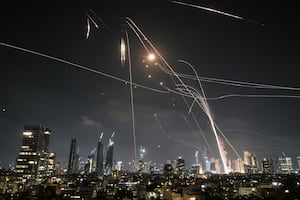
A defence source added that the Israelis were going through “an enormous bank of targets that they've started with the highest level” and would now “go through them in an orderly fashion”.
It is also becoming evident that Iran’s apparently strong air defences have proven ineffective and could very soon be wiped out by Israeli attacks.
“We are taking out their aerial defence system so we can operate more freely against their nuclear programme and against their military targets,” the Israeli military official added. “Dozens of radars and surface to air missile launchers have been destroyed.”
Nuclear dark ages
The key focus of attack will be Iran’s nuclear facilities with Israeli intelligence stating that Tehran now had enough enriched uranium to rapidly make 15 nuclear bombs.
While Israel does not have America’s GBU-57 13,600kg bunker buster bombs it does possess large but smaller GBU-28 1,800kg bombs thought to have been used in the assassination of Hezbollah leader Hassan Nasrallah in September.

With his command bunker buried deep below a Beirut apartment block, Israel deployed a number of the large bombs creating geometric patterns to penetrate deep.
Without US bombers, that could be the tactic Israel uses against Iran’s key nuclear sites such as Natanz and Fordow in order to eradicate its nuclear bomb making capability.
That will be the bombing campaign’s priority, said Richard Pater, director of the Anglo-Israeli Bicom think tank.
“The key question is that now embarked on this campaign, how many years are you going to be set be setting back Iran’s nuclear programme back as it had better be a long time,” he said.
“Everyone understands that the Iranian desire for revenge is going to be at a peak, so Israel had better do this thoroughly.”
Israel remains silent about whether its action will result in regime change but it is likely that it will want to remove the leadership that has sacrificed so much in search of its nuclear goal.

Retaliation options
Following Israel’s 18 months of fighting since October 7 attacks, Iran’s biggest deterrent against a backlash, Hezbollah, has been severely depleted and on Friday was only able to issue a benign statement that made no reference to military action.
Other proxies are unlikely to mount serious attacks, although there are concerns that that Houthis in Yemen might be able to up their near daily rocket attack with ballistic missiles, one of which came close to hitting Ben Gurion airport last month.
It now will take a few days for Iran to re-establish command and control over its armed forces after senior commanders were killed and once achieved, they may well have a limited revenge arsenal.
While 100 drones were fired towards Israel soon after Friday’s operation began, it appears that few made the eight or nine hour journey to their destination with most shot down.
That is because Israel now has a triple-layered air defence system that can take out drones, cruise as well as ballistic missiles.
Iran’s massed missile and drone attack last October only managed to kill a single Palestinian and damage an airfield.
That leaves the regime’s only other option of asymmetric warfare of using specialist teams such as Unit 840 to conduct terror attacks at Israeli establishments overseas.
But that will require direction and planning from the top, and Iran’s leadership appears under the unprecedented stress of having many of its generals removed from the battlefield.

Ineffectual Iran?
Defence analysts believe the air campaign could continue for a week, perhaps two to “degrade every aspect of the Iranian military command, control and executive function,” said Mr Ledwidge. “Today is just a start.”
“But the Iranians can't afford to wait a week to respond because they're going to be attrited now at a very high rate,’ he added.
Subsequently Iran’s internal communications have been seriously disrupted with the deaths the equivalent of Britain’s PJHQ (permanent joint headquarters), Ministry of Defence and head of military all being wiped out on one day, he said.
“Our mission is very clear, to remove an existential threat,” an Israeli military official told The National.
With Iran possessing a considerable stock of ballistic missiles – although their effectiveness is in question – Israel has made a point of attacking its launchers, including inserting a Mossad team, that was potentially local recruited, into Iran for direct strikes.

“We know they have hundreds of ballistic missiles ready to fire towards Israel,” the military official said. “We were able to in our actions this morning to weaken their chain of command, and carry out pre-emptive strikes against ballistic missiles.”
Ultimately the bombing campaign could see a “new Middle East” in the long term, said Dr Efrat Sopher, an Iranian foreign policy analyst.
“The immediate future is very worrying with the Iranian regime causing so much instability with all its tentacles but now removing the head of the octopus I believe will bring about a more a more stable international system and peace through prosperity,” she added.

