
Live updates: Follow the latest on Israel-Gaza
For decades, Zakaria Zubeidi had been arrested, released, re-arrested and even escaped Israeli jail in the famous Gilboa Prison break of 2021.
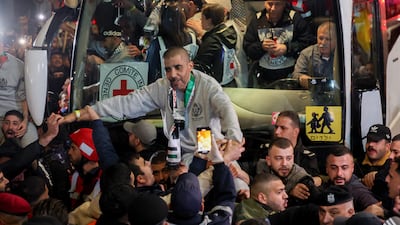
He was released on Thursday as part of an ongoing ceasefire agreement between Hamas and Israel in Gaza. Hamas and the Palestinian Islamic Jihad released three Israeli and five Thai hostages in exchange for 110 Palestinian detainees, one of whom was Mr Zubeidi.
Who is Zakaria Zubeidi?
The militant leader was born in the occupied West Bank's Jenin refugee camp in 1976 and was an active participant in armed resistance against Israeli occupation.
He rose through the ranks, becoming the head of the Fatah-affiliated Al Aqsa Martyrs' Brigades group in Jenin during the second intifada, which took place from 2000 to 2005.
“The second intifada was really the transformative moment,” Palestinian analyst and researcher Ahmad Bassioni told The National. That was when his mother was killed by Israeli forces in the 2002 Battle of Jenin along with his brother, who was also a fighter. “His relationship with the other brigades and people in the camp was very strong and he was a prominent member of society.”
Mr Zubeidi was arrested by Israel shortly afterwards. Upon his release years later, he admitted to being involved in the 2002 Beit She'an attack on an Israeli voting station, carried out by Al Aqsa Martyrs Brigades, in which six Israeli civilians were killed and 34 wounded.

In 2007, he was granted amnesty by Fatah and went on to become director of Jenin's Freedom Theatre and cultural centre. But Mr Zubeidi's own freedom was not long-lived. In 2011, Israel revoked his pardon – and he was arrested by the Palestinian Authority a year later for around six months.
On February 28, 2019, Mr Zubeidi, known as “The Dragon”, was arrested by Israel and charged with carrying out attacks on civilian buses in the West Bank. Two years later, he managed to escape from Gilboa prison, a maximum-security facility, through a tunnel with five other inmates, in a move that surprised Israel and made him a hero among Palestinians. He was re-arrested five days after his escape, and remained imprisoned until Thursday.
Mr Zubeidi denies the charges against him by Israel and said that he had given up his militant life in pursuit of political change. During his time in prison, he completed a Master's degree from Birzeit University, writing a thesis called The Hunter and the Dragon: Being hunted in the Palestinian Experience 1968–2018.
What comes next?
Following Thursday's release, Mr Zubeidi is in Ramallah and has not returned to Jenin, where Israel is carrying out a raid that has so far killed 18 people.

Unlike some of his fellow inmates released in this and previous rounds, Mr Zubeidi has not been exiled outside occupied Palestine.
“If he was a real threat, Israel would not have let him stay,” Mr Bassioni said. He added that slain Hamas leader Yahya Sinwar had promised Mr Zubeidi he would get him out of prison. “And now he has fulfilled that promise.”
Upon his release, a frail Mr Zubeidi prayed for victory to his comrades in Jenin camp. Dr Mai Al Kaileh, who examined him, said his ribs had been shattered and he had lost a startling amount of weight. “His condition is very difficult,” she said. “It’s not good.”
The question now is what the future holds for Mr Zubeidi – whether he will return to armed resistance, politics or art.
- Additional reporting from agencies

