Assad's fall leaves Syrians with challenge of healing six decades of tyranny


Khaled Yacoub Oweis
  • English
  • Arabic

Syria entered uncharted political waters on Sunday after the collapse of the 24-year rule of Bashar Al Assad under a rebel advance so swift even his allies in Moscow and Tehran failed to prevent it.

The president left the country by plane to an unknown destination hours after rebels overran the city of Homs, Arab officials said. The capture of Homs cut off the supply line from his seat of power in Damascus to the Alawite Mountains, the ancestral home of the Alawite minority that has dominated power in majority-Sunni Syria for the last six decades.

“Freedom, freedom,” shouted crowds in the main Umayyad Square in Damascus, a few blocks from Mr Assad’s home, as the fireworks lit the night sky.

The downfall of Mr Al Assad undermines years of methodical work by Russia and Iran to expand in the Middle East and weakens the US. He was a crucial link in an uneasy alliance but differed on how much Iran could use Syria as a launch pad to threaten Israel. The Russian and Iranian military presence had reportedly shrunk in Syria in the last week as the iron grip of the regime loosened.

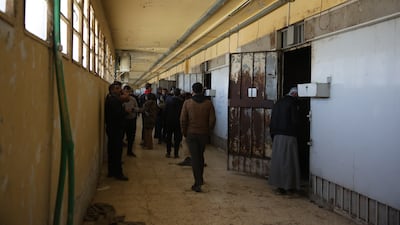
  • Syrians search for relatives whom they believe were detained in secret cells beneath Sednaya prison near Damascus. EPA
    Syrians search for relatives whom they believe were detained in secret cells beneath Sednaya prison near Damascus. EPA
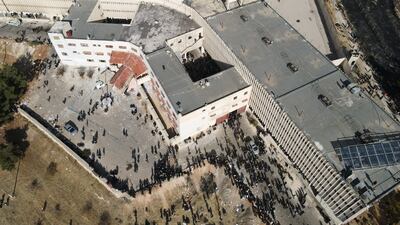
  • Rescue efforts to find prisoners at Sednaya prison continue. EPA
    Rescue efforts to find prisoners at Sednaya prison continue. EPA
  • Israeli soldiers in southern Syria. Reuters
    Israeli soldiers in southern Syria. Reuters
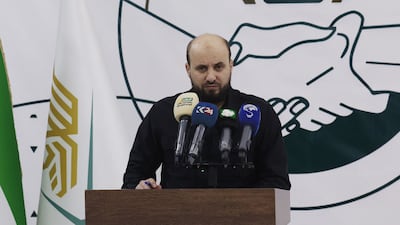
  • Mohammed Bashir, head of US-listed terrorist group Hayat Tahrir Al Sham's Salvation Government, at a press conference in the rebel-held northwestern Syrian city of Idlib in November. AFP
    Mohammed Bashir, head of US-listed terrorist group Hayat Tahrir Al Sham's Salvation Government, at a press conference in the rebel-held northwestern Syrian city of Idlib in November. AFP
  • Crowds gathering at Saadallah Al Jabiri Square in Aleppo. AP
    Crowds gathering at Saadallah Al Jabiri Square in Aleppo. AP
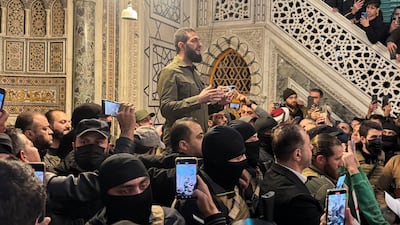
  • Senior insurgent commander Abu Mohammed Al Julani addresses a crowd at Ummayad Mosque in Damascus. Reuters
    Senior insurgent commander Abu Mohammed Al Julani addresses a crowd at Ummayad Mosque in Damascus. Reuters
  • Members of the Syrian government security forces are herded into a field by gunmen in Homs, Syria. EPA
    Members of the Syrian government security forces are herded into a field by gunmen in Homs, Syria. EPA
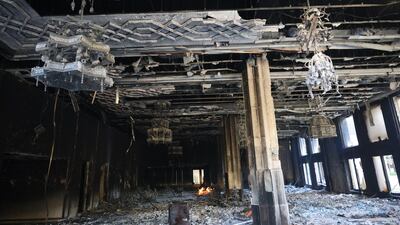
  • A hall inside the presidential palace gutted by fire after Syrian rebels took over Damascus. EPA
    A hall inside the presidential palace gutted by fire after Syrian rebels took over Damascus. EPA
  • A Syrian rebel fighter fires rounds as people celebrate in Homs after the city's liberation from the stranglehold of the Assad regime. AFP
    A Syrian rebel fighter fires rounds as people celebrate in Homs after the city's liberation from the stranglehold of the Assad regime. AFP
  • People gather to celebrate the Syrian government's fall at a mosque in Istanbul, Turkey. AP
    People gather to celebrate the Syrian government's fall at a mosque in Istanbul, Turkey. AP
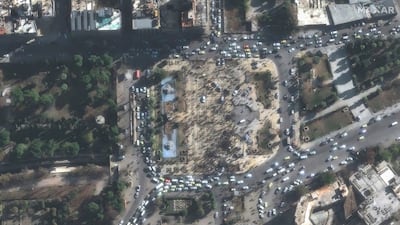
  • People gather around Umayyad Square in Damascus. AFP
    People gather around Umayyad Square in Damascus. AFP
  • Rebel fighters cheer from the back of a pick-up truck at Umayyad Square having stormed into the centre of Damascus, Syria. AFP
    Rebel fighters cheer from the back of a pick-up truck at Umayyad Square having stormed into the centre of Damascus, Syria. AFP
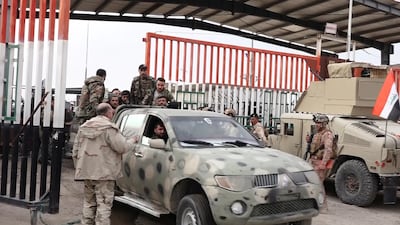
  • Syrian government forces cross the border into Iraq at Al Qaim. Reuters
    Syrian government forces cross the border into Iraq at Al Qaim. Reuters
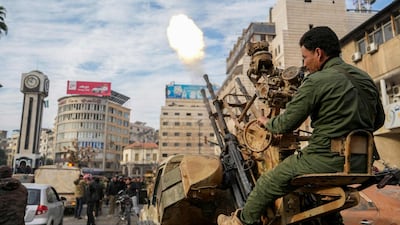
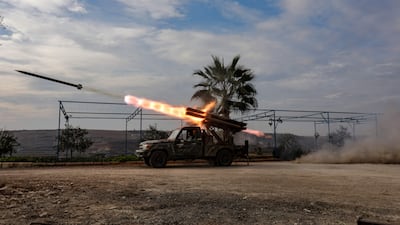
  • A multi-barrel rocket launcher fires at regime troops, in the northern outskirts of Syria's west-central city of Hama. AFP
    A multi-barrel rocket launcher fires at regime troops, in the northern outskirts of Syria's west-central city of Hama. AFP
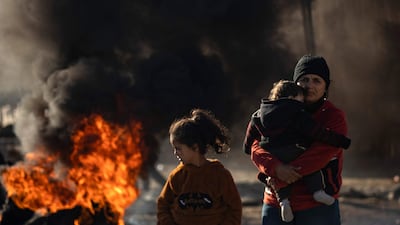
  • Syrian Kurds flee their homes in the outskirts of Aleppo. AFP
    Syrian Kurds flee their homes in the outskirts of Aleppo. AFP

Over the past 12 days, thousands of political prisoners in jails and secret police dungeons were freed after security forces abandoned their positions in the cities of Aleppo, Hama, Homs and finally Damascus. The high-walled compounds and security towers underpinned the iron rule of Mr Assad and before him his father Hafez Al Assad, who came to power in a 1970 military coup that deposed another Alawite officer. Posters and statues of the father and the son, symbols of the decades-long personality cult, came down.

“The minimum amount of bloodshed that has been spilt in the past several days leading to regime’s downfall tells you about the direction Syria is heading,” said Fawaz Tello, was jailed for five years for leading the pro-democracy Damascus Spring movement shortly after Mr Assad came to power in 2000.

The rebels are led by Hayat Tahrir Al Sham, an Al Qaeda offshoot with links to Turkey. Its leader Ahmad Al Shara, formerly known as Abu Muhammad Al Julani, has instructed the rebels to keep the civil department of the government under the supervision of the last prime minister who served under Assad. Mr Al Shara recently abandoned his nom de guerre, to project an image of moderation, although his organisation is listed as terrorist the US and Europe.

“The message is to maintain continuity of state functions and avoid violence,” Mr Tello said from Berlin, adding that Mr Shara is “currently the leader of the revolution” but that he will become a civilian figure.

“He can run for elections in the new, democratic Syria,” Mr Tello said, adding that core supporters of Mr Assad, who are mainly Alawites, can join in “building the new Syria if they don’t have blood on their hands".

“All what they need to do is to say sorry,” Mr Tello said.

Syria was the last country whose population arose in the wave of Arab uprisings a decade ago. The regime used deadly force to suppress the protest movement that began in March 2011, killing thousands of civilians and prompting a violent backlash by members of the Sunni majority. By the end of it, Syria was in civil war. The country fragmented into Russian, Iranian, US and Turkish zones of control, manned by the proxies of each country.

Ahmad Tumeh, who fled to Turkey to escape persecution after leading the pro-democracy movement in eastern Syria in 2011, said that the rebels “have learnt the lesson” from the disintegration of some states after the Arab uprisings.

“They will avoid chaos. Syria is on its way of becoming a pluralistic, tolerant state,” he said. “What happened has already proved that the Syrian people are capable of miracles."


Start-up hopes to end Japan's love affair with cash

Across most of Asia, people pay for taxi rides, restaurant meals and merchandise with smartphone-readable barcodes — except in Japan, where cash still rules. Now, as the country’s biggest web companies race to dominate the payments market, one Tokyo-based startup says it has a fighting chance to win with its QR app.

Origami had a head start when it introduced a QR-code payment service in late 2015 and has since signed up fast-food chain KFC, Tokyo’s largest cab company Nihon Kotsu and convenience store operator Lawson. The company raised $66 million in September to expand nationwide and plans to more than double its staff of about 100 employees, says founder Yoshiki Yasui.

Origami is betting that stores, which until now relied on direct mail and email newsletters, will pay for the ability to reach customers on their smartphones. For example, a hair salon using Origami’s payment app would be able to send a message to past customers with a coupon for their next haircut.

Quick Response codes, the dotted squares that can be read by smartphone cameras, were invented in the 1990s by a unit of Toyota Motor to track automotive parts. But when the Japanese pioneered digital payments almost two decades ago with contactless cards for train fares, they chose the so-called near-field communications technology. The high cost of rolling out NFC payments, convenient ATMs and a culture where lost wallets are often returned have all been cited as reasons why cash remains king in the archipelago. In China, however, QR codes dominate.

Cashless payments, which includes credit cards, accounted for just 20 per cent of total consumer spending in Japan during 2016, compared with 60 per cent in China and 89 per cent in South Korea, according to a report by the Bank of Japan.

War and the virus
Global state-owned investor ranking by size

1.

United States

2.

China

3.

UAE

4.

Japan

5

Norway

6.

Canada

7.

Singapore

8.

Australia

9.

Saudi Arabia

10.

South Korea

AL%20BOOM
%3Cp%20style%3D%22text-align%3Ajustify%3B%22%3E%26nbsp%3B%26nbsp%3B%26nbsp%3BDirector%3AAssad%20Al%20Waslati%26nbsp%3B%3C%2Fp%3E%0A%3Cp%20style%3D%22text-align%3Ajustify%3B%22%3E%0DStarring%3A%20Omar%20Al%20Mulla%2C%20Badr%20Hakami%20and%20Rehab%20Al%20Attar%0D%3Cbr%3E%0D%3Cbr%3EStreaming%20on%3A%20ADtv%0D%3Cbr%3E%0D%3Cbr%3ERating%3A%203.5%2F5%0D%3Cbr%3E%0D%3Cbr%3E%3C%2Fp%3E%0A
The specs
Engine: 3.0-litre 6-cyl turbo

Power: 374hp at 5,500-6,500rpm

Torque: 500Nm from 1,900-5,000rpm

Transmission: 8-speed auto

Fuel consumption: 8.5L/100km

Price: from Dh285,000

On sale: from January 2022 

It Was Just an Accident

Director: Jafar Panahi

Stars: Vahid Mobasseri, Mariam Afshari, Ebrahim Azizi, Hadis Pakbaten, Majid Panahi, Mohamad Ali Elyasmehr

Rating: 4/5

Countries recognising Palestine

France, UK, Canada, Australia, Portugal, Belgium, Malta, Luxembourg, San Marino and Andorra


Book%20Details
%3Cp%3E%3Cem%3EThree%20Centuries%20of%20Travel%20Writing%20by%20Muslim%20Women%3C%2Fem%3E%3Cbr%3E%3Cstrong%3EEditors%3A%20%3C%2Fstrong%3ESiobhan%20Lambert-Hurley%2C%20Daniel%20Majchrowicz%2C%20Sunil%20Sharma%3Cbr%3E%3Cstrong%3EPublisher%3A%20%3C%2Fstrong%3EIndiana%20University%20Press%3B%20532%20pages%3Cbr%3E%3C%2Fp%3E%0A
NEW%20PRICING%20SCHEME%20FOR%20APPLE%20MUSIC%2C%20TV%2B%20AND%20ONE
%3Cp%3E%3Cstrong%3EApple%20Music%3Cbr%3EMonthly%20individual%3A%20%3C%2Fstrong%3E%2410.99%20(from%20%249.99)%3Cstrong%3E%3Cbr%3EMonthly%20family%3A%20%3C%2Fstrong%3E%2416.99%20(from%20%2414.99)%3Cstrong%3E%3Cbr%3EIndividual%20annual%3A%20%3C%2Fstrong%3E%24109%20(from%20%2499)%3C%2Fp%3E%0A%3Cp%3E%3Cstrong%3EApple%20TV%2B%3Cbr%3EMonthly%3A%20%3C%2Fstrong%3E%246.99%20(from%20%244.99)%3Cstrong%3E%3Cbr%3EAnnual%3A%20%3C%2Fstrong%3E%2469%20(from%20%2449.99)%3C%2Fp%3E%0A%3Cp%3E%3Cstrong%3EApple%20One%3Cbr%3EMonthly%20individual%3A%20%3C%2Fstrong%3E%2416.95%20(from%20%2414.95)%3Cstrong%3E%3Cbr%3EMonthly%20family%3A%20%3C%2Fstrong%3E%2422.95%20(from%20%2419.95)%3Cstrong%3E%3Cbr%3EMonthly%20premier%3A%20%3C%2Fstrong%3E%2432.95%20(from%20%2429.95)%3C%2Fp%3E%0A
The President's Cake

Director: Hasan Hadi

Starring: Baneen Ahmad Nayyef, Waheed Thabet Khreibat, Sajad Mohamad Qasem 

Rating: 4/5

Updated: December 08, 2024, 11:50 AM