


The head of the UN’s nuclear watchdog will visit Iran on Wednesday for renewed negotiations on the country's disputed atomic programme days after Donald Trump was re-elected as US President, signalling more pressure on Tehran to come to the negotiating table.
Rafael Grossi, chief of the International Atomic Energy Agency, said it was imperative to “find ways to reach diplomatic solutions”.
“The Iranian administration must understand that the international situation is becoming increasingly tense,” Mr Grossi said ahead of his visit, AFP reported.
He is scheduled to hold talks with Iranian leaders on Thursday, including President Masoud Pezeshkian, who assumed office in July and is keen to improve ties with the West and revive the nuclear deal. He will also meet Foreign Minister Abbas Araghchi and Mohammad Eslami, the head of Iran's Atomic Energy Organisation.
The IAEA said it would hold “high-level meetings with the Iranian government” and conduct “technical discussions”.
Though Mr Grossi said he is hopeful of achieving a breakthrough on nuclear inspections, he also warned Iran that the “margins for manoeuvre are beginning to shrink”.
-
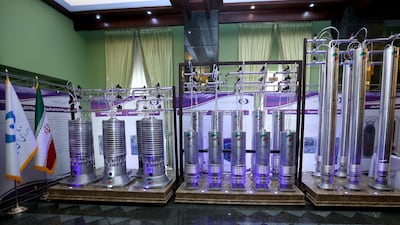
New generation Iranian centrifuges on display for Iran's National Nuclear Energy Day in Tehran, in April 2021. Iranian Presidency Office / Wana -

President Ebrahim Raisi, second right, is accompanied by Atomic Energy Organisation of Iran chief Mohammad Eslami, at Nuclear Technology Day in Tehran in April 2022. Iranian presidency / AFP -
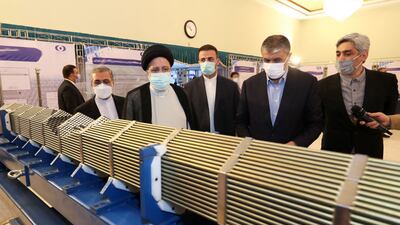
Mr Raisi and Mr Eslami at the April 2022 event. Iranian presidency / AFP -
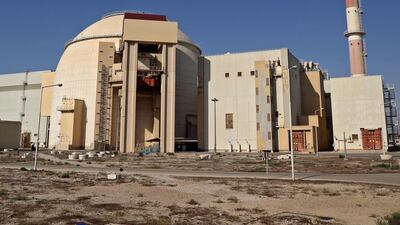
The Bushehr Nuclear Power Plant during a visit by Mr Raisi in October 2021. Iranian Presidency / AFP -
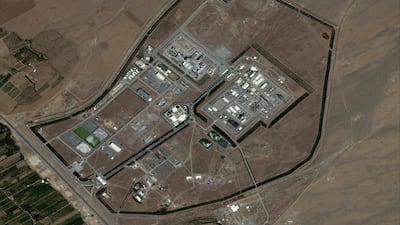
Iran's Arak Heavy Water Reactor complex, south of the capital Tehran in January 2020. Maxar Technologies / AFP -
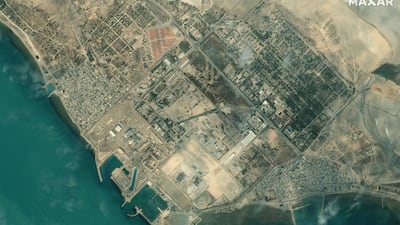
A satellite image of Iran's Bushehr Nuclear Power Plant in January 2020. Maxar Technologies / AFP -
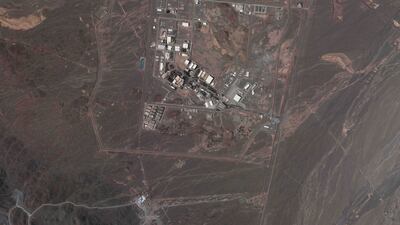
A satellite image of Iran's underground Natanz nuclear site in May 2022. Planet Labs PBC / AP -
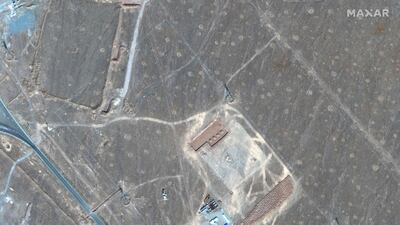
A satellite image in January 2020 of Iran's Fordow Fuel Enrichment Plant, north-east of the city of Qom. Maxar Technologies / AFP -
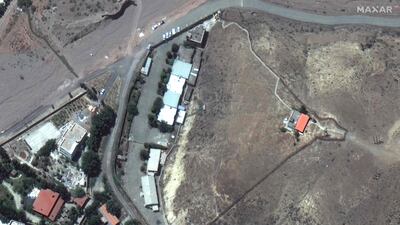
The Sanjarian nuclear centre, east of Tehran, in May 2021. Maxar Technologies / AFP


While the IAEA is allowed to carry out inspections in Iran, Mr Grossi said there was need for “more visibility” into Iran's nuclear programme, given its scale and ambition.
A 2015 nuclear agreement known as the Joint Comprehensive Plan of Action between Iran and China, France, Russia, the UK, US, Germany and the EU, curbed Iran's nuclear programme in exchange for the lifting of some economic sanctions.
But that deal collapsed after Mr Trump's administration in 2018 pulled out of JCPOA and imposed severe sanctions on Iran.
A year later Iran abandoned all limits on its nuclear programme and increased its reserve of enriched uranium to 60 per cent, short of the 90 per cent needed to develop an nuclear bomb.
It is against this backdrop that Mr Grossi is schedule to visit Iran for the first time since May. “They have a big, big nuclear programme,” he told CNN in an interview ahead of his visit.
“They have a lot of nuclear material that could be used eventually to make a nuclear weapon.”
He said he was visiting Iran at a moment it could take action that would trigger responses from Israel. The countries have traded recent missile attacks over the war in Gaza.

