Live updates: Follow the latest on Israel-Gaza
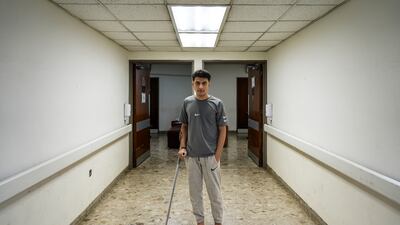
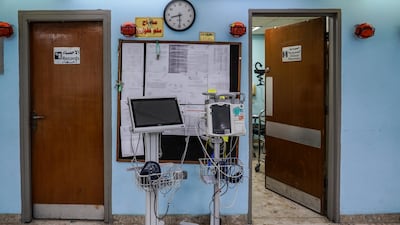
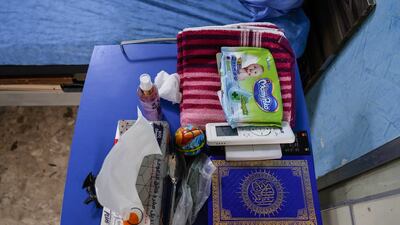
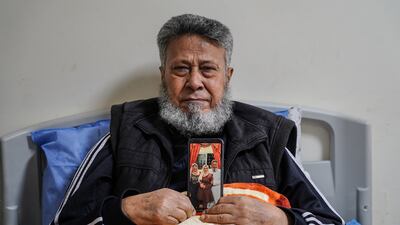
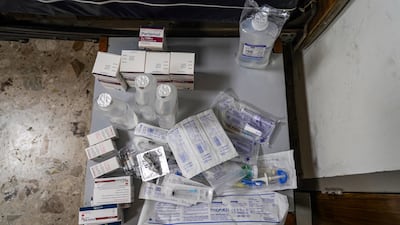
The first group of wounded Palestinians from the conflict-ridden Gaza Strip has arrived in Baghdad to receive treatment at Iraqi hospitals, the country's health ministry said in a statement.
A total of 27 patients injured in the Israel-Gaza war and with chronic diseases, accompanied by 42 carers, were flown on a military aircraft from Egypt late on Wednesday, the ministry said.
They arrived at Martyr Muhammad Alaa Airbase, at Baghdad International Airport, where ambulances waited to pick them up.
Patients were seen emerging from the aircraft on crutches, in wheelchairs and on stretchers. Some of the arrivals had Palestinian flags and keffiyehs draped over their shoulders.
Health ministry spokesman Saif Al Badr told The National that the Palestinians' injuries included burns and fractured bones.
They range in age from 10 to 70 years old, Mr Al Badr said, and among the elderly are patients with chronic diseases such as cancer and kidney failure.
“There is no time frame for their staying and they will leave whenever they finish the needed treatment,” he added, saying Iraq is ready to receive more Palestinians.
At least 35,800 Palestinians have been killed and 80,011 injured in Israel's military offensive on Gaza since the outbreak of the war in October, the enclave's health ministry said on Thursday.
Vast swathes of Gaza have been levelled during the conflict. Hundreds of thousands of people have been displaced and the lack of basic needs has prompted fears of a humanitarian crisis.
Thousands of wounded and sick Palestinians have been able to leave for treatment in Egypt and other countries since late last year.
Iraq welcomes first batch of wounded Palestinians for treatment – in pictures
'Our life was beautiful before the war'
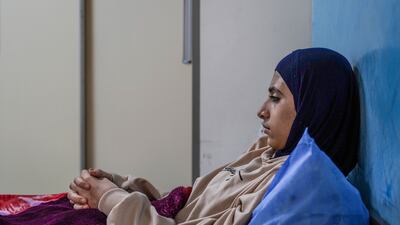
Among those who arrived in Baghdad was 13-year-old Mousa Mohammed Mousa.
Mousa crossed with his grandmother to Egypt in December, two weeks after two missiles hit a three-storey building in the Nuseirat area where they were sheltering. Six people were killed and 26 others from his family were wounded in the attack.
“I was sleeping when the explosion threw me outside the building,” Mousa told The National from his bed at Baghdad Medical City.
He received early treatment inside Gaza and then in Egypt for a broken pelvis and torn tendons in his right hand. He is likely to undergo plastic surgery in Baghdad.
“Our life was beautiful before the war,” he said. “We were going to schools, playing football, spending time by the beach and at restaurants but now devastation is everywhere,” he added.
In our entire life, we have never encountered a war of such ferocity
Ibtisam Kamil Al Amawi
His grandmother, Ibtisam Kamil Al Amawi, 56, added: “In our entire life, we have never encountered a war of such ferocity.
“It’s a genocide. As if they are telling us: ‘We want to kill you all,’” said Ms Al Amawi, who turned the TV on to live coverage of the war.
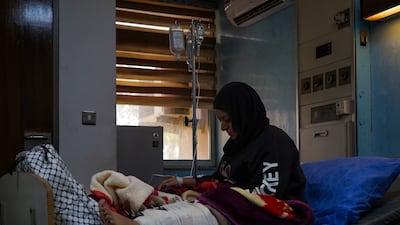
Next door, Reem Mohammed Abu Taha sat next to her 14-year-old daughter, Liyan. Two of her sons, aged seven and 17, were asleep in other rooms.
They were among 50 people inside a five-storey building in the Al Amal neighbourhood of Khan Younis, southern Gaza, when it was hit by four missiles in early December. Twelve people, including her 19-year old son, were killed.
Thirty minutes after the attack, they found Liyan under the rubble.
“She was in a coma and almost dead with shrapnel all over her body, brain bleeding and skull fractures,” Ms Abu Taha recalled, adding that her other sons also sustained fractures and burns.
She described Khan Younis as a “ghost city” where “no houses, no mosques and no hospitals remain, forcing all the residents to leave”.
Iraq is a staunch supporter of the Palestinian cause and has condemned the international community for not pressuring Israel to stop the war.
In March, the cabinet approved $25 million for the UN's Palestinian refugee agency, after international donors halted funding to UNRWA over allegations that employees were involved in the October 7 Hamas-led attacks on Israeli communities.

COMPANY%20PROFILE
%3Cp%3E%3Cstrong%3ECompany%20name%3A%3C%2Fstrong%3E%20Alaan%3Cbr%3E%3Cstrong%3EStarted%3A%3C%2Fstrong%3E%202021%3Cbr%3E%3Cstrong%3EBased%3A%3C%2Fstrong%3E%20Dubai%3Cbr%3E%3Cstrong%3EFounders%3A%3C%2Fstrong%3E%20Parthi%20Duraisamy%20and%20Karun%20Kurien%3Cbr%3E%3Cstrong%3ESector%3A%3C%2Fstrong%3E%20FinTech%3Cbr%3E%3Cstrong%3EInvestment%20stage%3A%3C%2Fstrong%3E%20%247%20million%20raised%20in%20total%20%E2%80%94%20%242.5%20million%20in%20a%20seed%20round%20and%20%244.5%20million%20in%20a%20pre-series%20A%20round%3Cbr%3E%3Cbr%3E%3C%2Fp%3E%0A
FIXTURES (all times UAE)
Sunday
Brescia v Lazio (3.30pm)
SPAL v Verona (6pm)
Genoa v Sassuolo (9pm)
AS Roma v Torino (11.45pm)
Monday
Bologna v Fiorentina (3.30pm)
AC Milan v Sampdoria (6pm)
Juventus v Cagliari (6pm)
Atalanta v Parma (6pm)
Lecce v Udinese (9pm)
Napoli v Inter Milan (11.45pm)
'Saand Ki Aankh'
Produced by: Reliance Entertainment with Chalk and Cheese Films
Director: Tushar Hiranandani
Cast: Taapsee Pannu, Bhumi Pednekar, Prakash Jha, Vineet Singh
Rating: 3.5/5 stars
Mercer, the investment consulting arm of US services company Marsh & McLennan, expects its wealth division to at least double its assets under management (AUM) in the Middle East as wealth in the region continues to grow despite economic headwinds, a company official said.
Mercer Wealth, which globally has $160 billion in AUM, plans to boost its AUM in the region to $2-$3bn in the next 2-3 years from the present $1bn, said Yasir AbuShaban, a Dubai-based principal with Mercer Wealth.
“Within the next two to three years, we are looking at reaching $2 to $3 billion as a conservative estimate and we do see an opportunity to do so,” said Mr AbuShaban.
Mercer does not directly make investments, but allocates clients’ money they have discretion to, to professional asset managers. They also provide advice to clients.
“We have buying power. We can negotiate on their (client’s) behalf with asset managers to provide them lower fees than they otherwise would have to get on their own,” he added.
Mercer Wealth’s clients include sovereign wealth funds, family offices, and insurance companies among others.
From its office in Dubai, Mercer also looks after Africa, India and Turkey, where they also see opportunity for growth.
Wealth creation in Middle East and Africa (MEA) grew 8.5 per cent to $8.1 trillion last year from $7.5tn in 2015, higher than last year’s global average of 6 per cent and the second-highest growth in a region after Asia-Pacific which grew 9.9 per cent, according to consultancy Boston Consulting Group (BCG). In the region, where wealth grew just 1.9 per cent in 2015 compared with 2014, a pickup in oil prices has helped in wealth generation.
BCG is forecasting MEA wealth will rise to $12tn by 2021, growing at an annual average of 8 per cent.
Drivers of wealth generation in the region will be split evenly between new wealth creation and growth of performance of existing assets, according to BCG.
Another general trend in the region is clients’ looking for a comprehensive approach to investing, according to Mr AbuShaban.
“Institutional investors or some of the families are seeing a slowdown in the available capital they have to invest and in that sense they are looking at optimizing the way they manage their portfolios and making sure they are not investing haphazardly and different parts of their investment are working together,” said Mr AbuShaban.
Some clients also have a higher appetite for risk, given the low interest-rate environment that does not provide enough yield for some institutional investors. These clients are keen to invest in illiquid assets, such as private equity and infrastructure.
“What we have seen is a desire for higher returns in what has been a low-return environment specifically in various fixed income or bonds,” he said.
“In this environment, we have seen a de facto increase in the risk that clients are taking in things like illiquid investments, private equity investments, infrastructure and private debt, those kind of investments were higher illiquidity results in incrementally higher returns.”
The Abu Dhabi Investment Authority, one of the largest sovereign wealth funds, said in its 2016 report that has gradually increased its exposure in direct private equity and private credit transactions, mainly in Asian markets and especially in China and India. The authority’s private equity department focused on structured equities owing to “their defensive characteristics.”
Classification of skills
A worker is categorised as skilled by the MOHRE based on nine levels given in the International Standard Classification of Occupations (ISCO) issued by the International Labour Organisation.
A skilled worker would be someone at a professional level (levels 1 – 5) which includes managers, professionals, technicians and associate professionals, clerical support workers, and service and sales workers.
The worker must also have an attested educational certificate higher than secondary or an equivalent certification, and earn a monthly salary of at least Dh4,000.
What the law says
Micro-retirement is not a recognised concept or employment status under Federal Decree Law No. 33 of 2021 on the Regulation of Labour Relations (as amended) (UAE Labour Law). As such, it reflects a voluntary work-life balance practice, rather than a recognised legal employment category, according to Dilini Loku, senior associate for law firm Gateley Middle East.
“Some companies may offer formal sabbatical policies or career break programmes; however, beyond such arrangements, there is no automatic right or statutory entitlement to extended breaks,” she explains.
“Any leave taken beyond statutory entitlements, such as annual leave, is typically regarded as unpaid leave in accordance with Article 33 of the UAE Labour Law. While employees may legally take unpaid leave, such requests are subject to the employer’s discretion and require approval.”
If an employee resigns to pursue micro-retirement, the employment contract is terminated, and the employer is under no legal obligation to rehire the employee in the future unless specific contractual agreements are in place (such as return-to-work arrangements), which are generally uncommon, Ms Loku adds.
Sholto Byrnes on Myanmar politics