

Live updates: Follow the latest on Israel-Gaza
Efforts to avert a famine in Gaza are at risk after Israel's military seized control of the Rafah border crossing on Tuesday, UN officials said.
Israeli tanks were seen on the Gaza side of the crossing from Egypt a day after the army ordered residents in parts of eastern Rafah to leave immediately ahead of a military operation in the area.
The Rafah border crossing between Gaza and Egypt has been closed, a UN official confirmed to The National on Tuesday.
Tamara Al Rifai, spokeswoman for the UN Relief and Works Agency for Palestine Refugees in the Near East (UNRWA), said the closure of the crossing to aid lorries since Monday would exacerbate the humanitarian crisis in Gaza.
“Most urgent/worrying if Rafah remains closed is that we will soon have a shortage of fuel, as fuel only comes in from Rafah,” she told The National.
“Without fuel, no movement of our lorries and people, no electricity, no sewage pumping."
Ms Al Rifai said the agency has been pushing for the entry of a minimum of 500 lorries a day into Gaza, carrying a mix of humanitarian and commercial items.
“That number was never reached. The numbers vary roughly between 100 and 250 per day,” she said.
Rafah is currently home to about 1.4 million people, more than 600,000 of them children.
-
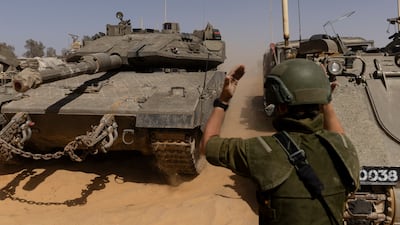
An Israeli soldier directs a tank near Israel's border with southern Gaza. Getty Images -
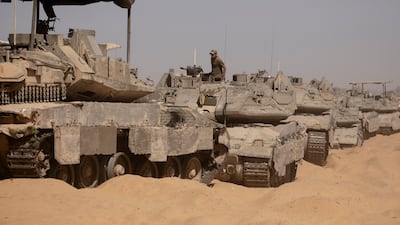
An Israeli soldier stands on a tank in southern Israel. Getty Images -
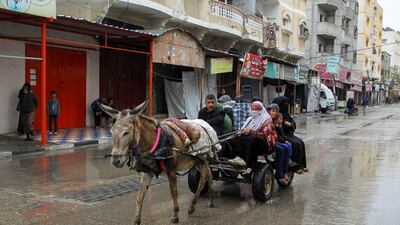
People flee the eastern parts of Rafah ahead of a threatened Israeli incursion. Reuters -
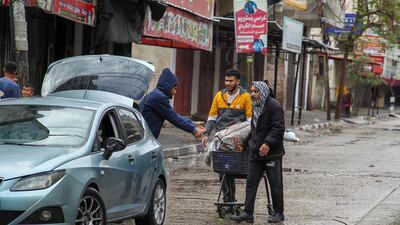
Palestinians leave ahead of a threatened assault on Rafah. Reuters -

Palestinians search for casualties in the rubble of a house destroyed in an Israeli strike in Rafah. AFP -
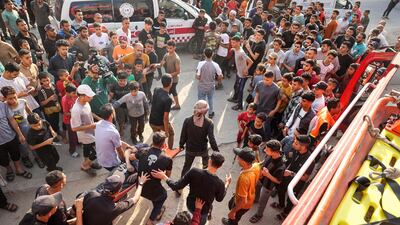
Palestinians carry an injured man who was pulled from the rubble of a house destroyed in an Israeli strike in Rafah. AFP -
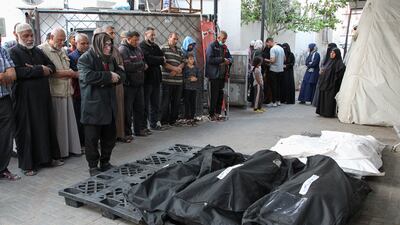
Mourners next to the bodies of Palestinians killed in an Israeli strike in southern Gaza. Reuters -
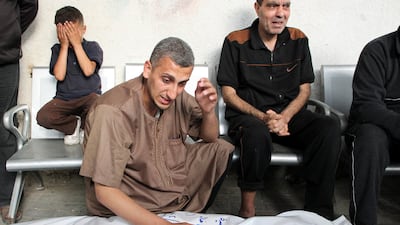
Mourners at Abu Yousef El-Najjar Hospital in Rafah. Reuters


Jens Laerke, spokesman for the UN humanitarian agency Ocha, said Israel had shut the Rafah and Kerem Shalom crossings, the two main entry points for aid delivery to Gaza, as part of its so-called limited-scope military operation in Rafah.
“The two main arteries for getting aid into Gaza are currently choked off,” he said.
He said UN agencies had very low stocks inside the Gaza Strip because humanitarian supplies are consumed almost immediately.
Gaza has a one-day buffer of fuel stocks, he said.
“If no fuel comes in for a prolonged period of time, it would be a very effective way of putting the humanitarian operation in its grave,” he said.

Israel closed the Kerem Shalom crossing on Sunday after a rocket attack by the militant group Hamas killed four soldiers stationed nearby.
Its incursion into Rafah comes despite repeated warnings from the international community about the toll that military operations would have on civilians in the overcrowded city. Israel insists it must enter Rafah to achieve its goal of eliminating Hamas and freeing hostages the group seized during its attack on southern Israel in October that left about 1,200 people dead.
Israel responded with a military offensive in Gaza that has claimed about 34,800 lives, destroyed most medical infrastructure and razed large areas of the territory. Strict controls on the entry of goods have created widespread hunger. Rafah is the only urban area its troops have not entered so far.
Ms Al Rifai said Rafah's residents were “all vulnerable – most have already been displaced several times".
She added: "An incursion into Rafah inevitably means a bloodbath.”
'Death sentence'
A spokesman for Gaza's crossing authority at Rafah said its closure was tantamount to a death sentence for residents of the Palestinian enclave.
“Israeli occupation has sentenced Gaza residents to death by closing the Rafah crossing," Hisham Idwan told The National. "It exacerbates the humanitarian situation and hinders aid entry into the strip.
“The presence of Israeli forces at the Rafah crossing led to its closure and the prevention of traffic and travel. Closing the Rafah crossing condemns cancer patients to death amid the collapse of the healthcare system."
Meanwhile, residents of eastern Rafah who moved west to Al Mawasi on Israel's orders said there were no facilities for them in the Israeli-designated "humanitarian area".
Ahmad Abu Saif, 22, said the coastal area was not equipped to receive civilians.
“The place is full of people and you have to bring your tent, otherwise you stay on the streets," he told The National.
"We managed to build a tent and a bathroom but there are dozens of people who are confused and don’t know what to do."
Ali Hassouna said the section of Al Mawasi in Khan Younis was destroyed and full of rubble.
“People have to clear the rubble and then prepare to build tents, which is not easy especially with the bad weather," he told The National.
“The situation is so difficult. Where are people supposed to go? I brought my aunt from the centre of Rafah city to the west but there is no place to stay. There are no tents or any essential facilities."

