

Live updates: Follow the latest on Israel-Gaza
Medical staff and civilians who were trapped in Israel's siege of Al Shifa Hospital are still missing as officials search the scenes of destruction, government and medical officials told The National on Wednesday.
Israeli forces withdrew from the medical complex in Gaza city on Monday following a two-week raid that left behind a trail of destruction and piles of decomposing bodies. The Israeli military said it had killed 200 "militants" and detained 900 for questioning, without specifying where.
Relatives of Palestinians missing from the hospital told The National of their frustration and concern.
Sarah Al Madhoun, whose husband worked as a nurse at Al Shifa, said he was arrested with several other doctors and is still missing.
“When the Israeli soldiers returned to the hospital they arrested my husband while he was on duty, along with many medical staff members. They fired at some of them, abused and tortured them in front of people,” said Ms Al Madhoun, who was among those stuck in Al Shifa during the raid.
Some of the Israeli soldiers were speaking in Arabic and insulting medical staff, she said.
“After that, they took them for interrogation and up to now we don't know anything about their fate,” she said, explaining that Israeli soldiers had set up interrogation rooms inside the hospital.
Ms Al Madhoun had moved to stay at Al Shifa Hospital after her home on Jalaa Street in Al Zeitoun to the south of Gaza city was destroyed during the war.
“We thought Al Shifa was a safe place because the occupation had withdrawn from it,” she said. "However, our expectations were wrong."
Dr Motasim Salah, a member of the Health Emergency Committee, said several of his colleagues were killed by Israeli forces inside the hospital, while others were missing.
"There were around 58 members of the medical staff inside Al Shifa Hospital," he told The National. "Israeli forces killed four of them, including the director of the pharmacy department, director of maintenance and a plastic surgery doctor.
"Israeli forces arrested approximately 41 members of medical staff, including all the specialists in the intensive care unit.
"Among the 41 medical staff members, there are some whom we don't have any information about; they are missing and not officially arrested because the Israeli occupation published a list of names of a number of medical staff, and those individuals are not on the list. Their families have come to inquire about them," he added.
Dr Salah said the Red Cross and the World Health Organisation had been contacted in the hope they could provide information regarding the missing staff but no update had been received.

Another civilian who had sought shelter in Al Shifa told The National three of her sons were still missing.
Nisreen Ishtiwi, 50, a homemaker, said she had taken her family to Al Shifa after their home in Al Zeitoun was destroyed and Israeli troops forced them to leave and head to the west of Gaza.
“I was with them, we had iftar together, and then I went to sleep at my brother's house,” she said. "At night, we woke up to find that the Israeli army invaded Al Shifa.
“I couldn’t find any news about them and I was so worried about them for two weeks”.
Ms Ishtiwi said people who were inside the hospital had told her that her sons were arrested and tortured, but she has not since received any news about them.
“Every time I heard about people being executed, I was very afraid and I prayed, 'God, please don't let it be them'," she said.
“My sons have no affiliations with any organisations or factions, they have never had any connections with any Palestinian party."
Israel has accused Palestinian organisations, including Hamas, of using hospitals as command centres, claims which Hamas and medical staff deny.
Ms Ishtiwi said she returned to Al Shifa after the Israeli withdrawal looking for her sons but still knows nothing about their current circumstances.
-

Palestinians inspect the damage at Al Shifa Hospital after Israeli forces withdrew from it following a two-week operation. Reuters -
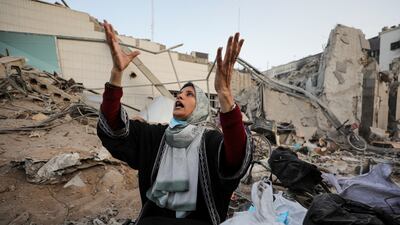
A woman reacts as she surveys the devastation at Al Shifa Hospital. Reuters -

Palestinians who returned to the site reported seeing 'hundreds' of bodies strewn around the area. Reuters -
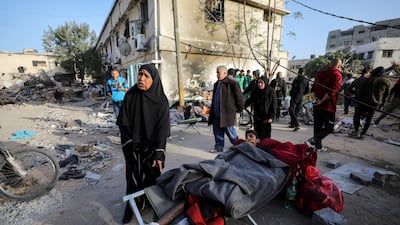
A woman stands next to a wounded Palestinian lying on a bed at Al Shifa Hospital after Israel's withdrawal. Reuters -

Palestinian women weep at the site of the hospital. AFP -

Israel says it killed 200 'militants' during its two-week siege at Al Shifa Hospital. EPA -

Palestinians inspect the damage at Gaza's Al Shifa Hospital after the Israeli military withdrew from the medical complex. AFP -
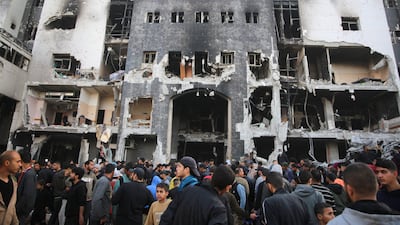
Gazans gather outside the damaged hospital. The Israeli raid began in the early hours of the morning on 18 March. AFP -

A man inspects the damage caused by Israeli air strikes at the hospital. The Gaza Health Ministry says at least 300 people were killed in the two-week Israeli operation. AFP -
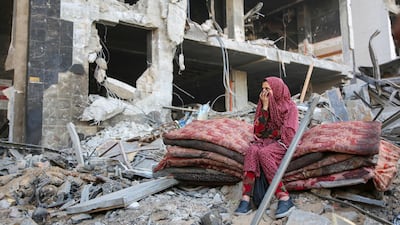
A Palestinian woman reacts as she sits amidst the rubble of the hospital. AFP -
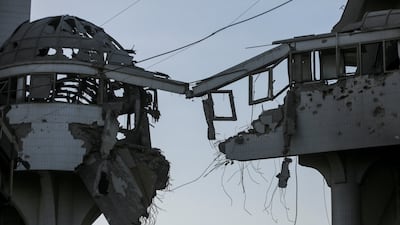
A destroyed part of a building stands at Al Shifa Hospital after Israeli forces withdrew following a two-week operation. Reuters -
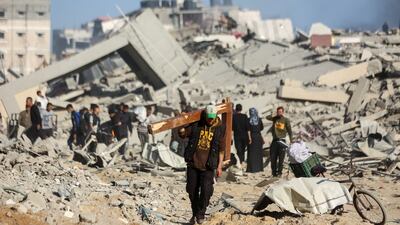
Palestinians inspect the damage caused by Israeli forces. Army radio said at least 200 'militants' were killed by Israeli forces, while Gaza health authorities say at least 300 people were killed. Reuters -

Palestinians look out of the Special Surgery building at Al Shifa Hospital. Reuters -
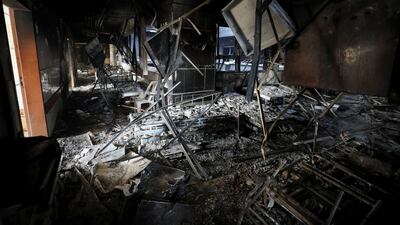
Burnt beds lie on the floor at Al Shifa Hospital amid the continuing conflict between Israel and Hamas. Reuters -
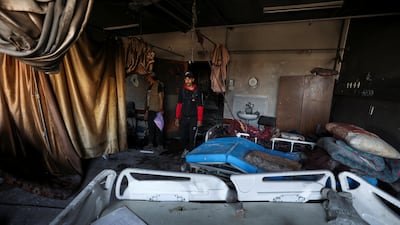
Palestinians inspect a destroyed ward inside the hospital. Reuters -

Destroyed houses and buildings around Al Shifa Hospital. Reuters -

The Israeli army destroyed a makeshift graveyard established near the hospital. Reuters


Omar Al Hiw, 30, who lives in Jabalia camp in northern Gaza, said he had no information about his father, who was inside Al Shifa with his brother when Israeli forces attacked.
“My brother, Salah, was injured in Al Shifa Hospital and went to get treatment there, my father was with him to take care of him,” he told The National.
Mr Al Hiw said he was told by people inside the hospital that Israeli soldiers had arrested his 52-year-old father, and abused him in front of other people in the room.
“When the army released photos of the detainees in Al Shifa, we were surprised to see a picture of my father among them," he added.
"My father doesn’t have any connection to the resistance.
“We have lost contact with him, we don't know how to reach him. We tried with the Red Cross and others, but with no result."

