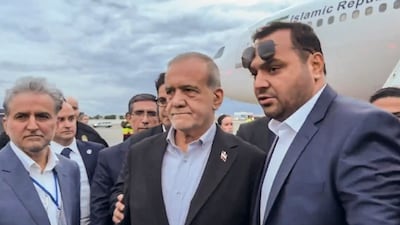

Iran's President Masoud Pezeshkian has arrived in New York for the UN General Assembly as senior US and Iranian officials pursue talks that could open the way to further diplomatic contact between the two countries.
Mr Pezeshkian is due to address the 193-member body on Wednesday. His visit is unfolding against a backdrop of renewed US-Iranian diplomacy and uncertainty over whether he will meet President Donald Trump.
Mr Trump said on Tuesday that his envoys, Steve Witkoff and Jared Kushner, had a “very good” three-hour meeting with Iranian Foreign Minister Abbas Araghchi and that there was “a lot of momentum” towards a deal. Mr Witkoff later said the two sides had completed a round of discussions that he hoped would "prove constructive and promising".

Mr Pezeshkian touched down in New York under pressure from Iran's hardline establishment over how far Tehran should go in engaging with Washington.
Mohammad Jafar Ghaempanah, a senior presidential aide, said in a post on X that he conveyed calls to cancel the trip, but Mr Pezeshkian insisted on going to present Iran's strength and grievances to the world.
Before leaving Tehran, Mr Pezeshkian said he would “firmly defend” Iran's positions at international forums and use the UN to present what he described as the country's plight and the consequences of the war.
Iranian officials have emphasised that the delegation's mission is to defend Iran's rights and interests. Hardliners have warned against allowing the visit to become an opportunity for conciliatory gestures.
The ultraconservative Kayhan newspaper warned that “New York is not a place for smiles and negotiations”, urging Mr Pezeshkian instead to turn the UN into “a courtroom for American crimes”. Other hardline voices have questioned whether Iran should have attended the General Assembly at all.
Yet alongside that rhetoric, senior figures in Iran's security establishment have been making the case that negotiations can be consistent with resistance.
military adviser to Iran's supreme leader and former IRGC chief
A notable signal came from Yahya Rahim Safavi, a former commander-in-chief of the Islamic Revolutionary Guard Corps who now serves as military adviser to the supreme leader.
“If the leader of the revolution has now deemed it in the country’s interest and has left the government open to negotiations, that is a very important act of prudence,” Maj Gen Safavi said, leaving room for talks without requiring Iran’s security establishment to describe them as a retreat.
The remark was widely reported by Iranian media overnight, including outlets on the conservative and hardline side of the political spectrum.
He also argued that Iran could negotiate while remaining prepared for war, framing diplomacy and military readiness as complementary rather than contradictory. It is a position also echoed by Parliament Speaker Mohammad Bagher Ghalibaf.
Maj Gen Safavi has nevertheless stressed that Iran's demands must be respected, including its positions on the Strait of Hormuz, the Bab Al Mandeb strait and a regional security arrangement involving Iran and the Gulf states rather than Washington.
That language gives Mr Pezeshkian some political room to engage. Tehran can present negotiations as a way to pursue its interests without portraying them as a concession to Washington.
It remains unclear whether that approach can extend to a meeting between the two presidents. Reformists have argued that any presidential meeting would require approval from the highest levels of Iran's political establishment. Former parliament speaker Mehdi Karroubi has called for a meeting aimed at pursuing lasting peace.
The Etemad newspaper has highlighted previous missed opportunities for meetings between former presidents Mohammad Khatami and Bill Clinton in 2000 and Hassan Rouhani and Barack Obama in 2013.
For now, no meeting between Mr Pezeshkian and Mr Trump has been scheduled, with Iranian officials saying no such plans are in place.
Mr Trump has signalled that he is open to a meeting, while Arab mediators continue to work to facilitate high-level US-Iranian contact at the UN. Any meeting with Mr Trump is likely to carry considerably greater political weight than the talks taking place through intermediaries.

