
The Spanish train driver who died in Wednesday’s high-speed crash had warned of the “shocking deterioration” of the country’s railway infrastructure.
Anger has followed the initial shock caused by the crash, which killed 69 people. A similar incident in January killed 46 people on the same rail line.
Spain's Transport Ministry initially appeared to blame human error for the latest crash, but railway unions have said a failing system is at fault. They went on a planned strike on Thursday over demands for enhanced security measures after January's accident.

The Civil Guard said it has received reports of 64 people missing in what is already Spain's deadliest train accident since 2013.
Spanish media published leaked audio of the last moments before the crash, in which train driver Antonio Acedo, 36, is told by a controller to restart his train at full speed, unaware that a second immobilised train had stopped in front of him.
Mr Acedo then travelled 25km towards the train that a colleague was trying to restart. Mr Acedo's train rammed into it at a speed of at least 160 kph, a preliminary report about the accident has found, causing carriages to derail. The driver of the second train is reported to have survived the crash.
"The sequence of malfunctions, instructions, and actions eventually led to the collision, in the absence of the necessary mitigating barriers," the preliminary report by the Independent Authority for the Technical Investigation of Accidents and Incidents.
Mr Acedo had helped Spain's centre-left political party Izquierda Espanola with its transport programme, party founder Guillermo del Valle said on X.

He had raised concerns about shortcomings, including "the glaring lack of funding for maintenance, and the abandonment of all these years that has resulted in a shocking deterioration of the railway infrastructure", Mr Valle said.
Degradation and deterioration
Mr Valle said it was "dramatic" that the Socialist government was "incapable of assuming the slightest political responsibility". It is "intolerable" that it tried to blame Wednesday's crash on human error, "as if Spain's high-speed safety system depended on a specific worker, not on a design and a technically complex system', he added.
Lawyer Paula Fraga, who worked with Mr Acedo in Izquierda Espanola, told El Mundo that: "He was one of the first to speak out against the degradation and deterioration he saw in his working conditions, even before Adamuz". That was a reference to January's accident in which a high-speed train crashed into a second one that had derailed.
"Afterwards, he was very worried, saying that if things didn't change, we were doomed to repeat the same mistakes. And look, it's happened to him. It's unbelievable," Ms Fraga said.
The tragedy has soured Prime Minister Pedro Sanchez's bid for re-election in a snap vote scheduled for November 29. He had lately appeared to be gaining some traction, with an October survey by state-run pollster CIS showing his party ahead of its rivals.
On Wednesday evening, hundreds of mostly far-right demonstrators gathered in front of Spain's Transport Ministry to call for Mr Sanchez to resign. One protester carried a banner emblazoned with the words: "Spain can't take it any more."
-
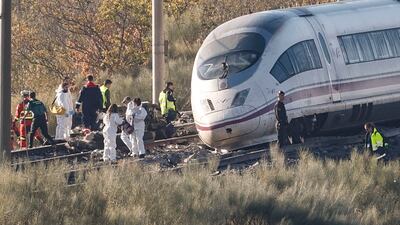
Emergency crews work at the scene of a deadly collision between two trains near Urda, in Toledo province, central Spain. EPA -
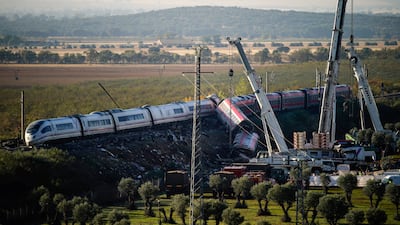
Cranes lift derailed carriages at the crash scene as rescue crews search for survivors. Reuters -
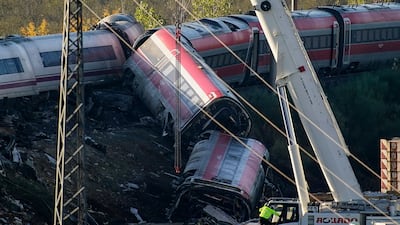
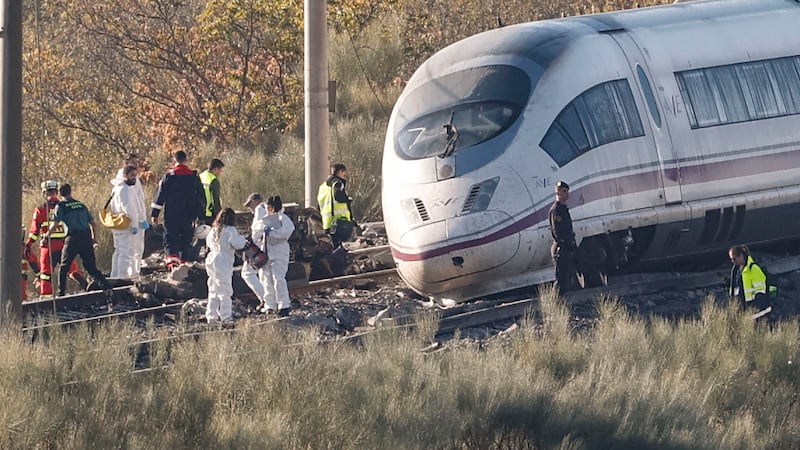
A state-run Renfe train collided with a stationary Iryo-operated train. Reuters -
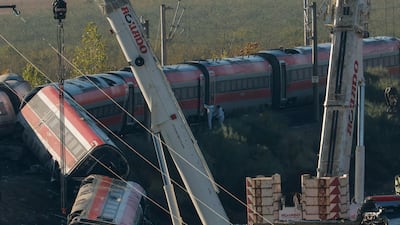
Spain declared three days of mourning following the country's second deadly high-speed train crash of 2026. AFP -
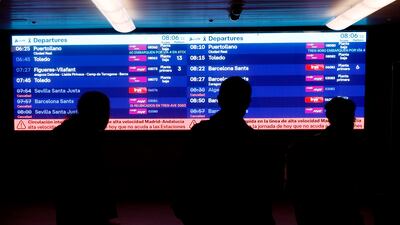
A passenger-information screen at Madrid's Atocha station shows cancelled trains following the crash near Urda, as drivers' union Semaf starts a 24-hour strike. EPA -
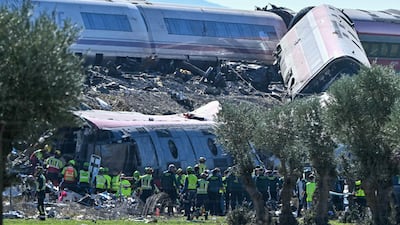
Emergency crews at the crash site 132km south of Madrid. AFP -
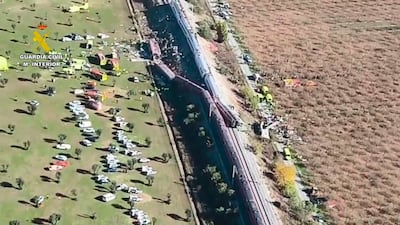
An aerial view of the site. EPA -
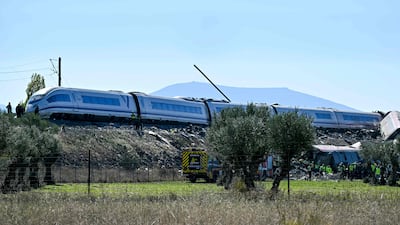
The two trains were carrying more than 540 people on the line from Madrid to Seville. AFP -
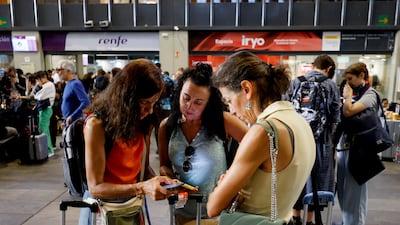
People check their phones for updates at Sevilla Santa Justa station amid delays and cancellations following the collision. Reuters -
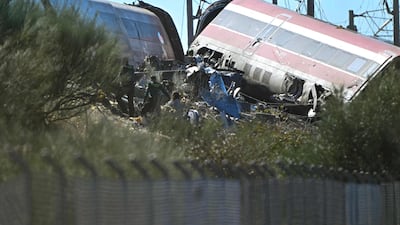
A derailed carriage and twisted metal on the embankment following the crash. AFP


"This government has destroyed absolutely everything, including infrastructure," said Santiago Abascal, leader of the far-right Vox party at a rally on Wednesday. "We will not let them use the mourning we share, the anger, pain and indignation, to silence even for a second the condemnation of what is happening in Spain."
Transport Minister Oscar Puente rejected accusations in a media conference on Wednesday that Spain's railway system was dangerous. He said it was "reliable and safe ... with the limits of the material itself and of human action, as is the case with any form of transport".
Mr Sanchez once described the country's 4,000km high-speed rail system – the world's second-largest after China's – as a political asset, but it may now become a liability.
Polls in Spanish media in January showed 57 per cent believed rail services had worsened since Mr Sanchez took office. About 60 per cent said they had little or no trust in Spain's rail system.
An investigation into the cause of the latest accident is still under way, the Transport Ministry said. A preliminary report found a fracture in the rail that appeared to have occurred before the derailment.
Agencies contributed to this report

