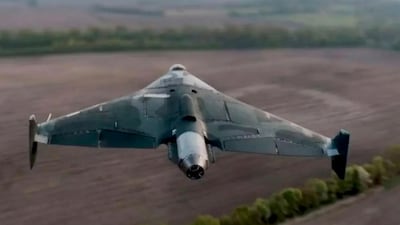

Western analysts are racing to discover the secrets of a Russian jet-powered drone that crashed in Moldova this week as they seek to combat a weapon that could become a major threat.
The wreckage will give intelligence experts a rare opportunity to examine the technology behind Moscow’s increasingly sophisticated kamikaze drones that could tilt the Ukraine war in Russia’s favour.
There are also fears, experts have told The National, that the technology could rapidly be transferred to Iran, providing it with a weapon that Ukraine is struggling to shoot down.


Robert Tollast, an analyst at the Royal United Services Institute, called the Geran drone “a phenomenal development” and “one of those moments in the Ukraine war, where suddenly a weapon has changed the war”.
Initially, Russia was only able to produce about 500 Geran-4s and the more advanced Geran-5 turbojet drones a month in May. But production rates have now accelerated to 3,000 in the last month, according to Ukrainian military intelligence.
Wreckage secrets
The debris from Wednesday’s crash is likely to reveal how Russia is making its jet drones travel at 600kph, more than triple the speed of the Shahed-136 models originally supplied by Iran.
“They’re moving so fast that we can’t get a proper lock on them,” Ukrainian air defence commander Volodymyr Serdiuk told the media.
Investigators will pore over the flight computer and navigation systems to see how they are controlled and the potential to jam them with electronic warfare.
Processors, antennas and communications equipment, as well as the engine itself will give clues to new and innovative designs.
While the wreckage is probably a Geran-4, it is similar to the latest Geran-5, which carries a heavier payload and represents a further evolution of the original Iranian-designed Shahed.

It will be crucial to discover how and why Moscow has been able to so quickly develop a weapon that could have an impact far beyond Ukraine’s battlefields.
“The defining challenge posed by Russia’s Geran programme is the speed at which Russia can learn and adapt,” the Centre for Strategic and International Studies, a US think tank, stated in a report last month.
It added that modifications were quickly tested in combat, with solutions adopted and “unsuccessful experiments quickly discarded”.
The report described a “continuous adaptation cycle” in which front-line experience translates into production changes within weeks rather than years.
Speed race
But that is something the Ukrainians are capable of too, with significant work now going into building jet-powered interceptors.
The Gerans were flying higher and faster than propeller-driven drones. Ukraine’s quickest interceptors, capable of a maximum 400kph, are not fast enough.
“Right now, we’re in a race for speed,” said a Ukrainian drone developer.
One advantage they do have is that the Geran’s relatively short 950km range means it needs to be launched much closer to the border, making it vulnerable to counter-attack.

Its 90kg payload – compared with about 400kg for a Russian cruise missile – is probably not enough to penetrate the concrete defences surrounding Ukrainian substations, which will be key to supplying electricity during freezing winter temperatures.
Russia and Iran’s older, slower drones had previously given Ukraine a long “engagement window” for tracking before shooting down. Interception rates dropped to about 60 per cent compared to previous models as Ukraine’s defences struggled with the new models' speed, altitude and manoeuvrability.
While fighter jets, using either their cannon or more expensive missiles, can be used, the cost ratio means million-dollar weapons are being deployed against drones costing little more than $100,000 each. Therefore, Ukraine needs to find a cost-effective method of interception.
Iran transfer
That will become relevant to the Gulf as questions are being asked about whether the Russian technology will be transferred back to Iran.
Tehran already has the turbojet-powered Shahed-238, which CSIS believes can travel between 300kph and 600kph while carrying a payload of up to 90kg.

In a major attack, Iran could combine jet-powered drones with Shahed-136s and ballistic missiles, presenting multiple threats simultaneously.
It was only a “matter of time” before Tehran got hold of the technology, said Mr Tollast.
“Iran is famously good at reverse engineering various components that it's got its hands on from various conflicts in the region.”
He also raised the prospect of the rebel Houthis, who have already demonstrated an ability to build their own rockets and drones, manufacturing jet-powered drones that would present a threat to Saudi Arabia.

The key, he said, would be for GCC countries to work alongside the Ukrainians “to accelerate the development of low-cost jet-powered interceptors” and build a highly capable defensive belt.

