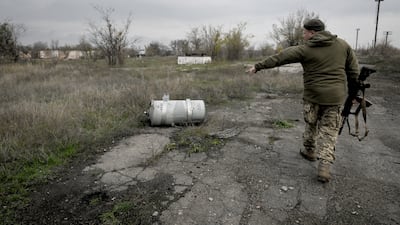

Almost nine in 10 casualties from cluster munitions in 2025 were civilians, a report has found, as wars on multiple fronts result in a rise in their use.
At least 1,063 people were killed or injured by cluster munitions, one of the highest totals on record, according to a monitor report released today by the Cluster Munition Coalition (CMM), an organisation working in more than 100 countries to eradicate the weapons.
Cluster munitions are ground-launched or air-dropped weapons that release hundreds of smaller “bomblets” intended to detonate on the ground. However, many fail to explode on impact and can remain active for decades, acting like hidden landmines.
Fresh attacks caused 946 casualties, while 117 were caused by remnants. CMM said civilians accounted for 87 per cent of the casualties, “bearing the overwhelming human cost of these indiscriminate weapons”, in nine countries: Iraq, Syria, Lebanon, Afghanistan, Cambodia, Laos, Myanmar, Russia and Ukraine.
Ukraine recorded at least 927 casualties – the highest country total globally for the fourth consecutive year.
The Third Review Conference on the 2008 Convention on Cluster Munitions takes place in Laos next week, 16 years after the convention came into force.
The CMM said that while the convention banning these weapons “continues to deliver tangible humanitarian results”, it is coming “under mounting pressure from ongoing use and production, the first-ever withdrawal of a state party, and deep cuts to funding for clearance and survivor support”.
It said states outside the convention “risk undermining the broader norm against cluster munitions”. It said Iran used them repeatedly against Israel in 2026 and Thailand used them against Cambodia last year, and Russia and Ukraine both continue to use them in their war, which is in its fifth year.
It cited three separate Iranian attacks on Israel that caused dozens of injuries and at least eight deaths. It said there had also been allegations of use by other states not party – including Israel, Pakistan, and possibly the US as well as by Houthi forces operating in Yemen – but remained unconfirmed.
Policy researcher Nicolo Scarpat told The National there had been allegations of use by Israel in Lebanon and Palestine since 2023, and by Israel and/or the US in Iran in 2026, but the monitor could not independently verify them.

The monitor also found evidence of new production in several countries, including Israel, which had struck a three-year contract with the US despite announcing in 2020 that its last known manufacturer had ceased manufacturing the weapons. There was also evidence that North Korea transferred cluster munitions to Russia.
“This year's findings show a convention that keeps delivering results to affected communities,” said Tamar Gabelnick, director of the Cluster Munition Coalition. “Yet the rising human toll, continued and new use, production, and transfers by states not party are stark warnings that these gains cannot be taken for granted. And as humanitarian needs grow, funding cuts are stripping away the care survivors depend on.”
Syria had the highest number of casualties from remnant munitions from the 2012-24 period, at 68, while Iraq suffered four casualties. Iraq's contamination dates mainly from 1991, when the US, France and the UK dropped 61,000 cluster bombs containing some 20 million bomblets over Iraq and Kuwait, and from 2003, when the US and UK used nearly 13,000 cluster munitions containing 1.8 to 2 million bomblets.
“There are no known uses of cluster munitions in Syria since the fall of the Assad regime in late 2024, and Iraq has not used them,” said Mr Scarpat.
In 2025, approximately $116 million in international and national funding was provided to address cluster munition contamination. However, the US foreign assistance freeze in February 2025 disrupted clearance in several regions, including South-East Asia, while subsequent grant terminations reduced mine action capacity in Afghanistan, Iraq and South Sudan.

