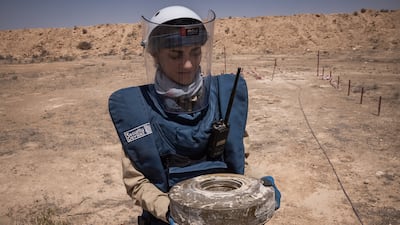

At least 800 people, almost a third of them children, have been killed by mines and unexploded devices since the collapse of the Assad regime in Syria in December 2024, according to figures shared with The National.
Of the 2,300 people reported injured, 40 per cent were children, the Halo Trust has revealed. The British demining charity estimates the actual number is much higher due to underreporting, as an increasing number of Syrians return to their homes and land.
Russian-made landmines remain scattered across farmland where they were laid by the Assad regime’s forces during the 13-year civil war. The largest concentration is on the former front lines in north-west Syria, where the Halo Trust estimates there is a 200km stretch of landmines across agricultural land.

The Halo Trust hopes UN Secretary General Antonio Guterres's visit to Damascus this week will help to highlight the risk Syrians are facing.
“They're coming [back] and starting to cultivate that land and having accidents in frightening numbers,” said Andrew Moore, Halo's regional director, who has recently returned from a mission in Syria.
“It’s having a devastating impact on the agricultural economy because those areas were completely abandoned by their populations. It was just the militaries there.”
The fields once used for wheat and other cereals, or orchards and olive groves, were turned into front lines when the population fled as the Syrian army and its backers moved in.
Tractors operated by farmers have struck landmines. A father and daughter were killed on the day they returned to their land when they went out looking for firewood, Mr Moore said.
This is in addition to unexploded devices in towns and cities targeted during the war.
Clearing the mines and unexploded bombs could take a decade. But displaced Syrians cannot wait that long to go back home.

Mr Moore hopes Mr Guterres’ visit to Syria will help shed light on the issue has killed hundreds of people so far and will continue to worsen as more people return to the country.
“I’m hoping that the Guterres visit can just bring some focus back to Syria, bring some attention, because this is a country that people really want to return to peace, to stability, to prosperity,” he said. “You can see it everywhere you go. They just need a bit of a helping hand.”
Mr Guterres will meet Syrian President Ahmad Al Shara as well as civil society groups during his visit, which begins on Saturday.
The UN came under repeated criticism during the Syrian civil war due to the Security Council’s inability to pass resolutions on sanctions and humanitarian aid due to Russia’s veto power.
The World Food Programme was also accused of allowing the Syrian regime to direct aid to the territories that it controlled, while opposition-held areas were under siege.

Yet the new authorities have continued to engage with the organisation, with a UN representative appointed soon after the fall of the Assad regime.
Halo’s team in Syria has grown from 40 to 250 members since Bashar Al Assad was ousted from power and it expects to reach 350 staff by the end of the year. The charity plans to bring in overseas specialists for the first seven years, with the view that demining can then be entirely managed by Syrians.
It is also working on public awareness campaigns about the landmines and their risks.
“People are acutely aware of the landmines. But you have a population that is returning, is desperate to return to normality and earn income from its land again,” Mr Moore said. “People are willing to take a risk because they don't want to wait 10 years to cultivate their land.”