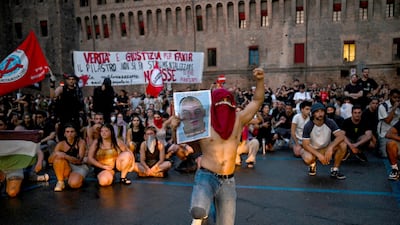

A Moroccan man's death during an arrest in northern Italy has threatened to escalate into a diplomatic row after sparking anti-police protests that have left dozens injured.
Morocco's Foreign Ministry said it is “following with concern the events and facts leading to the death of a Moroccan national in Bologna, Italy”.
Witness footage shows that Moroccan-born Abderrahim Fakir appeared to die by suffocation as officers sought to arrest him in the Pilastro neighbourhood on the outskirts of Bologna on Sunday.

Residents called security after seeing Mr Fakir displaying erratic behaviour, including damaging parked cars. The police used pepper spray before physically restraining him. They reportedly told ambulance personnel that Mr Fakir had been having a “psychiatric episode”.
A widely shared video shows him face down saying “Help, help, that’s enough”, as two officers sit on him after handcuffs were applied. Medical personnel appear to turn him over and check for signs of life after he fell silent.

“Moroccan authorities have asked the relevant Italian authorities to swiftly initiate a thorough investigation to shed full light on the circumstances of this death and to provide the necessary clarifications regarding this tragedy,” the Moroccan Foreign Ministry said.
“They have also called for accountability and the full application of the required legal measures and procedures.”
Violent protests
The circumstances of Fakir's death have drawn comparisons with George Floyd, an unarmed African-American man whose death at the hands of police in Minneapolis in 2020 sparked mass protest movements under the slogan “I can't breathe”.
Bologna’s center-left mayor Matteo Lepore, who had urged people to gather in the city to demand justice for Mr Fakir, said Italy did not want “victims like George Floyd”. But he called the subsequent violence “blind, unjustified, and senseless”.
The Bologna prosecutor's office has launched an inquiry into Mr Fakir's death, as is standard procedure in such cases. Italian Prime Minister Giorgia Meloni called for a full investigation while condemning anti-police protests in central Bologna on Monday that left 56 people injured.
The demonstration turned violent when a group of protesters threw firecrackers, bottles and chairs at police, who responded with tear gas and water cannon, Italian media reported.
The case has drawn political reactions from across the spectrum, with opposition politicians demanding full accountability and members of the governing coalition defending the officers involved.
Speaking to Il Giornale newspaper on Wednesday, Ms Meloni said “it is imperative that any potential responsibilities are thoroughly investigated with the utmost rigour”.

“The truth must be pursued to the very end, without prejudice and without leniency for anyone,” she said. “But nothing can justify violence against law enforcement. Those who chose to use this incident as a pretext to set the city ablaze, assault officers and sow violence – also endangering the safety of innocent bystanders completely unrelated to the unrest – were not seeking the truth: they were seeking confrontation.”
Mr Fakir's death has reignited debate over police using force during arrests and prompted comparisons with cases that resulted in years of legal proceedings and calls for reform. Bologna police said body-camera footage from the officers involved would be made available to investigators.
Moroccan 'outrage'
Mr Fakir had moved to Italy as a child and was a legal resident of Italy at the time of his death, according to his lawyer, Barbara Spinelli. “He was a businessman who regularly paid his taxes,” she said. “He was a well-integrated person.”
Ms Spinelli, who was assisting Mr Fakir in his quest for permanent residency, said questions about the man's legal status were diverting attention from whether containment measures that can be “highly harmful” are appropriate.
“He was a human being and that in itself is enough,” she said of Mr Fakir. “Trying to understand whether he was bad, good, a legal or illegal migrant is profoundly damaging.”
Moroccans form the largest non-EU immigrant community in Italy.
Left Alliance, an opposition party in the Moroccan parliament, expressed “outrage” over what it called a “killing” and linked the incident to “the dangerous rise of hate speech, systematic harassment and institutional violence against immigrants in Europe”.