

The US has for the first time backed a broad coalition of Ukraine’s allies in vowing to provide security guarantees that leaders said would include binding commitments to support the country if it is attacked by Russia again.
The pledge came at a summit in Paris of the “coalition of the willing” of mainly European nations to firm up security guarantees to reassure Kyiv in the event of a ceasefire with Russia, which invaded its neighbour in 2014 and again at full scale in 2022.
US special envoy Steve Witkoff said after the summit that President Donald Trump “strongly stands behind security protocols”.

“Those security protocols are meant to … deter any attacks, any further attacks in Ukraine, and … if there are any attacks, they're meant to defend, and they will do both. They are as strong as anyone has ever seen,” he said.
A declaration by coalition leaders also said that allies will take part in a proposed US-led ceasefire monitoring and verification process.
UK Prime Minister Keir Starmer said signing the declaration “paves the way for the legal framework under which British, French and partner forces could operate on Ukrainian soil, securing Ukraine's skies and seas and regenerating Ukraine's armed forces for the future.
Polish Prime Minister Donald Tusk welcomed the security guarantees but said on X that he remained sceptical about Russia's intentions and called for renewed pressure on Moscow.
Diplomatic activity on Ukraine peace talks has intensified in the past months, with the US holding separate meetings with Ukrainian and Russian negotiators but generally sidelining European states.
“We are preparing important political steps,” Ukrainian President Volodymyr Zelenskyy said on X as he arrived in France. Last week, he said he had asked Mr Trump to provide security guarantees for up to 50 years, but that 15 years had been agreed to.

Russia has not agreed to such terms and continues to demand that Ukraine surrender its fortress belt in the Donbas, an area that the Russian military has been unable to fully capture. Mr Zelenskyy’s counter-proposal has been for a demilitarised zone, with both sides withdrawing from the line of contact.
Future of Europe at stake
In Paris, heads of state from 27 European countries reaffirmed expressions of support for Ukraine. Europe is Ukraine's largest military and financial backer. “After all, these discussions are also about the future of European security as a whole,” Lithuanian President Gitanas Nauseda said.
“Our goal is clear: Provide robust security guarantees for Ukraine,” wrote European Commission President Ursula von der Leyen on X, “with strong Ukrainian armed forces that can deter future attacks, a multinational force for deterrence and binding commitments to support Ukraine in the case of a future attack by Russia.”
Before the talks, an adviser to Mr Macron said: “We have now converged on the operational modalities of these security guarantees.” He added that they would make public solely “what military secrecy allows us to say”.
“We all want … peace [in Ukraine] to be fair, lasting and clear-eyed … we want this peace to have its guarantees,” Mr Macron told a news conference after the summit.
US General Alexus Grynkewich, Nato's senior commander in Europe, held a separate meeting with French Chief of Defence Staff Fabien Mandon and senior Ukrainian military leadership.
“The ongoing military work, conducted for months with our coalition and in connection with the United States, supports the political efforts to establish lasting peace on our Continent,” Mr Mandon's office said on X.
Kyiv has long said it cannot be safe without guarantees that are comparable to the Nato alliance's mutual defence agreement, to deter Russia from attacking again. Moscow wants any peace deal to exclude Ukraine from military alliances.
Hanging over the Paris meeting are European worries over US threats to invade Greenland. Europeans have reacted cautiously in an effort to keep the US administration on their side on Ukraine.
-
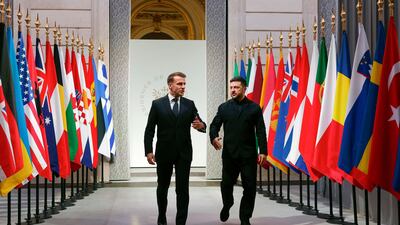
French President Emmanuel Macron and Ukrainian President Volodymyr Zelenskyy arrive at the Elysee Palace, for a meeting of leaders from Europe and Canada, held to discuss US-led efforts to end the Russia-Ukraine war. AFP -
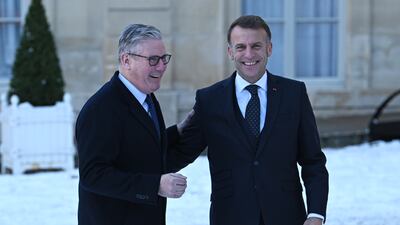
British Prime Minister Keir Starmer is welcomed by Mr Macron. Bloomberg -
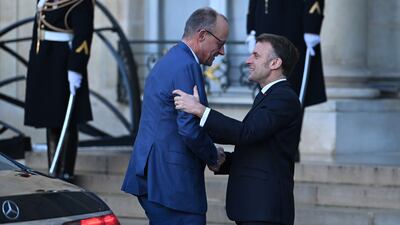
German Chancellor Friedrich Merz arrives for the summit of the 'Coalition of the Willing', in support of Ukraine. Bloomberg -
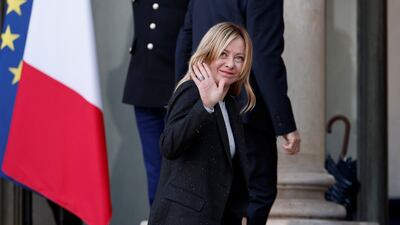
Italy's Prime Minister Giorgia Meloni in Paris. Reuters -
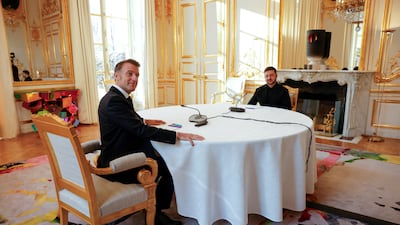
Mr Macron, left, and Mr Zelenskyy held one-on-one talks at the Elysee before meeting the other European leaders. Reuters -
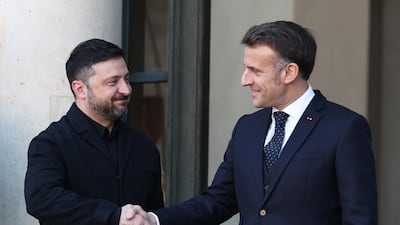
Mr Macron, right, and Mr Zelenskyy. Getty Images -
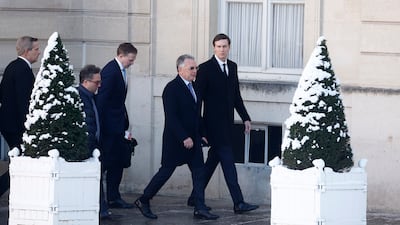
Steve Witkoff, US President Donald Trump's special envoy, and Mr Trump's son-in-law Jared Kushner arrive at the Elysee. EPA -
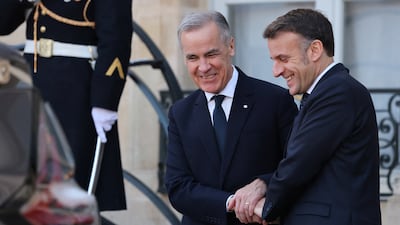
Mr Macron with Canada's Prime Minister Mark Carney. Reuters -
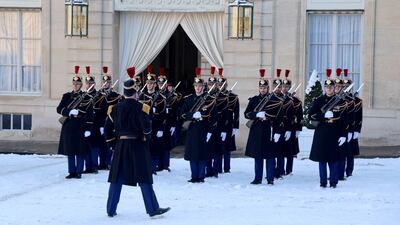
French Republican Guards on the snow-covered courtyard of the Elysee. AFP


“Greenland belongs to its people,” leaders of France, Germany, Italy, Poland, Spain, the UK and Denmark said in a joint statement issued on Tuesday.
Security in the Arctic region must be achieved “in conjunction with Nato allies including the US, by upholding the principles of the UN Charter, including sovereignty, territorial integrity and the inviolability of borders.”
– With additional reporting from news agencies

