
Portugal's government declared a day of national mourning on Thursday after at least 16 people died and 21 were injured when a car on Lisbon's Gloria funicular railway derailed and crashed.
Eleven foreigners were among the injured in Wednesday's accident at the popular tourist spot: two Germans, two Spaniards and nationals from France, Italy, Switzerland, Canada, South Korea, Morocco and Cape Verde. Foreign nationals were also among the dead.
“It's a tragic day for our city … Lisbon is in mourning, it is a tragic, tragic incident,” said Carlos Moedas, Mayor of the Portuguese capital.
The number of fatalities increased to 16 after one person died overnight, Margarida Castro Martins, head of Lisbon’s Civil Protection Agency, said on Thursday, after an initial update said the death toll had risen to 17.
Footage from the site showed the destroyed yellow tram-like funicular vehicle. Emergency workers were pulling people from the wreckage.
The service carries people up and down a steep hillside and is one of the city's symbols, as well as being popular with tourists.
-
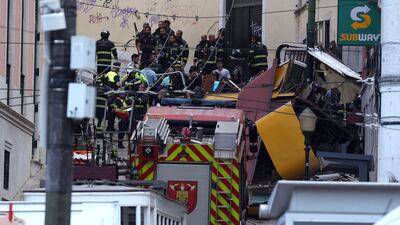
Rescuers at the scene after the Gloria funicular cable railway derailed in Lisbon. EPA -
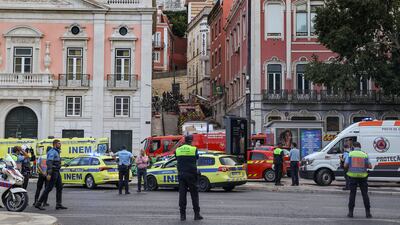
The funicular, popular with tourists, derailed and crashed on Wednesday. EPA -
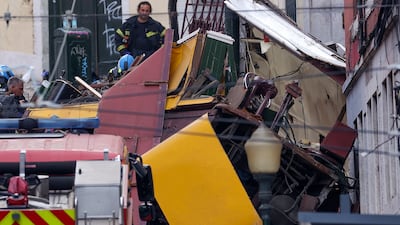
Portugal's government declared a day of national mourning, with at least 15 dead in the incident. EPA -
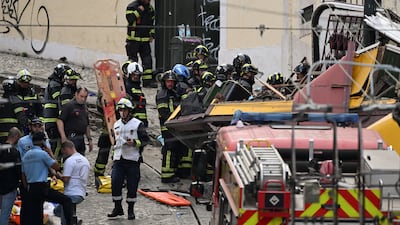
"It's a tragic day for our city," Mayor Carlos Moedas said. Reuters -

Pedro de Brito Bogas, chairman of Carris, the company that operates the funicular, talks to the media. Reuters -
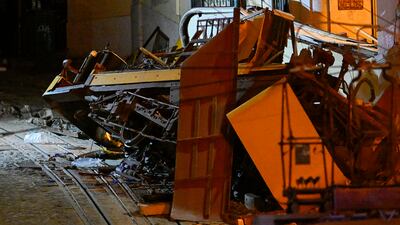
The remains of wrecked funicular, which connects Lisbon's Restauradores Square to the neighbourhood of Bairro Alto, 275 metres above. Getty images


President Marcelo Rebelo de Sousa offered condolences to the families of the dead and expressed hope that authorities would soon establish the cause of the crash.
Police investigators were inspecting the site and the prosecutor general's office said it would open a formal investigation, as is customary in public transport accidents.
The line, which opened in 1885, connects Lisbon's downtown area near the Restauradores Square with the Bairro Alto (Upper Quarter), famous for its vibrant nightlife.
It is one of three funicular lines operated by the municipal public transport company Carris and is used by tourists and residents.
Carris said in a statement that “all maintenance protocols have been carried out”, including monthly and weekly maintenance programmes and daily inspections.
The Gloria line carries about three million people a year, according to the town hall. Its two cars, each capable of about 40 people, are attached to opposite ends of a cable with traction provided by electric motors on the cars.
The car at the bottom of the line was apparently undamaged, but video from bystanders broadcast by CNN Portugal showed it jolting violently when the other one derailed, several passengers jumping out of its windows and people shouting.
Portugal, and Lisbon in particular, has experienced a tourism boom in the past decade, with visitors cramming the popular downtown area in the summer.
A representative of Britain's Foreign, Commonwealth and Development Office said it was in contact with the local authorities and stood by “to provide consular assistance if there are any affected British nationals”.
Britain is the largest source of tourism to Portugal, followed by Germany, Spain and the US. The US State Department did not immediately respond to a request for comment.

