Munich Security Conference: JD Vance criticises Europe over mass migration


Damien McElroy
  • English
  • Arabic

US Vice President JD Vance told European leaders they face “no more urgent challenge” than mass migration, as he handed Washington's allies a brutal dressing down for what he portrayed as a culture of censorship and elitism, at a key defence summit on Friday.

Mr Vance told the Munich Security Conference that “no voter” in Europe had gone to the ballot box to “open the floodgates to millions of unvetted immigrants”. He described an incident in which more than 30 people were injured by a car driven by an Afghan asylum seeker in the southern German city a day earlier, as one of the “horrors wrought” by Europe's liberal policies.

“It’s a terrible story, but it’s one we’ve heard way too many times in Europe,” Mr Vance told the conference.

Touching only briefly on the keenly anticipated issue of US President Donald Trump's stance on Ukraine, Mr Vance said the US “believes we can come to a reasonable settlement” between Kyiv and Moscow, as he repeated Washington's urgings for Europe to spend more on defence.

But he devoted most of his speech to telling Europe that its biggest danger was not from Russia or China but from abandoning the values of the “Cold War winners”.

“What I worry about is the threat from within. The retreat of Europe from some of its most fundamental values, values shared with the United States of America,” said Mr Vance, who is a champion of declining communities in the US.

He gave examples such as prosecutions of religious activists and the annulment of the Romanian presidential election in December due to allegations of Russian-funded interference and disinformation.

Watch: US and Europe clash on first day of Munich Security Conference

“There is no security if you are afraid of the voices, the opinions and the conscience that guide your very own people,” said the Vice President.

“The crisis this continent faces right now – the crisis we all face together – is one of our own making. If you’re running in fear of your own voters, there is nothing America can do for you.”

Ukraine funding

Mr Vance was expected to meet Ukraine's President Volodymyr Zelenskyy for face-to-face talks later on Friday. The Ukrainian leader has expressed concerns about US proposals to end the Russia-Ukraine war, saying his country must be included in talks.

A peace agreement could end up being just “a pause, without the real security guarantees”, Mr Zelenskyy said on Friday. “I don't want to give him a pause and be the person in history who helped Putin to occupy my country.”

The US Vice President appeared to mock European efforts to appease Mr Trump with pledges to spend more on defence.

Minutes before Mr Vance spoke, European Commission President Ursula von der Leyen conceded that EU states had “outsourced” their security in recent years and should spend more on their militaries. She declined to name a figure such as Mr Trump’s proposal of putting 5 per cent of gross domestic product into defence.

Ms von der Leyen also said it was time to move mountains to accelerate the accession of Ukraine into EU. She claimed that a collapse of Ukraine would rebound on the US as well.

“A failed Ukraine would weaken Europe, but it would also weaken the United States,” she said. “It would intensify the challenges in the Indo-Pacific.” She called for Europe as well Ukraine to have a seat at the negotiating table as President Trump’s talks process with Vladimir Putin gets under way, as the third anniversary of the war that began on February 24, 2022 looms.

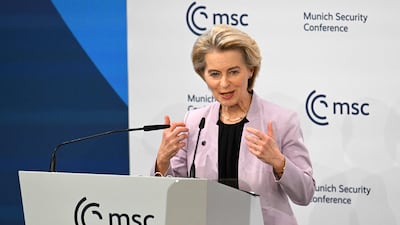
European Commission president Ursula von der Leyen conceded that EU states had 'outsourced' their security in recent years and should spend more on their militaries

Germany's President Frank-Walter Steinmeier warned that Europe and the US were on the brink of a departure point, warning that diplomacy was not a “cage fight” for Germany.

“It is clear that the American administration holds a world view that is very different from our own,” he said. “One that shows no regard for established rules for partnerships that have grown over a long time and for a trust that has been built over time.

“We cannot change that, we have to accept it. We will deal with it, but I'm convinced that it is not in the interest of the international community for this world view to become the dominant paradigm. The absence of rules must not become the guiding principle of a new world order.

“That is why, in any scenario, our support for Ukraine must continue, both from Europeans and Americans. Despite all the turmoil, I believe in the international community. Diplomacy is not a fight, not a cage fight.”

In the US, Congressman Adam Smith, the top Democrat on the House Armed Services Committee, said Mr Vance's "hollow reiteration of the ‘might makes right’ rhetoric weakens our standing in the world and our national security and defence."

“His ham-fisted attempt to gaslight those fighting for democracy in the face of blatant Russian aggression and Putin’s bloodthirsty desire to break [Nato] and fracture the 50-plus nation coalition that has come to Ukraine’s defence as it fights for survival was an appalling display of cynicism and cowardice," Mr Smith said.

The Munich conference began days after Mr Trump held talks with Mr Putin on seeking an end to the three-year war in Ukraine, sparking fears they will cut a deal that disadvantages Kyiv and Europe.

Amid tectonic shifts in US policy towards Europe, Nato members were told on Wednesday by US Defence Secretary Pete Hegseth that the US will “no longer tolerate” Europe being dependent on American military might. He also called it unrealistic for Ukraine to join Nato or reclaim all of its internationally recognised territory.

Britain's Prime Minister Keir Starmer said in a call with Mr Zelenskyy on Friday that he was “unequivocal that there could be no talks about Ukraine, without Ukraine”, Downing Street said. He also “reiterated the UK’s commitment to Ukraine being on an irreversible path to Nato”.

JD Vance told the Munich Security Conference that Europe has 'retreated from some of its most fundamental values'. Getty Images

Mr Zelenskyy has avoided openly criticising Mr Trump, but has used a round of calls with fellow European leaders to stress that “no negotiations with Putin can begin without a united position” between Ukraine, Europe and the US. On Friday he reported a Russian drone strike on the site of the Chernobyl nuclear disaster, saying radiation levels were normal but that Moscow “is definitely not preparing for negotiations”. Russia has denied any claims it attacked Chernobyl.

Concern has been expressed in Europe that Mr Trump's team is already making key concessions to Russia. “We shouldn’t take anything off the table before the negotiations have even started, because it plays to Russia’s court,” said the EU's foreign affairs commissioner, Kaja Kallas.

Mr Hegseth fired back that he was merely “recognising some realities that exist on the ground”. He said neither Russia nor Ukraine will “get everything that they want” in negotiations to end the war.

Munich Security Conference – in pictures

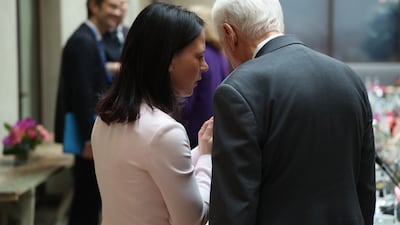
  • German Foreign Minister Annalena Baerbock, left, chats with Steny Hoyer, US representative for Maryland's 5th congressional district, prior to a meeting between German diplomats and a US congressional delegation at the 61st Munich Security Conference on February 14 in Munich. Getty Images
    German Foreign Minister Annalena Baerbock, left, chats with Steny Hoyer, US representative for Maryland's 5th congressional district, prior to a meeting between German diplomats and a US congressional delegation at the 61st Munich Security Conference on February 14 in Munich. Getty Images
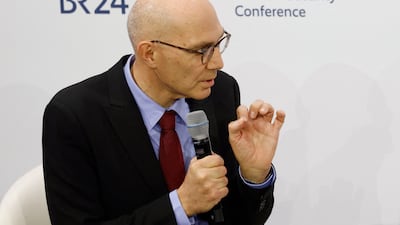
  • High Commissioner for Human Rights Volker Turk. AFP
    High Commissioner for Human Rights Volker Turk. AFP
  • Chinese Foreign Minister Wang Yi. AFP
    Chinese Foreign Minister Wang Yi. AFP
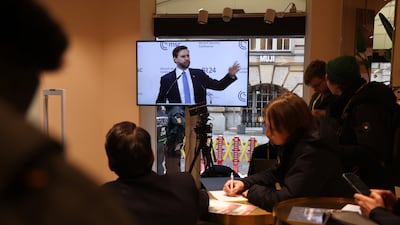
  • Members of the media watch Mr Vance speak at the conference. Getty Images
    Members of the media watch Mr Vance speak at the conference. Getty Images
  • European Commission President Ursula von der Leyen delivers her speech. AFP
    European Commission President Ursula von der Leyen delivers her speech. AFP
  • Mr Vance meets German Foreign Minister Annalena Baerbock and German President Frank Walter Steinmeier. Reuters
    Mr Vance meets German Foreign Minister Annalena Baerbock and German President Frank Walter Steinmeier. Reuters
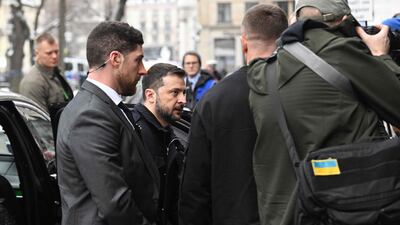
  • Ukrainian President Volodymyr Zelenskyy arrives in Munich. AFP
    Ukrainian President Volodymyr Zelenskyy arrives in Munich. AFP
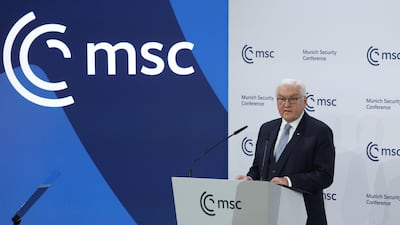
  • Mr Steinmeier speaks during the conference. Getty Images
    Mr Steinmeier speaks during the conference. Getty Images
  • Munich Security Conference Chairman Christoph Heusgen speaks. EPA
    Munich Security Conference Chairman Christoph Heusgen speaks. EPA
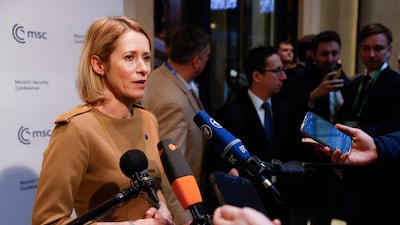
  • EU High Representative for Foreign Affairs and Security Policy Kaja Kallas delivers a statement. AFP
    EU High Representative for Foreign Affairs and Security Policy Kaja Kallas delivers a statement. AFP
  • Mr Vance participates in a bilateral meeting with British Foreign Minister David Lammy. Reuters
    Mr Vance participates in a bilateral meeting with British Foreign Minister David Lammy. Reuters
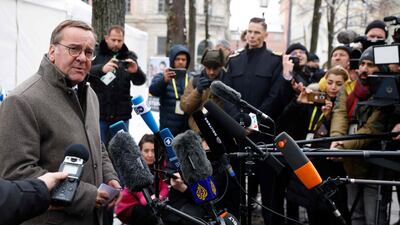
  • German Defence Minister Boris Pistorius delivers a press statement. AFP
    German Defence Minister Boris Pistorius delivers a press statement. AFP
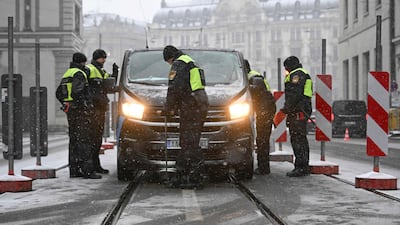
  • Police check a vehicle outside the Bayerischer Hof hotel in Munich, where the conference is being held. AFP
    Police check a vehicle outside the Bayerischer Hof hotel in Munich, where the conference is being held. AFP
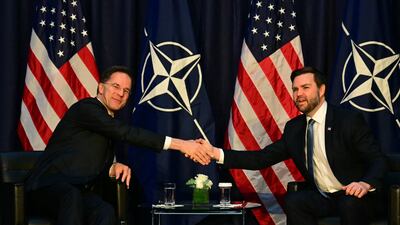
  • Nato Secretary General Mark Rutte meets Mr Vance. AFP
    Nato Secretary General Mark Rutte meets Mr Vance. AFP
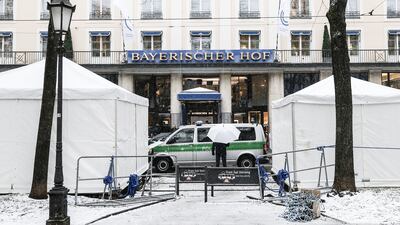
  • The conference's venue, the Bayerischer Hof hotel, was built at the request of Bavarian King Ludwig I in 1839. EPA
    The conference's venue, the Bayerischer Hof hotel, was built at the request of Bavarian King Ludwig I in 1839. EPA
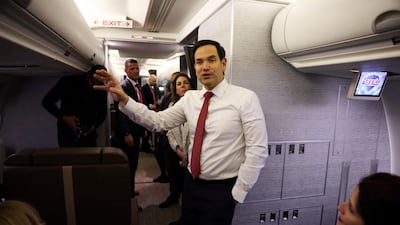
  • US Secretary of State Marco Rubio speaks to journalists travelling with him to the Munich Security Conference, after a mechanical issue forced his plane to return to Joint Base Andrews, Maryland. Reuters
    US Secretary of State Marco Rubio speaks to journalists travelling with him to the Munich Security Conference, after a mechanical issue forced his plane to return to Joint Base Andrews, Maryland. Reuters

Abdul Jabar Qahraman was meeting supporters in his campaign office in the southern Afghan province of Helmand when a bomb hidden under a sofa exploded on Wednesday.

The blast in the provincial capital Lashkar Gah killed the Afghan election candidate and at least another three people, Interior Minister Wais Ahmad Barmak told reporters. Another three were wounded, while three suspects were detained, he said.

The Taliban – which controls much of Helmand and has vowed to disrupt the October 20 parliamentary elections – claimed responsibility for the attack.

Mr Qahraman was at least the 10th candidate killed so far during the campaign season, and the second from Lashkar Gah this month. Another candidate, Saleh Mohammad Asikzai, was among eight people killed in a suicide attack last week. Most of the slain candidates were murdered in targeted assassinations, including Avtar Singh Khalsa, the first Afghan Sikh to run for the lower house of the parliament.

The same week the Taliban warned candidates to withdraw from the elections. On Wednesday the group issued fresh warnings, calling on educational workers to stop schools from being used as polling centres.

Mission%3A%20Impossible%20-%20Dead%20Reckoning%20Part%20One
%3Cp%3E%3Cstrong%3EDirector%3A%3C%2Fstrong%3E%20Christopher%20McQuarrie%3Cbr%3E%3Cstrong%3EStars%3A%3C%2Fstrong%3E%20Tom%20Cruise%2C%20Hayley%20Atwell%2C%20Pom%20Klementieff%2C%20Simon%20Pegg%3Cbr%3E%3Cstrong%3ERating%3A%3C%2Fstrong%3E%204%2F5%3C%2Fp%3E%0A
Analysis

Members of Syria's Alawite minority community face threat in their heartland after one of the deadliest days in country’s recent history. Read more

Mercer, the investment consulting arm of US services company Marsh & McLennan, expects its wealth division to at least double its assets under management (AUM) in the Middle East as wealth in the region continues to grow despite economic headwinds, a company official said.

Mercer Wealth, which globally has $160 billion in AUM, plans to boost its AUM in the region to $2-$3bn in the next 2-3 years from the present $1bn, said Yasir AbuShaban, a Dubai-based principal with Mercer Wealth.

Within the next two to three years, we are looking at reaching $2 to $3 billion as a conservative estimate and we do see an opportunity to do so,” said Mr AbuShaban.

Mercer does not directly make investments, but allocates clients’ money they have discretion to, to professional asset managers. They also provide advice to clients.

“We have buying power. We can negotiate on their (client’s) behalf with asset managers to provide them lower fees than they otherwise would have to get on their own,” he added.

Mercer Wealth’s clients include sovereign wealth funds, family offices, and insurance companies among others.

From its office in Dubai, Mercer also looks after Africa, India and Turkey, where they also see opportunity for growth.

Wealth creation in Middle East and Africa (MEA) grew 8.5 per cent to $8.1 trillion last year from $7.5tn in 2015, higher than last year’s global average of 6 per cent and the second-highest growth in a region after Asia-Pacific which grew 9.9 per cent, according to consultancy Boston Consulting Group (BCG). In the region, where wealth grew just 1.9 per cent in 2015 compared with 2014, a pickup in oil prices has helped in wealth generation.

BCG is forecasting MEA wealth will rise to $12tn by 2021, growing at an annual average of 8 per cent.

Drivers of wealth generation in the region will be split evenly between new wealth creation and growth of performance of existing assets, according to BCG.

Another general trend in the region is clients’ looking for a comprehensive approach to investing, according to Mr AbuShaban.

“Institutional investors or some of the families are seeing a slowdown in the available capital they have to invest and in that sense they are looking at optimizing the way they manage their portfolios and making sure they are not investing haphazardly and different parts of their investment are working together,” said Mr AbuShaban.

Some clients also have a higher appetite for risk, given the low interest-rate environment that does not provide enough yield for some institutional investors. These clients are keen to invest in illiquid assets, such as private equity and infrastructure.

“What we have seen is a desire for higher returns in what has been a low-return environment specifically in various fixed income or bonds,” he said.

“In this environment, we have seen a de facto increase in the risk that clients are taking in things like illiquid investments, private equity investments, infrastructure and private debt, those kind of investments were higher illiquidity results in incrementally higher returns.”

The Abu Dhabi Investment Authority, one of the largest sovereign wealth funds, said in its 2016 report that has gradually increased its exposure in direct private equity and private credit transactions, mainly in Asian markets and especially in China and India. The authority’s private equity department focused on structured equities owing to “their defensive characteristics.”

PROFILE OF SWVL

Started: April 2017

Founders: Mostafa Kandil, Ahmed Sabbah and Mahmoud Nouh

Based: Cairo, Egypt

Sector: transport

Size: 450 employees

Investment: approximately $80 million

Investors include: Dubai’s Beco Capital, US’s Endeavor Catalyst, China’s MSA, Egypt’s Sawari Ventures, Sweden’s Vostok New Ventures, Property Finder CEO Michael Lahyani

Other workplace saving schemes
  • The UAE government announced a retirement savings plan for private and free zone sector employees in 2023.
  • Dubai’s savings retirement scheme for foreign employees working in the emirate’s government and public sector came into effect in 2022.
  • National Bonds unveiled a Golden Pension Scheme in 2022 to help private-sector foreign employees with their financial planning.
  • In April 2021, Hayah Insurance unveiled a workplace savings plan to help UAE employees save for their retirement.
  • Lunate, an Abu Dhabi-based investment manager, has launched a fund that will allow UAE private companies to offer employees investment returns on end-of-service benefits.
COMPANY%20PROFILE
%3Cp%3E%3Cstrong%3ECompany%20name%3A%3C%2Fstrong%3E%20Switch%20Foods%3Cbr%3E%3Cstrong%3EStarted%3A%3C%2Fstrong%3E%202022%3Cbr%3E%3Cstrong%3EFounder%3A%3C%2Fstrong%3E%20Edward%20Hamod%3Cbr%3E%3Cstrong%3EBased%3A%3C%2Fstrong%3E%20Abu%20Dhabi%2C%20UAE%3Cbr%3E%3Cstrong%3EIndustry%3A%3C%2Fstrong%3E%20Plant-based%20meat%20production%3Cbr%3E%3Cstrong%3ENumber%20of%20employees%3A%3C%2Fstrong%3E%2034%3Cbr%3E%3Cstrong%3EFunding%3A%3C%2Fstrong%3E%20%246.5%20million%3Cbr%3E%3Cstrong%3EFunding%20round%3A%3C%2Fstrong%3E%20Seed%3Cbr%3E%3Cstrong%3EInvestors%3A%3C%2Fstrong%3E%20Based%20in%20US%20and%20across%20Middle%20East%3C%2Fp%3E%0A

Monster Hunter: World

Capcom

PlayStation 4, Xbox One

The specs
Engine: 2.0-litre 4-cyl turbo

Power: 201hp at 5,200rpm

Torque: 320Nm at 1,750-4,000rpm

Transmission: 6-speed auto

Fuel consumption: 8.7L/100km

Price: Dh133,900

On sale: now 

In The Heights

Directed by: Jon M. Chu

Stars: Anthony Ramos, Lin-Manual Miranda

Rating: ****

Updated: May 08, 2025, 6:56 PM