


World leaders on Monday gathered in Paris for an artificial intelligence summit co-hosted by French President Emmanuel Macron and Indian Prime Minister Narendra Modi, as countries compete for influence over the rapid development of the technology.
Europe wants to champion its AI industry as it races to keep up with China and the US, which have so far led global development of the technology. US Vice President JD Vance and China’s Vice Premier Zhang Guoqing are among those attending the summit.
"It is high time that we move from science fiction to the real world of applications of AI," Anne Bouverot, Mr Macron's AI envoy, said in an opening speech. "With its unprecedented protection potential, artificial intelligence fuels both immense hopes and at times exaggerated fear."
The summit was launched a day after Mr Macron announced France would invest €109 billion ($112.59 billion) in AI in the coming years. The investment includes a UAE-driven project to build a 1 gigawatt data centre in Europe's biggest AI campus.
At the summit, industry leaders have expressed concern over how to best regulate AI. "We have to ensure that we navigate a difficult path between over-regulation that will kill innovation and free-riding with the risk of AI taking fully taking over humans," said Denis Machuel, chief executive of the Adecco Group, a Swiss-French human resources company.
Senior executives including Google chief executive Sundar Pichai and OpenAI founder Sam Altman are scheduled to speak at the summit.
The summit is expected to include an announcement on Tuesday of an AI foundation with a budget of about €2.5 billion, financed by governments, businesses and philanthropy. "It will be a new fund that will invest in AI infrastructure elements that will be able to irrigate and diversify the AI ecosystem," an Elysee adviser said, without confirming the size of the budget.
On Sunday, UAE AI company G42 and US tech company Microsoft announced the launch of an Abu-Dhabi based AI foundation for the Middle East and the Global South.
European lawmakers last year approved the bloc's AI Act, the world's first comprehensive set of rules governing the technology. Tech giants and some governments have pushed for it to be enforced leniently. The EU is finalising an accompanying code of practice.
In a televised interview on Sunday evening, Mr Macron warned that too much regulation without enough investment would threaten Europe's position in the AI race. "We should not be afraid of innovation," Mr Macron said. "With Mr Modi, we want to work with China and the US but also not depend on anyone."

Mr Macron also pushed back against the idea of banning Chinese AI, days after US politicians introduced a bill to prohibit Chinese company DeepSeek from being used on government devices. The release of its latest high-quality chatbot roiled the markets because it was developed at a far lower cost than its US competitor, ChatGPT.
Mr Vance, who is scheduled to have lunch with Mr Macron on Tuesday, is expected to be at odds with European leaders over the future of tech development. US President Donald Trump's government has pushed for deregulation, as European powers express frustration over what they say is political interference by Elon Musk, who leads the US Department of Government Efficiency.
France this week opened an investigation over allegations that X, the social media company owned by Mr Musk, manipulated its algorithm. A German court ruled that X must provide researchers with access to data to politically related content before the country's federal election.
-
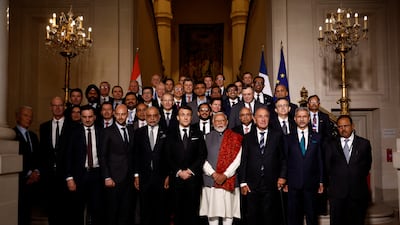
French President Emmanuel Macron and Indian Prime Minister Narendra Modi with participants at the Franco-Indian Economic Forum after the AI Action Summit in Paris. Reuters -

Mr Macron delivers a speech during a plenary session of the AI Action Summit. EPA -
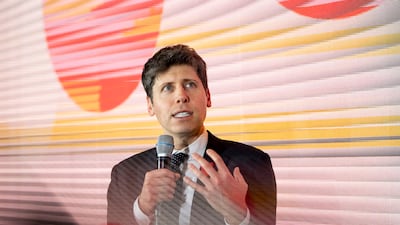
Sam Altman, chief executive officer of OpenAI Inc, speaks during the summit. Bloomberg -

US Vice President JD Vance and Mr Modi attend a bilateral meeting. AFP -

Mr Macron takes photographs with participants at the AI Action Summit. AFP -
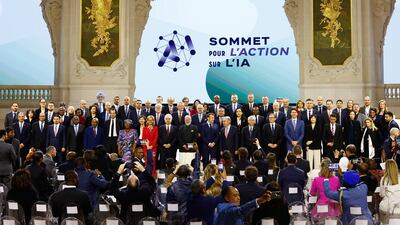
Mr Macron, Mr Modi and UN Secretary General Antonio Guterres pose for a family photo at the end of a plenary session. EPA -
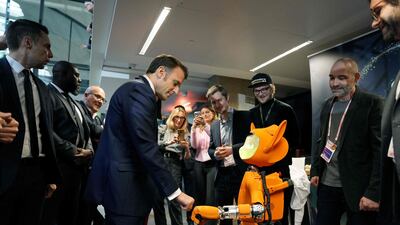
Mr Macron interacts with a robot. AFP -

Mr Macron at the presentation of AI-related artwork 'Agoria', by digital artist and Johan Lescure, on the opening day of the Artificial Intelligence Action Summit at the Grand Palais. AFP -

Mr Macron delivers a speech to help close the first day of the summit, attended by world leaders and tech executives. AFP -

Canadian Prime Minister Justin Trudeau addresses delegates at the summit, where world leaders are to discuss the applications of AI. AP -

Mr Macron, centre, with European leaders at the Elysee Palace in Paris. EPA -
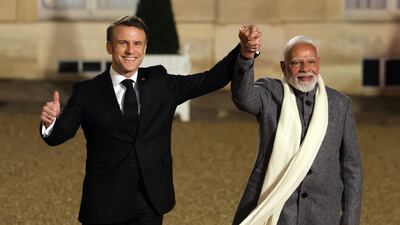
The summit is being co-hosted by Mr Macron and Indian Prime Minister Narendra Modi. AFP -

Delegates gather for the AI summit in Paris. Bloomberg -

Sundar Pichai, chief executive of Google, is among the tech leaders who have travelled to Paris. Bloomberg -
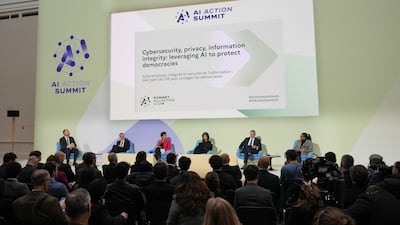
Meredith Whittaker, centre, president of the non-profit Signal Foundation, speaks at a panel event in Paris. Bloomberg -

France is set to announce it will invest €109 billion ($112.59 billion) in AI projects in the country. Bloomberg -
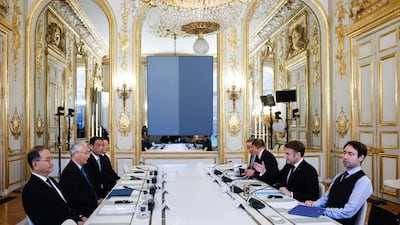
China's Vice Premier Zhang Guoqing and Mr Macron hold talks at the Elysee Palace. AFP -
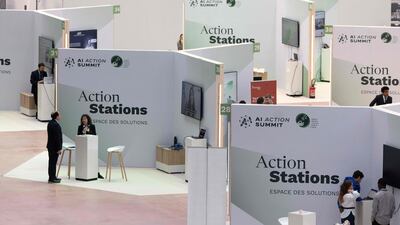
Booths set up at the Grand Palais, the venue for the AI summit. AFP



